‘mAnJE! MaNJe (an epic)’ demands prompt attention at The Baxter
A visually arresting, multidisciplinary spectacle challenges both narrative clarity and audience comfort, raising questions about how theatre must evolve for modern spectators
 Black News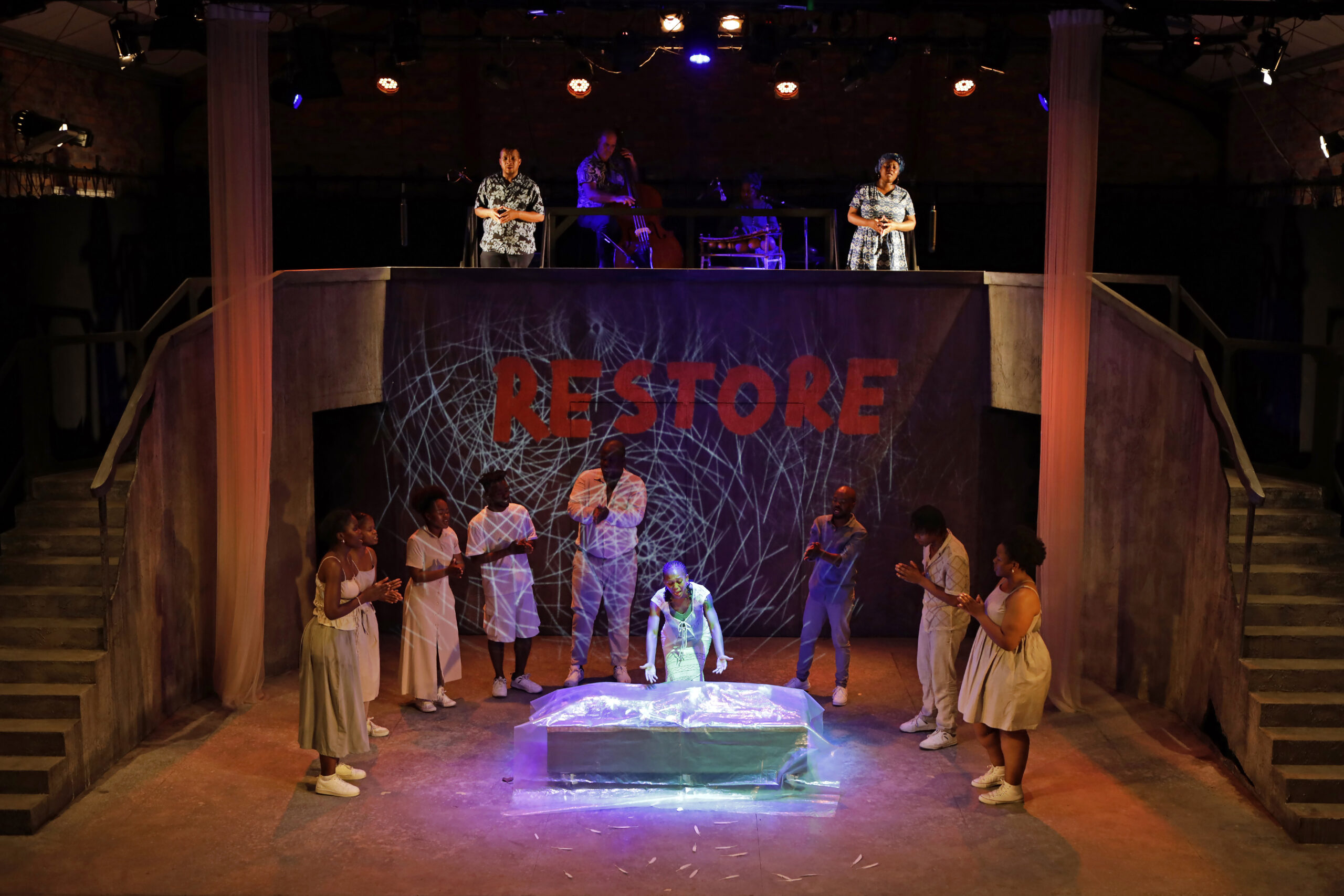


Lately, my relationship with live theatre has reached a breaking point. Bear with me because what I am about to say might sound just a bit crazy. Why has theatre failed to accommodate the modern spectator?
In 2026 the human beings now come with a fractured attention span and an uncompromising devotion to our own comfort, yet the theatrical experience remains stubbornly frozen in the 1980s. One can’t come in late. One can’t go to the bar mid-performance. One can’t snack nor drink from a bottle of wine. One can’t do anything as a member of the audience. Except watch.
Meanwhile, the productions themselves have evolved. They have become sleek, interdisciplinary hybrids of film, live performance and digital art like mAnJE! MaNJe (an epic).
Theatre auditoriums remain relics of austerity. With their unforgiving chairs and rows so narrow that getting to your seat involves stepping on everyone’s toes. You see where I am going with this? The art has moved into the future but the audience is still relegated to the past.
Anyway, on Saturday evening I attended the opening night of the multiple award-winning Magnet Theatre’s mAnJE! MaNJe (an epic) at the Baxter Theatre’s Flipside Studio. The show is on until this Saturday, April 25. Ten performances only.

From the get go, I was struck by the stage curation. It was a visual feast that evolved into a dense landscape of multidisciplinary maximalism. As the house lights dimmed, the production dissolved into a seamless ‘all-things-at-once’ experience: a mesmerising fusion of song, choreodrama, mime, sophisticated multimedia projections and some damn good acting. The set was not merely a backdrop but a marvel of engineering and intent. Props to Craig Leo, the show’s designer and Ina Wichterich, the choreographer. I was enthralled throughout, to say the least.
But, here is where things get interesting: I could not, for the life of me, tell you what mAnJE! MaNJe (an epic) was actually about. I heard the name “Daedalus” on several occasions, yes. But, to be honest, I found the narrative a bit too complex, a touch scattered and generally dense. And that is okay. I am willing to accept this as a personal failing. Publicists today would likely strike me from their media lists for such a confession but bear with me as I strive to find a balance here.
After the show I felt compelled to go and do some digging. I discovered that the production is anchored in the mythic cycles of the Minoan civilization on the island of Crete, reimagining their bronze age history, spanning from 3 000 to 1 100 BCE and the legendary figure of Daedalus through an African lens.

“These stories were never part of a coherent collection, a continuous mythic poem for instance. And yet they do suggest a chronology that might be understood as a cycle of stories. In other words, we can assemble the various story fragments into episodes that together form an epic construction,” said mAnJE! MaNJe (an epic) director, Mark Fleishman. You see? Coherence. Or lack thereof.
The epic is meant to be a series of interlocking narrative strands, left for the spectator to weave together as they see fit. One must accept, I suppose, that this is less a puzzle to be solved and more a visceral experience. In other words I should have stopped trying to find meaning and simply enjoyed what I felt I enjoyed.
“Is Theatre something that always needs to be understood in the way that its makers intended it to be? Or is it something to be experienced on a more emotional, effective level? We love the complexity and density of the work, because we feel that the human condition is complex and dense. And we hope that it can resonate for an audience on different levels simultaneously. I’m not even sure that we understand it all the time [too] – we are constantly discovering layers and new meanings!” added Fleishman.
“I do not believe that there can be any single experience of any work of art. We need to experience the thing from our own perspective as we bring our own attitudes and relations to the world into the theatre with us. The idea that there is one singular meaning to any artwork defeats the purpose of art itself which is to be a stimulus and a catalyst for thought and experience.”
That said, please do not allow my musings to deter you from experiencing this play. It is a visceral polyphonic marvel. An arresting spectacle, even. The performances were an absolute revelation. I have not seen such good acting in a while. And I mean all the actors, every single one of them. Props to Lungiswa Plaatjies and Neo Muyanga for weaving the sonic elements together so beautifully too. And then, there were Jennie Reznek and Mwenya Kabwe on stage. ‘Wow!’ is all I can say.