Fewer Than 1 in 4 Nigeriens Are Online. A New Fibre Link With Algeria Is Meant to Improve the Odds.
The Niger Algeria fibre optic link went live at Assamaka on October 6, 2026, giving landlocked Niger a second international route for its internet traffic. The link starts at 100 gigabits per second (Gbps), according to SatellitePro ME and Africa News Agency, and capacity can be raised as demand grows. Whether it changes anything for [...]
 Black News
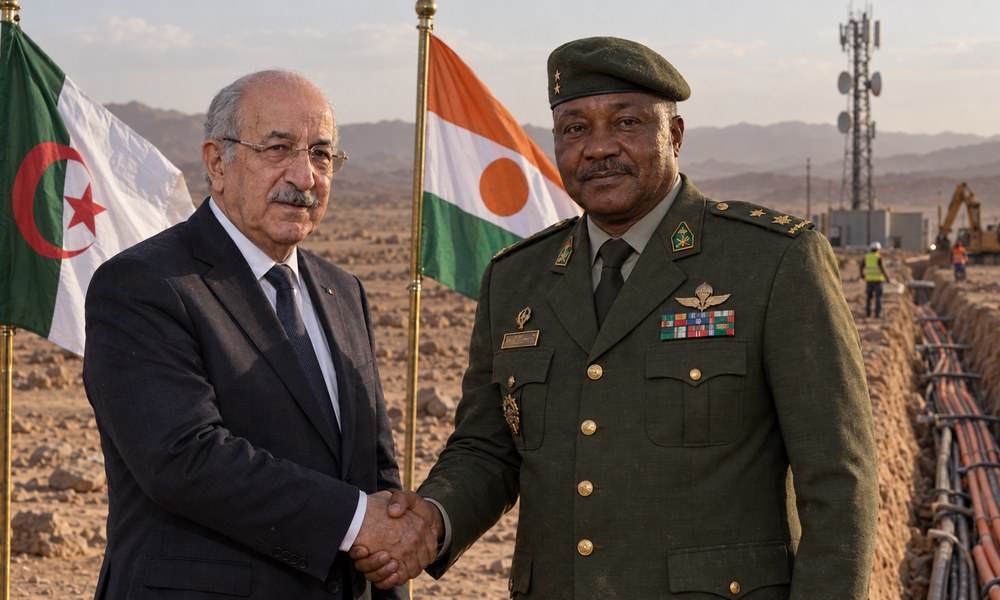
The Niger Algeria fibre optic link went live at Assamaka on October 6, 2026, giving landlocked Niger a second international route for its internet traffic. The link starts at 100 gigabits per second (Gbps), according to SatellitePro ME and Africa News Agency, and capacity can be raised as demand grows. Whether it changes anything for most Nigeriens depends on price, reach and reliability, and the launch did not settle any of the three.
About 6.5 million of Niger’s 28.1 million people were online at the end of 2025, a penetration of 23.2 percent, according to DataReportal. That leaves roughly 21.6 million people offline.
ALSO READ: Burkina Faso, Mali and Niger Launch Joint Development Bank
What the Niger Algeria Fibre Optic Link Fixes
Niger has no coastline and no direct access to submarine cables, so its international bandwidth travels overland through neighbouring countries. When a West Africa cable outage on March 13, 2024 affected 13 countries, Niger stayed connected over satellite and terrestrial fibre through Burkina Faso into Benin, according to the Internet Society. The report listed Niger’s terrestrial links as running to Burkina Faso, Nigeria and Benin. It also gave Niger an Internet Resilience Index score of 26 percent, the lowest of the 13 countries in its table.
A second path matters most when something breaks. If a line fails elsewhere, traffic can be rerouted instead of slowing or stopping. For operators and internet service providers, the extra route also gives more room to manage traffic and keep services running during disruptions.
The new route leads north to a much larger network. Ecofin Agency cites Algeria’s capacity at 9.8 terabits per second in 2024, against about 580 gigabits per second combined for the three submarine systems serving Benin, Niger’s southern route. It adds that a new Algerian cable, Medusa, is due in early 2027. About 2,548 kilometres of fibre now run from Algiers to In Guezzam, SatellitePro ME reports, and the link continues to Arlit and Agadez in Niger, Radio Algérie reports.
The link is one part of a wider build-out. Niger provisionally accepted 1,031 kilometres of fibre on five routes in November 2025, Ecofin reports: Arlit to Assamaka and the Algerian border (220 kilometres), Diffa to N’Guigmi and the Chadian border (186), Zinder to Magaria and the Nigerian border (117), Niamey to Gaya and the Benin border (300), and Niamey to the Burkina Faso border (118). Niger minister Adji Ali Salatou called the network “a crucial tool for reducing Niger’s digital isolation,” and authorities expect better service quality, wider access and lower costs. A Tier III national data centre is also planned.
What the Link Does Not Fix Yet
Price. WebManagerCenter notes that wholesale prices, the share of capacity sold to operators and uptime figures have not been published, and cautions that open infrastructure does not automatically mean cheaper or more stable internet. Mobile internet in Niger costs 8.31 percent of income per person, against a 2 percent affordability target, according to International Telecommunication Union (ITU) figures cited by Ecofin.
Power. Phones, towers and data centres need electricity, and about one in five people in Niger has it. World Bank data put access at 21.3 percent in 2024.
Interconnection and timing. The Internet Society expected the Trans-Saharan backbone to be live in 2024, and said it would “significantly boost” landlocked Niger and Chad. It launched in October 2026. Ecofin reports the timeline for full interconnection is unconfirmed, and that Niger’s border with Benin is “closed until further notice.” Coverage of the launch gives no progress report for the sections in Mali, Mauritania and Nigeria.
Protection of a remote route. Coverage of the launch does not say how the desert route will be maintained or protected. AFP reports that Niger faces attacks, including in areas near its border with Algeria.
The numbers themselves. Outlets describe the capacity differently. Radio Algérie says it can be expanded to 100 Gbps, while SatellitePro ME says it starts there. WebManagerCenter describes the 100 Gbps figure as only partly confirmed, since it did not find the underlying capacity contracts. The cost of the link has not been disclosed. A figure of about 30 billion CFA francs announced in 2025 relates to Niger’s wider fibre programme, not to this link alone.
Who Built It, and Why Now
Algérie Télécom and Niger Telecom built the link as one segment of the Trans-Saharan Fibre Optic Backbone, a project joining Algeria, Mali, Niger, Mauritania, Nigeria and Chad that is inspired by the New Partnership for Africa’s Development (NEPAD). The Algeria-Niger segment is the one confirmed as operating.
Officials framed it as a sovereignty project. Algeria’s Post and Telecommunications Minister, Sid-Ali Zerrouki, called it a “structural gain” for connectivity among partner countries’ networks, Radio Algérie reported. The same outlet quoted Algerian President Abdelmadjid Tebboune’s message that “Africa can only build its future by relying on its self-capabilities.”
It also follows a diplomatic recovery. In April 2025, Algeria said it had shot down a Malian drone near Tin Zaouatine, a claim Mali disputed. Mali, Niger and Burkina Faso recalled their ambassadors, and Algiers did the same. Niger and Algeria restored their ambassadors on February 12, 2026, and Niger’s head of state, General Abdourahamane Tiani, later travelled to Algiers.
What to Watch Next
- Prices: whether Niger Telecom and the mobile operators publish what they pay for capacity, and whether retail prices fall.
- Connections: whether the remaining sections link up, including those in Mali, Mauritania, Nigeria and Chad.
- Reach: whether the planned national data centre is built, and whether coverage and power reach beyond the main cities.