.
Tabari Morris of SF Bay View reviews Reflectacles privacy eyewear and issues a PSA on how Black communities can confront facial recognition and biometric tracking on their own terms. The post . appeared first on San Francisco Bay View.
 Black News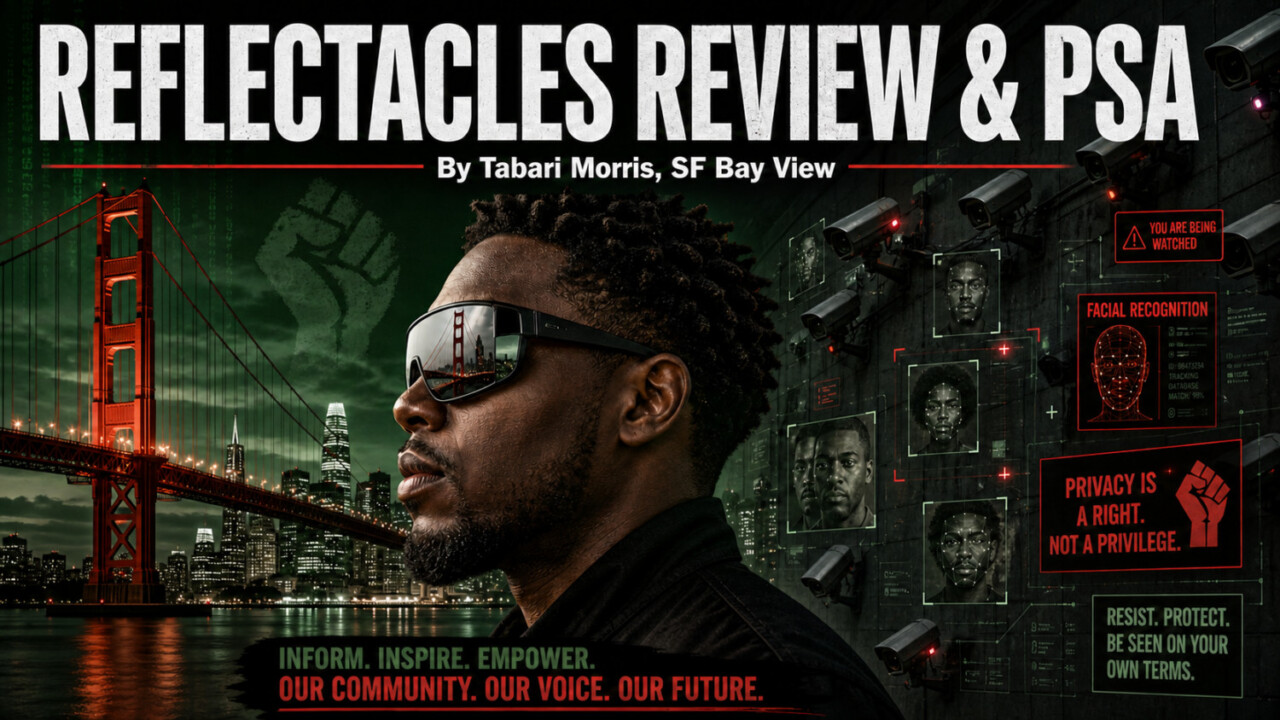

A firsthand review of Reflectacles finds the eyewear delivers a real sense of protection in an era of expanding facial recognition, while a comparison with Zenni ID Guard shows why readers should treat anti-tracking claims carefully.
Where I, as a buyer, found confidence in real-world camera tests with Reflectacles, another major eyewear retailer openly warns that its own product cannot promise anonymity.
by Tabari Morris
Privacy eyewear is not a cure-all, but it may offer one of the few practical options available to people who want more control over how their faces are scanned, mapped and stored.
With facial recognition becoming more common in smartphones, companies like Flock, Axon, camera networks for both private and public purposes, people interested in protecting themselves need products that will help decrease the likelihood of them being recognized through their facial features. An experiment that I carried out showed that Reflectacles really worked with the cameras I tested, and gave a real feeling of security when using them outdoors. The explanation provided by Zenni Optical about ID Guard helps to understand that these are anti-tracking glasses and not anonymity products.
Why this matters
The problem is not simply an issue of fashion or novelty. Eyewear brands like Reflectacles and Zenni ID Guard represent products appealing to the growing market of people concerned with surveillance, databases, and tracking their identities, who may use such glasses to interfere with infrared systems to some extent. But most often the most solid evidence to support these arguments comes from corporate materials themselves.
Reflectacles says that their glasses are designed to avoid facial recognition technology that uses infrared lighting and infrared 3D mapping. They explain how their product works based on two analog technologies; infrared light blocking lenses and reflective frames. The Ghost glasses I got with Dark-IR lenses seem to make a visible impact on cameras and have boosted my level of confidence when in public because watching me and recognizing me are two different things.

The purchase of Reflectacles was driven by my desire to reclaim some sense of privacy in daily living following the awareness of the stock alert from the company and its long-established privacy policy. There’s a practical difference between how the glasses appear in person and how they register in photos and video, which aligns with Reflectacles’ broader claim that the products are meant to alter how cameras and infrared systems read the wearer.
I had a chance to observe the glasses at work on several different cameras and realized that using them made my movements in the public area feel different. I haven’t seen the demonstration effect on all the systems like Flock; however, the ones that I was on, I couldn’t see my eyes. And it is also newsworthy since it is an honest user review that answers the very first question people are interested in regarding the product.
I compared the competition that has been advertised in BART stations and billboards throughout the City and discovered the following.
Zenni markets ID Guard as an anti-infrared coating that helps disrupt unwanted tracking and says its proprietary coating offers up to 80% more near-infrared protection than standard lenses. On its support page, Zenni says the coating reflects 80.44% of near-infrared light in the 700-1100 nm range and may interfere with Face ID or Windows Hello because those systems can rely on infrared light.
But Zenni also includes a critical disclaimer that should matter to readers weighing the product’s real-world value. The company says EyeQLenz and Zenni ID Guard are designed to reflect signals to help disrupt unwanted tracking only under certain conditions, that results may vary because of recognition technology and environmental factors, and that Zenni does not guarantee anonymity or total protection from surveillance and biometric identification.

Zenni further says users are responsible for complying with anti-masking, biometric, identification and facial recognition laws, along with private property rules, and that the company is not liable for misuse of the eyewear. In plain terms, that means the product is being sold as limited defensive eyewear, not as a reliable shield against every camera, every algorithm or every legal setting.
The practical distinction is not subtle. Reflectacles presents itself as privacy eyewear built around anti-surveillance use from the start, while Zenni frames ID Guard as a broader lens product with privacy benefits but explicit limits.
This is important as the viewer might think that all glasses meant to block facial recognition are doing the same thing. However, as can be observed from the products so far available, this is not the case as Reflectacles focuses on interfering with cameras while Zenni discourages the use of its product for anonymity.

For readers trying to protect themselves, the strongest responsible message is not that any glasses will make someone invisible. It is that some products may reduce how effectively certain infrared-based systems capture facial details, but real-world results depend on the camera, the lighting, the algorithm and the environment around where the glasses are worn.
That is why this review should be read as both endorsement and warning. Reflectacles earned confidence from a buyer who says the glasses worked in personal camera tests, but readers should still avoid absolute claims and should pay close attention to the kind of fine print Zenni places on its own anti-tracking product pages as well as the other products that come out in the future.
If widespread surveillance cannot be stopped immediately, people may still look for tools that help restore some measure of choice and comfort. In that context, Reflectacles stands out here as the more convincing privacy-first option, while Zenni ID Guard reads more like a conditional layer of interference than a dependable answer to facial recognition.
Tabari Morris is Managing Editor at the San Francisco Bayview as well as an investigative journalist. He can be reached at Tabari@sfbayview.com
The post . appeared first on San Francisco Bay View.