Democratic coup rocks Senegal as lawmakers elect sacked PM Sonko as Speaker in challenge to President Faye
Senegal’s political crisis escalated dramatically on Tuesday, May 26, after lawmakers elected recently dismissed Prime Minister Ousmane Sonko as speaker of parliament, handing the influential opposition figure a powerful new platform just days after President Bassirou Diomaye Faye removed him from office.
 Black News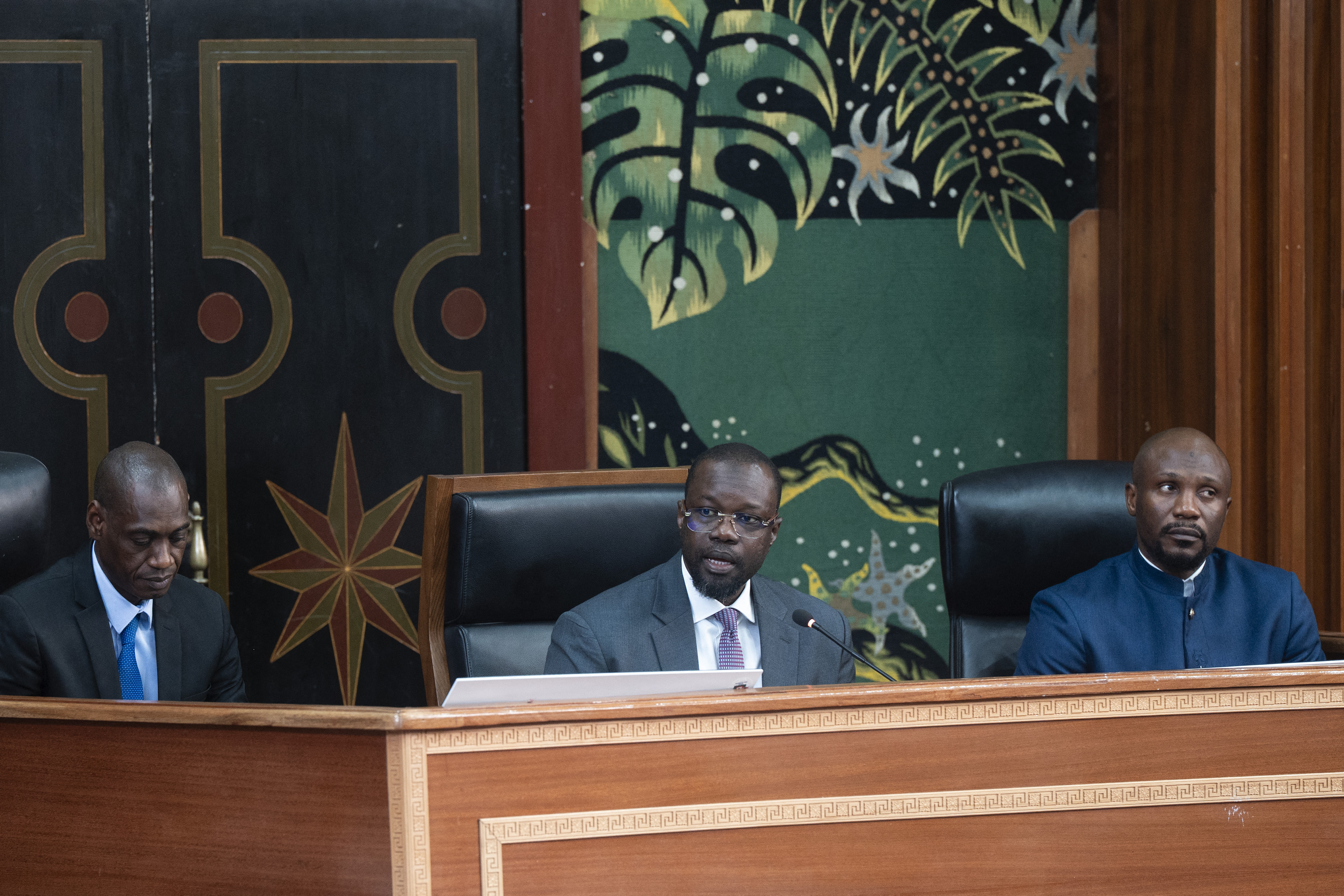
![Former Senegal Prime Minister Ousmane Sonko (C) delivers his first speech as the new Speaker of the Senegal National Assembly on May 26, 2026, at the National Assembly in Dakar. [Photo by SEYLLOU / AFP via Getty Images]](https://ocdn.eu/pulscms/MDA_/1c29b9589f457bb9f6c2607cf1919724.jpg)
Senegal’s political crisis escalated dramatically on Tuesday, May 26, after lawmakers elected recently dismissed Prime Minister Ousmane Sonko as speaker of parliament, handing the influential opposition figure a powerful new platform just days after President Bassirou Diomaye Faye removed him from office.
- Senegal’s parliament has elected ousted Prime Minister Ousmane Sonko as speaker in a dramatic political comeback.
- The move comes days after President Bassirou Diomaye Faye dismissed Sonko and dissolved the cabinet.
- Opposition figures have described the development as an “institutional coup” amid growing tensions within the ruling alliance.
- The power struggle unfolds as Senegal faces mounting debt pressures and economic uncertainty.
The stunning political comeback has intensified speculation of a deepening fracture at the top of Senegal’s leadership, raising fresh uncertainty over who truly controls power in one of West Africa’s most closely watched democracies.
Sonko secured 132 votes in the 165-seat parliament after legislators moved to reinstate him as a member of the National Assembly earlier in the day. No lawmaker voted against him, while one abstained.
The vote came only four days after Faye dissolved the cabinet and dismissed Sonko as prime minister, ending months of rumours about growing tensions between the two allies over how to tackle Senegal’s mounting debt crisis and worsening economic pressures.
Sonko, the dominant figure within the ruling Pastef party, received a prolonged standing ovation after the presiding member of the session, Ismael Diallo, announced the result. He was the sole candidate for the role.
His election followed the resignation of former parliament speaker El Malick Ndiaye, a close ally who stepped down on Sunday, clearing the path for Sonko’s rapid return to the political front line.
![Former Senegal Prime Minister Ousmane Sonko (C) wears his parliamentary sash on May 26, 2026, at the National Assembly in Dakar. [Photo by SEYLLOU / AFP via Getty Images]](https://ocdn.eu/pulscms/MDA_/ab8f534228c95d84fa20a3a490715900.jpg)
The development has triggered fierce backlash from the opposition, with senior opposition leader Aissata Tall Sall describing the move as an “institutional coup.”
She argued that Sonko should have formally resigned as prime minister before reclaiming his parliamentary seat, accusing the ruling majority of forcing through a politically engineered transition.
Faye appointed Sonko prime minister in April 2024 after winning the presidency in an election widely seen as fuelled by Sonko’s popularity and political machinery.
Although barred from contesting the presidency himself because of a defamation conviction, Sonko remains the country’s most influential political figure and continues to command significant loyalty within the ruling coalition.
Meanwhile, Faye has appointed economist Ahmadou Al Aminou Mohamed Lo as Senegal’s new prime minister, tasking him with steering the country through growing debt and economic uncertainty.