EU denies abandoning Nigeria’s 2027 election observation, confirms just 2–4 experts as observers
The European Union has confirmed it will observe Nigeria’s 2027 general election, rejecting reports that it had declined an invitation to participate in the vote.
 Black News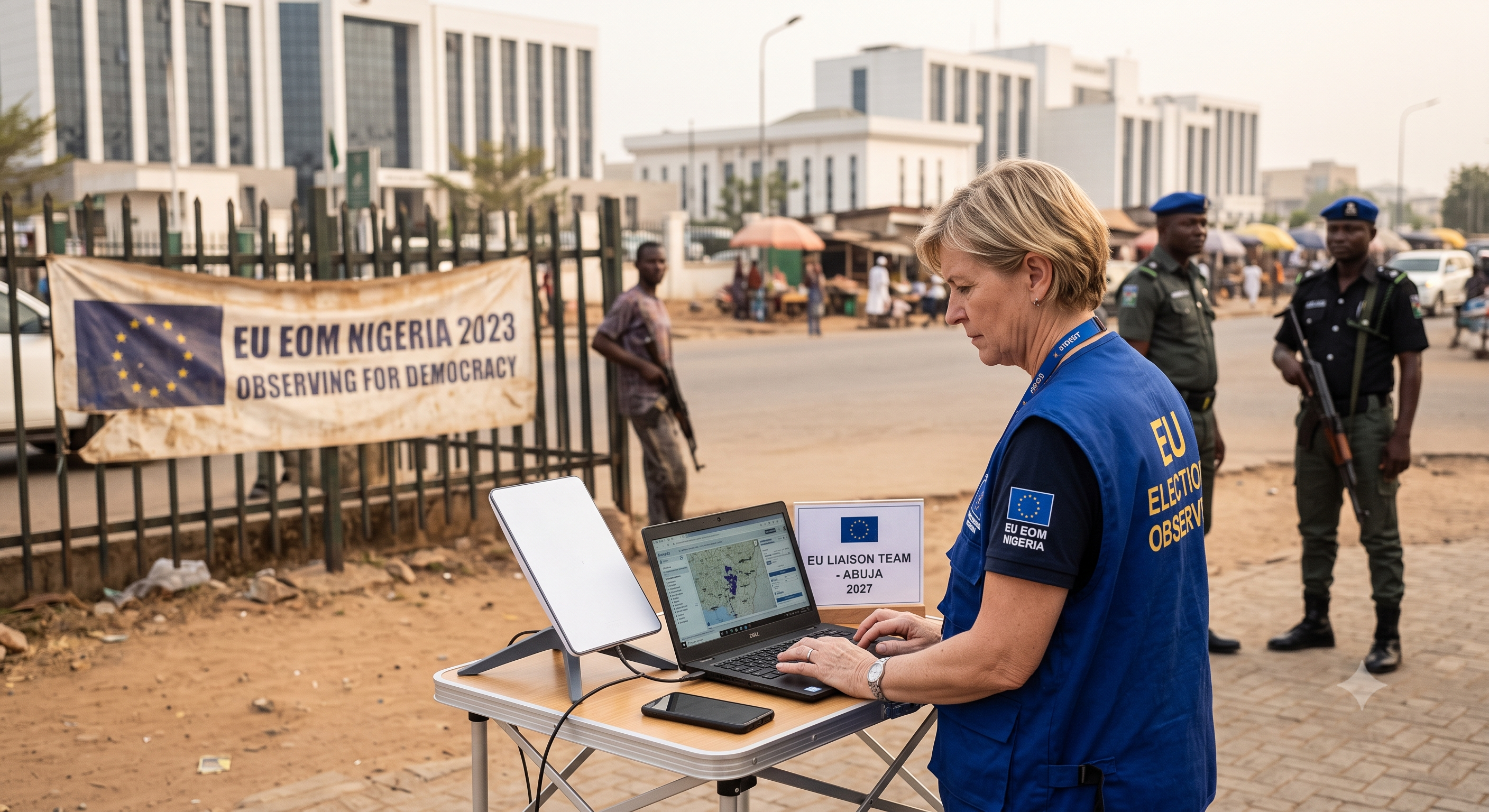

![EU denies abandoning Nigeria’s 2027 election observation, confirms just 2–4 experts compared with 110 observers in 2023.[Gemini Generated Image]](https://ocdn.eu/pulscms/MDA_/4fe78054e0557c5ecf5f1cb53a0c5974.png)
The European Union has confirmed it will observe Nigeria’s 2027 general election, rejecting reports that it had declined an invitation to participate in the vote.
- The EU will observe Nigeria’s 2027 election with a smaller team of two to four experts.
- It rejected reports that insecurity or hostility influenced the decision to scale back its mission.
- The bloc previously deployed 110 observers for Nigeria’s 2023 elections and issued 23 recommendations.
- The smaller mission will still assess the election and issue recommendations on improving Nigeria’s electoral process.
The bloc said it will instead deploy an Electoral Expert Mission (EEM) comprising two to four independent experts, significantly fewer than the 110 observers accredited for Nigeria’s 2023 elections.
The EU Delegation to Nigeria and ECOWAS issued the clarification following reports that it had decided against observing the election because of worsening insecurity and hostile treatment of its officials after its critical assessment of Nigeria’s 2023 polls.
The delegation said those reports were inaccurate and described the alleged reasons for its decision as “pure speculations”.
Nigeria’s Independent National Electoral Commission (INEC) formally invited the EU on April 17, 2026, to deploy observers for the election.
The EU responded on July 28, accepting the invitation but informing the commission that it would send the smaller expert mission rather than another full-scale Election Observation Mission.
EU will send two to four experts
The difference in the size of the EU’s presence between Nigeria’s last election and the next one will be substantial.
For the 2023 general election, the EU initially deployed 11 election analysts and 40 long-term observers across Nigeria’s 36 states. The mission was later reinforced by EU diplomats and European Parliament representatives for election day, bringing its planned deployment to about 116 observers.
The mission operated in Nigeria for three months and assessed the presidential, National Assembly and subsequent state elections.
For 2027, the EU says its Electoral Expert Mission will consist of two to four independent experts who will be formally accredited as observers by INEC. It is still unclear if the bloc will deploy more experts subsequently.
Despite the smaller physical presence, the delegation said the expert mission would assess the election using many of the same standards applied by a full observation mission.
“An EEM, like an Electoral Observation Mission, assesses whether the electoral process is conducted in line with international, regional and national obligations and commitments,” the EU said.
DON'T MISS THIS: Nigeria could face sanctions from Trump for allegations of ‘religious cleansing’
The experts will produce a final report containing recommendations on how Nigeria can improve its electoral framework and future elections.
That report will be shared with the Nigerian government and, subject to its agreement, could subsequently be released publicly.
EU rejects claims it abandoned Nigeria’s election
The EU’s statement directly contradicts reports that it had rejected INEC’s invitation and would not observe the 2027 election.
Those reports also claimed that the EU’s decision was linked to worsening insecurity in Nigeria and hostility directed towards its observers and officials following the publication of its final report on the 2023 elections.
The delegation rejected that explanation. “The two alleged reasons mentioned in the press reports do not appear in the letter: these are pure speculations,” it said.
The EU explained that it decides each year which electoral missions to deploy to partner countries that have extended invitations and determines what type of mission is appropriate for each country.
The choice depends on “individual situations and available resources”, according to the delegation.
It also stressed that INEC had sent a formal invitation rather than merely requesting information about whether the bloc intended to observe the election.
The clarification means the EU is not withdrawing from scrutiny of Nigeria’s 2027 electoral process, although its physical presence will be considerably smaller than in 2023.
A critical assessment of Nigeria’s 2023 election
The decision comes four years after one of the EU’s largest election observation deployments to Nigeria.
DON'T MISS THIS: Trump administration puts Nigeria’s 2027 election under close watch as US weighs tougher ties
Its 2023 mission eventually involved 110 accredited observers and remained in the country from January to April.
Following the elections, the mission concluded that the process exposed “enduring systemic weaknesses” and said shortcomings in electoral law and administration damaged public trust.
The EU subsequently issued 23 recommendations, six of which it considered priorities.
They included measures aimed at improving transparency around election results, strengthening accountability in the appointment of election officials, addressing impunity for electoral offences and improving protections for journalists.
The recommendations also sought to address barriers to greater participation by women in Nigerian politics.
The assessment drew criticism from Nigerian government officials at the time, but the disagreement did not end electoral cooperation between Abuja and Brussels.
EU returned ahead of 2027
In October 2025, an EU Election Follow-up Mission returned to Nigeria to assess progress in implementing recommendations from the previous election.
Barry Andrews, who headed the 2023 observation mission, led the follow-up delegation.
The mission found progress in some areas but said further action was required to improve Nigeria’s electoral process ahead of 2027.
DON'T MISS THIS:BREAKING: Tinubu wins Nigeria's most closely-fought presidential election
INEC subsequently issued the formal invitation for the EU to return for the next general election.
The bloc’s decision to send an expert mission rather than another large observation mission also does not affect its wider support for Nigeria’s democratic institutions.
The EU said its decision “does not affect in any way” the continued implementation of its Support to Democratic Governance in Nigeria programme, including assistance to the country’s electoral process.
The EU launched the second phase of the programme with €39 million in funding covering electoral administration, political parties, the legislature and judiciary, media, civil society and efforts to increase political participation by women and young people.
A smaller presence for a closely watched African election
Nigeria’s 2027 election will be closely watched across the continent.
With more than 200 million people, Nigeria is Africa’s most populous country and one of West Africa’s major political and economic powers, giving the credibility of its elections significance beyond its borders.
The region has also experienced years of political instability and military coups, increasing scrutiny of democratic institutions in countries that have retained civilian governments.
The EU will not be the only international organisation involved in observing Nigeria’s election. The African Union, Economic Community of West African States and Commonwealth have traditionally deployed missions, alongside thousands of domestic observers.