The Midterm Reckoning: How a Divided Congress Can Strangle Executive Orders
A presidential signature on an executive order creates massive headlines, but it does not create permanent statutory law. In a divided Washington, executive actions operate on borrowed time. Between legislative funding chokeholds, immediate federal court injunctions, and the constant threat of instant rescission by a successor, discover how the system of checks and balances actually dismantles White House directives when Capitol Hill swings out of the president's grasp. The post The Midterm Reckoning: How a Divided Congress Can Strangle Executive Orders appeared first on The Narrative Matters.
 Black News
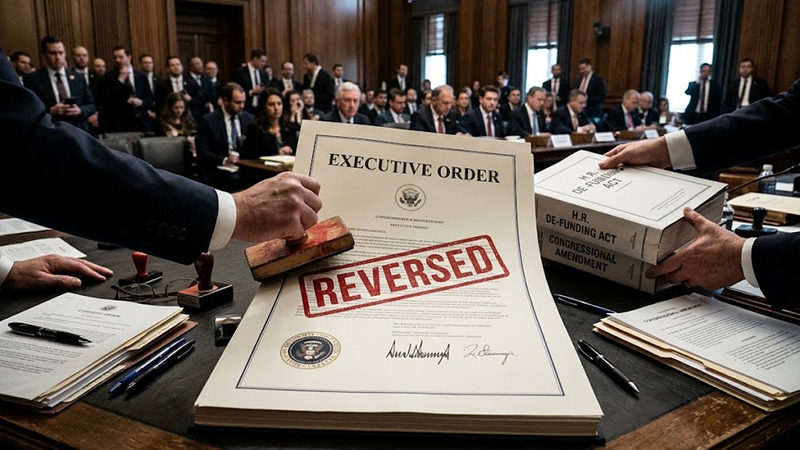
Overview: Executive orders are not permanent legislation; they are administrative directives that can be systematically stopped through three constitutional mechanisms:
Congress can defund or override directives by attaching spending prohibitions to critical appropriation bills or passing conflicting federal legislation.
Federal courts can issue immediate nationwide injunctions and declare orders invalid if they exceed Article II authority or violate statutory law.
A sitting or incoming president can unilaterally rescind or replace any prior order with a new executive action on day one.

The presidential pen makes headlines, but shifting legislative majorities, legal challenges, and budget firewalls hold the real power to neutralize unilateral White House actions.
Can Executive Orders Be Overturned? The Rules of Power in a Divided Washington
Every time a president issues an executive order, political commentary treats it like permanent law. The signature is bold, the press conference is confident, and the initial reaction feels decisive.
If you lead an organization, deploy capital, or shape strategy, you need the operational reality rather than the political drama.
The fundamental rule of executive power is straightforward: what begins with a signature can be undone just as fast. Executive actions do not create permanent statutes. They exist on borrowed time, and their survival changes completely the moment power swings on Capitol Hill.
When congressional control shifts, executive directives run directly into a wall. Three separate mechanisms can dismantle, starve, or invalidate them.
1. The Congressional Stranglehold: Appropriations and Legislative Firewalls
The fastest shift following a midterm balance-of-power change happens in the committee rooms.
An executive order is simply an instruction directing federal agencies on how to enforce existing laws. It cannot generate a single dollar on its own. When an opposing party gains leverage or wins a chamber majority in Congress, the legislative purse becomes an active weapon against executive overreach.
Lawmakers push back in two decisive ways:
- Funding restrictions: Congress attaches riders to critical government spending bills that explicitly forbid federal agencies from spending appropriated funds to enforce a specific executive order. Without agency staff and enforcement budgets, the order becomes an empty gesture.
- Statutory overrides: Lawmakers introduce legislation that directly amends federal code to block or rewrite the administration’s policy. While an incumbent president will routinely veto such bills, demanding a steep two-thirds supermajority to override, the constant threat of funding standoffs forces the executive branch to scale back controversial programs.
On rarer occasions, lawmakers also assemble bipartisan coalitions to invoke formal resolutions of disapproval against administrative rules that grew out of executive mandates.
2. The Legal Gauntlet: Federal Courts Enforce the Boundary
A president cannot bypass the Constitution simply because legislative negotiations stall. Every executive directive must derive its authority either from Article II powers or from specific statutes previously passed by Congress.
When a midterm election signals public pushback, lawsuits from coalitions, state attorneys general, and affected industries accelerate rapidly. Federal courts act as the immediate enforcement referee.
Judges push back through two legal avenues:
- Nationwide injunctions: A single federal district court can issue an emergency freeze, halting an administration’s initiative across the country while litigation moves forward.
- Judicial invalidation: If a court determines an order exceeds presidential authority or runs counter to statutory language, the order is struck down and declared unlawful.
This friction point appears constantly across high-profile administration policies, whether the disputes center on emergency economic declarations, immigration enforcement rules, or federal agency mandates. When the White House tries to rule through the pen, the courtroom is where that overreach gets stopped.
3. The Successor’s Eraser: Instant Rescission
The third and most absolute check on executive power is the calendar.
Because an executive directive is administrative rather than legislative, the sitting president or any future administration holds full constitutional authority to revoke, replace, or alter it on day one. No debate on the House floor is required. No filibuster can intervene.
Whenever the political tide turns and a new president enters office, a substantial portion of the previous administration’s signature executive portfolio gets erased before the inaugural parade finishes. A policy that relies entirely on executive action is only as durable as the person sitting in the Oval Office.
What This Means for Strategic Decision-Making
If your business or investment roadmap treats every White House announcement like settled law, you will misallocate resources and react to headlines that never turn into durable policy.
Strategic planning in a divided Washington requires looking past the initial press release to evaluate the checks and balances:
Does the order rely on clear statutory authority, or is it legally vulnerable to court challenges?
Can the administration actually enforce the directive without new congressional appropriations?
Will a shifted balance of power on Capitol Hill block the funding required to sustain it?
Executive orders make for swift politics, but they cannot replace the enduring weight of statutory law. When the balance of power shifts, the limits of the presidential pen become impossible to ignore.
#ExecutiveOrders #CapitolHill #MidtermPower
The post The Midterm Reckoning: How a Divided Congress Can Strangle Executive Orders appeared first on The Narrative Matters.