Tracing the Unfinished: Human–Plant Encounters and Their Echoes in China’s Interior Frontier
In a town on the edge of a desert, a holoparasitic plant threads together memories of hardship, dreams of prosperity, and the feeling that development has come to a halt. Following centuries of human–plant encounters, this essay explores how China’s interior frontier has been shaped by successive incomplete projects of land reclamation, industrialisation, and nature conservation. Paying attention to this sense of unfinishedness sheds light on how people today live through political depression in China, where the future feels suspended but not entirely closed. The post Tracing the Unfinished: Human–Plant Encounters and Their Echoes in China’s Interior Frontier appeared first on Made in China Journal.
 Black News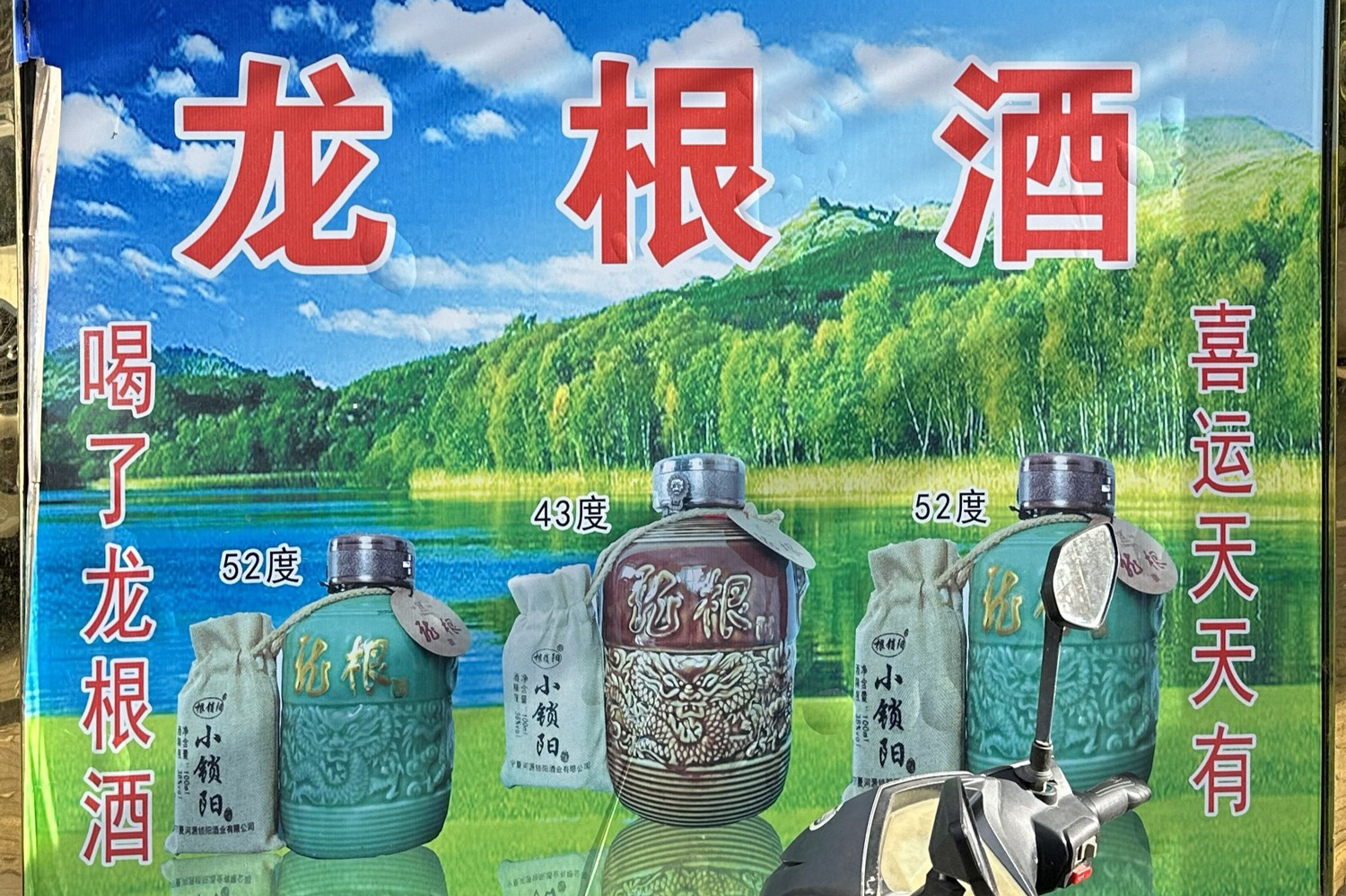
Almost every convenience store in Shuangxi (a pseudonym, as are the names of all places administratively lower than the municipal level and people below) has the same poster taped to its front window. On market days, crowds of villagers and townspeople pass in front of it in a steady tide, the poster’s surface catching the ochre light that blows in from the Mu Us Desert. The design is both saturated and somewhat abrupt: a bold red slogan—‘Drink Dragon Root Liquor, good fortune comes your way every day’ (喝了龙根酒, 喜运天天有)—runs down the sides, while three oversized bottles stand before an impossible landscape of green grasslands and blue lakes (see Figure 1). In the real Shuangxi, sand and dust grind along the streets and the sky is often the colour of dust; the promised scene is always out of reach.
A store owner returned from his delivery route and insisted I try the local specialty. He opened a bottle of Dragon Root Liquor and poured some into a disposable cup, swirling it until dark flecks appeared. ‘See, that’s suo‑yang [锁阳, literally, “locking away yang energy”],’ he said, ‘but the plant is vanishing. This batch has little.’ I pleaded alcohol allergy, so he drank it himself, pausing to remember the thick sweetness of the liquor from its early days. ‘Suo-yang’s sweetness should balance alcohol’s harshness … But nowadays it’s hard to find real suo‑yang.’ The missing plant hung over his words—an absence that seeped into the everyday conversations with which I engaged during my stay in this town.
This essay centres on that plant, suo‑yang (Cynomorium purpureum Rupr.), a humble desert root that grows by attaching itself to a host shrub called baici (白刺), drawing water and nutrients from its host beneath the sand. Over two fieldwork seasons in 2024 and 2025 around Shuangxi, Ningxia Hui Autonomous Region, I encountered suo‑yang less as a concrete object than as memory, rumour, joke, or glimpse of hope. It appeared in stories of Mao‑era hunger and of post‑Mao prosperity, in business schemes and conservation plans, always hovering on the edge of presence. As I followed conversations between farmers, herders, traders, cadres, and retired officials, a pattern emerged: what people described, again and again, was not a completed story of progress, but a site stuck in something unfinished.
In what follows, I trace how human–plant encounters in China’s interior frontier have long been entangled with grand projects sponsored by the state and other powerful actors. Drawing on ethnographic data and archival material, I show how this frontier has been shaped by schemes that promised transformation but often stalled or shifted direction, leaving behind ruins, aspirations, and altered ecologies. Rather than evaluating ‘failure’ or ‘success’, I turn to ‘unfinishedness’ (Wallen 2015; Biehl and Locke 2017): to projects that never quite ended, to landscapes that keep changing, and to futures that feel suspended. This way of noticing unfinishedness may help us understand how people in contemporary China live with what is increasingly described as a kind of political depression, in which hope and exhaustion coexist and cannot be easily separated from each other.
A Frontier of Unfinished Projects
Located in northeastern Ningxia, Shuangxi sits where the Yellow River meets desert sand. In China’s late-imperial times, this area became a testing ground for different visions of how to inhabit the country’s Inner Asian borderlands (Bello 2016; Wang 2021). During the Republican era, both the central government and local warlords saw this area as a node of frontier governance, drawing in landless migrants to reclaim the sandy ground, which was once Mongolian herders’ pastures, and established Shuangxi County (Tighe 2005; Yu and Zhang 2023). After the founding of the People’s Republic in 1949, the county was held up as an emblem of interior frontier development—a place in which to fight back the desert and poverty through continuing migration, infrastructure construction, and campaigns to ‘open up wasteland’ (开荒). For decades, Shuangxi received some of the highest levels of fiscal support in the country for agricultural and environmental engineering projects.
On paper, the promise was clear. A 1958 migration pamphlet circulated among rural cadres in Henan described Shuangxi as a land of opportunity: ‘Vast land and a sparse population, with every prospect for development’, where migrants could not only find fields to cultivate but also earn money by collecting medicinal plants such as suo-yang, licorice, and ephedra. The document painted a picture of abundant resources waiting to be utilised, a frontier whose story would be linear progress. But migrants arriving there soon found something else: loose sand, scarce irrigation, and a landscape that resisted quick transformation. Yellow River floods could wash away newly cleared fields; dunes could return overnight to land that had been painstakingly levelled.
Shuangxi’s administrative status has also been unsettled. In 1941 it became a county—recognition that brought with it direct ties to higher levels of the state and more funding. In 2004, it was unexpectedly demoted from county to township—a bureaucratic change that residents describe as a turning point. Direct central subsidies dried up. Schools and factories closed or were left half‑abandoned, prompting many people to leave. Some residents who remain in Shuangxi Town describe this shift with a simple phrase: ‘Development has stopped here.’ The town’s story feels incomplete—a promise of prosperity that never quite materialised, a future that has been left hanging.
Today, Shuangxi is full of traces of unfinished projects. There are half‑used residential blocks built for Mao-era migrants and the ruins of a distillery and grand hotel to which I will return below. At the same time, the desert continues to move despite the steady expansion of farmland and desert plants follow patterns that scientists and villagers alike only partially understand. In this setting, human–plant relations become a way for people to express what has been lost, what has been changed, and what might still be possible (Yeh and Lama 2013). The unfinished is not just an abstract idea; it is felt in sandy fields, stalled buildings, and the stories people tell about plants that have become part of their lifeworld.
Double Symbiosis
Long before suo‑yang became the Dragon Root in glossy commercials, it was part of everyday survival. Older residents remember it as a humble root that grew at the edges of their fields, especially when those fields were still half-desert. In times of hardship before and during the Mao era, families went to the desert, dug it up, and ate it as a food or medicine for digestive ailments. In the 1970s and 1980s, children joined adults after school to dig up suo‑yang and sell it to the county’s herbal company. One man, whom I call Uncle Yang, recalled how lines of villagers would bring sacks of fresh roots to the company courtyard, where they were piled up into ‘small mountains’ before being dried and shipped away to factories elsewhere.
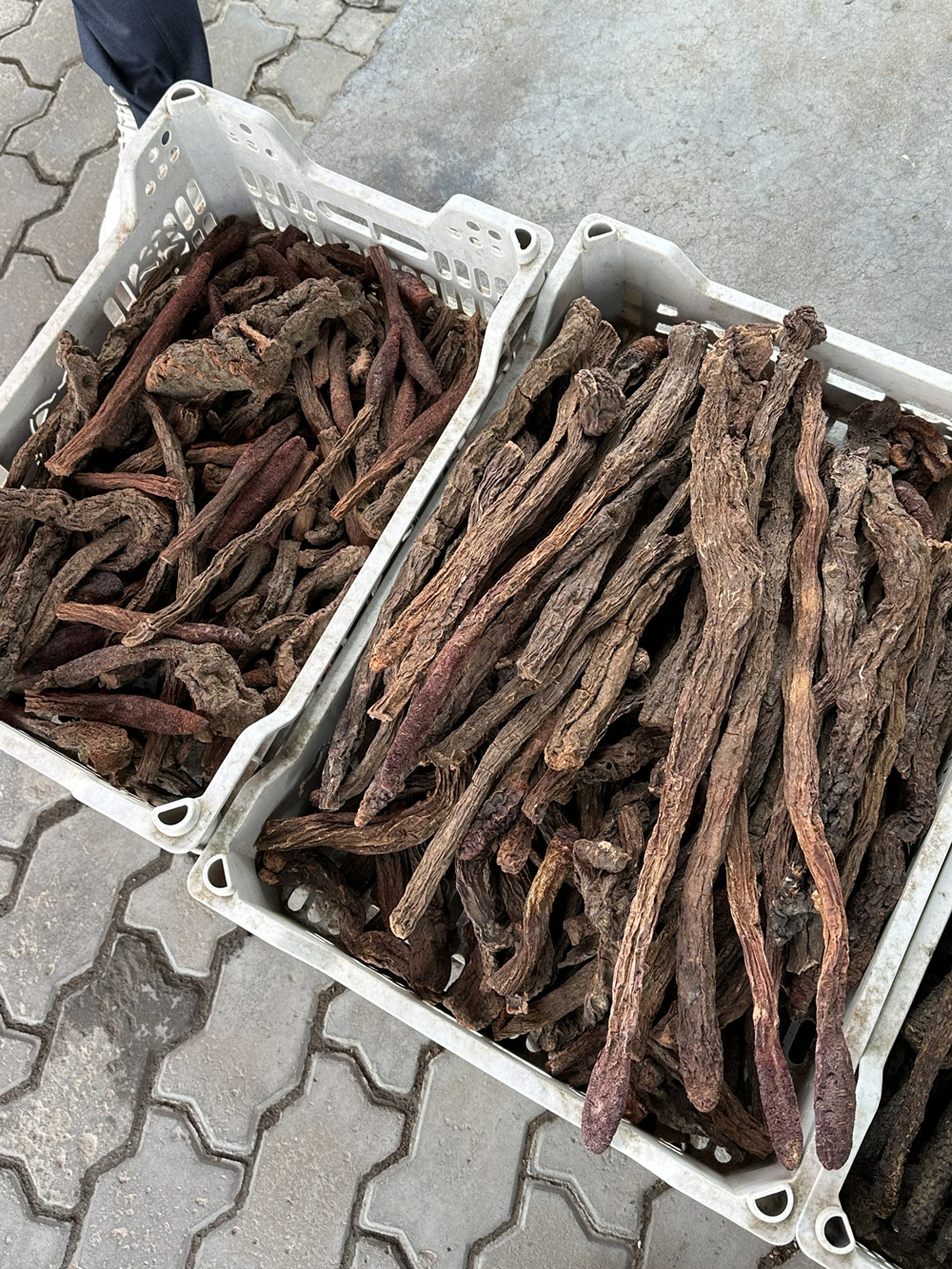
This work created a web of symbiotic relations that was both economic and intimate. People learned where suo‑yang tended to grow—in sandier patches, near certain shrubs—and how to spot the faint-red stalk that might indicate an underground root. They also learned how to dig it in a way that allowed it to come back. Several older farmers told me there were ‘right’ and ‘wrong’ ways to harvest suo‑yang. The right way meant tracing the main stem carefully, leaving part of the root system and the delicate connection to its host intact. One man told me:
Leave a little and suo-yang comes back. Tear out everything for quick profit, and it’s gone forever. You also cannot just leave it alone. The more you harvest suo-yang [in the right way], the more it grows; if you don’t harvest it, it just stays at that amount.
These techniques were never written down and people disagree about how effective they were. Younger farmers sometimes roll their eyes at the elders’ claims, suggesting that climate change, large‑scale land reclamation, or simple overharvesting are more to blame for the plant’s decline. None of them is entirely sure. But the very existence of these arguments points to something important. In Shuangxi, debates about how to pick suo‑yang are also debates about how to live with the land, how to balance immediate needs and future possibilities, and who has the right to speak about causality. Harvesting becomes an ethical question grounded in a long, complicated symbiosis between humans, shrubs, roots, the state, and shifting sand.
Further, this symbiosis extends beyond the fields and is reflected in suo-yang’s shifting value. Since the late Ming Dynasty, the plant has been widely recognised as a kidney tonic in classics of Chinese medicine such as the Great Pharmacopoeia (本草纲目) and Leigong’s Explanation of Drug Properties and Preparation (雷公炮制药性解), particularly associated with male sexual vitality. In Shuangxi, people remember it as both a poor person’s supplement in hard times and a more valuable commodity as markets expanded. When the Dragon Root Liquor distillery opened about 2002 to cater to post-socialist China’s growing appetite for sex and consumption (Farquhar 2002; Zhang 2015), suo‑yang’s value shifted again, becoming a branded ingredient that linked local pride, masculinity, and speculative profit. The desert root that once stood for endurance in rough conditions now sat on supermarket shelves in distant cities as a bottled promise of strength and luck.
Yet, even as it travelled, suo-yang remained stubbornly tied to particular ecologies. Unlike another holoparasitic plant, rou congrong (肉苁蓉), which scientists and enterprises have managed to cultivate in controlled conditions (Zee 2019), suo‑yang has resisted domestication. Researchers in nearby regions have experimented with planting host shrubs and trying to coax the root to grow, but so far, as Mr Lu, the owner of a herbal store, told me, ‘Nobody has really figured it out.’ This is considered part of the plant’s most distinctive characteristic. ‘Suo‑yang is wild,’ he told me. ‘It grows where and how it wants.’ Its refusal to be fully controlled adds another layer to the sense of unfinishedness that pervades the town: even the plants do not fully cooperate with humans’ ever-changing prospects and aspirations.
Living with Absent Presence
At the southwestern edge of Shuangxi, past low brick houses and dusty yards, stands the skeleton of a dream. Here, a businessman from Henan built a distillery in 2003 and, at the peak of his business, began constructing a grand hotel meant to host tourists drawn to the desert and to Dragon Root Liquor. For a time, the project seemed promising. With the support of the county and later township governments, the land was taken over from villagers, who received compensation that many recall as ‘decent’. The liquor company hired more than 200 locals in its heyday, and bottles of liquor bearing Shuangxi’s name were shipped far and wide. Newspapers ran cheerful headlines such as ‘Liquor Made of Suo-Yang Secures the Henan Market’ (锁阳酒锁定河南市场) (Zhou 2008) and people excitedly discussed the town’s possible revival after its administrative demotion.
When I visited in summer 2025, the distillery buildings were faded and partially abandoned, their signs warped by sun and sand. The hotel stood unfinished, its concrete floors open to the sky, stairwells filled with drifts of dust. A loudspeaker at the gate still occasionally blared a recorded warning—‘Restricted area! No unauthorised entry!’—that sounded less like a genuine threat than an echo from a time when something was meant to be guarded. The site has become part of the everyday landscape, a reminder of a project that advanced halfway and then froze.
Locals are eager to offer me different stories about why the project failed. Some blame the owner’s excessive ambition: he took loans from the government, from banks, and then from relatives and neighbours, always chasing expansion; when the money ran out, his project collapsed. Others point to the town’s remote location and poor transport links, which made it difficult to compete in a crowded liquor market. For Mr Lu, the herbalist, the real issue lies with the plant. ‘There just wasn’t enough suo‑yang left here, because the environment had been changed,’ he said. As the local supply dwindled year by year, the distillery had to bring in roots from other provinces at a higher price, eating into its profits. Rou congrong could be used as a cheaper substitute, but, as Mr Lu put it, ‘people know it’s not the same’.
Ironically, the bad ending of this development story derives from a humble root and its changing environment. The scarcity of suo‑yang becomes another way of talking about Shuangxi’s stalled future: a root of hope that proved too fragile, too wild, or simply too entangled with shifting ecologies to bear the weight of grand expectations. When residents gesture towards the hotel’s skeleton or the distillery’s rusted gates, they often circle back to the plant’s absence and to the sense that something slipped away just as it was meant to take off. The ruin is not only a monument to speculative capital; it is also the marker of an unfinished relationship between humans and the desert plants on which these schemes rested.

Amid numerous encounters with suo-yang during fieldwork, I came to know this unfinishedness not as a single event but as a mood that seeped into conversations. Many residents, especially older ones, linked their memories of the plant to historical moments: gathering it as children to help families through lean years, selling it to the herbal company, or seeing its name printed on the liquor labels that promised a new era of prosperity. When they talked about its current absence, they rarely presented a single clear cause. Some mentioned climate change or the expansion of croplands and windbreaking forest that replaced sandy scrub with more uniform crops. Others complained that ‘people nowadays don’t know how to harvest properly’, blaming greed and moral decay. Still others shrugged and mumbled, ‘Maybe it just left, went to wealthier places, like Ordos.’ The plant has become a kind of absent presence, a figure that echoes their own uncertain futures.
On several trips into the dunes with Uncle Yang in his dusty SUV, we tried to find wild suo‑yang. We scanned ridge after ridge, stopping when we thought we saw a hint of red, only to discover a different plant or a shard of brick. As the hours passed and the light softened, my initial excitement gave way to a shared, quiet disappointment. For my informants, this disappointment was even sharper; they were searching not for a rare ethnographic object, but for a former symbiotic partner that had quietly withdrawn. Back in the village, these failed forays became stories in themselves, occasions to compare the present with the past and to joke darkly that the plant had ‘taken its future elsewhere’.
Meanwhile, new state projects have appeared around Shuangxi that cast the plant in a different role. A nature reserve dedicated to protecting wild suo‑yang has been established, complete with fences, monitors, and locked gates. Official signage celebrates this as a step towards China’s ‘Ecological Civilisation’ (生态文明), presenting the plant as an estate to be protected by the state. Many residents with whom I spoke were ambivalent. On the one hand, they welcomed attention to this area and hoped the reserve might bring some form of recognition. On the other, they worried about losing access to land and being labelled ‘ignorant’ if they questioned the new rules. The reserve—still in its early stages—is another unfinished project layered onto older ones, another attempt to fix in place the future of both plants and people.
By the time I left Shuangxi in 2025, I had still not seen a living suo‑yang root in the ground. It remained an absence that shaped the way people talked about their town, their past, and their future. In this sense, the encounters I had were not with the plant directly, but with what its long entanglement with humans had left behind: tastes remembered on the tongue, techniques recalled in the hands, business plans turned to dust, and new fences around land where it might or might not still grow. The unfinishedness of Shuangxi’s development is mirrored in the unfinished story of suo‑yang’s presence there: a story still being argued over, reconfigured, and lived.
Unfinishedness as a Lens
When we speak of ‘China in transition’, a set of images may spring to mind: from plan to market, from poverty to prosperity, from village to city (Kipnis 2016), and the recently rising anxiety over a reversal from development to stagnation. Stories of suo-yang and Shuangxi trouble the binary and linear discourse. In such a frontier for ecology and progress, migration waves, land reclamation, industrial schemes, and nature conservation have accumulated without ever fully resolving. People live among half‑completed buildings, altered ecologies, and memories of upheavals that have come and gone. Suo‑yang, once dug up as food and medicine, then sold as a commodity and branded as Dragon Root, now appears mostly as an absence, its uncertain fate echoing residents’ own doubts about what comes next. These interspecies encounters reveal an emergent frontier—not a blank slate to be filled, but a site where past and present projects remain open‑ended, their outcomes still in question (Faier and Rofel 2014).
In recent years, observers have witnessed growing political depression within and around China—a diffuse mix of exhaustion and disillusionment in the face of suffocating governance and shrinking horizons. If this depression exists in Shuangxi, it appears not in dramatic outbursts, but in the quiet insistence that ‘development has gone elsewhere’ and in the shrug that follows the observation that a once‑familiar plant has simply ‘left’. Unfinishedness is a lens that helps us see that this depression is not only about the collapse of grand promises, but also about the everyday work of inhabiting projects that have stalled yet still organise people’s lives. It draws our attention to how people continue to care for plants and land, to argue about ethical techniques, and to both worry and joke about what the future holds. In an era when many feel that horizons have dimmed, noticing the world’s ‘unfinished’ quality and building weak theory (Stewart 2008)—rather than rushing to declare success or failure—can be one way to stay with the messy density of a vast and often evasive country; to recognise that in places such as Shuangxi, perhaps as in much of China today, what survives is neither evolutionary certainty nor despair but the tentative, ongoing labour of piecing together a future in the company of plants, sand, and the traces of what remains unfinished.
Featured Image: A poster for Dragon Root Liquor, 2024. Photo by the author.
References
Bello, David A. 2016. Across Forest, Steppe, and Mountain: Environment, Identity, and Empire in Qing China’s Borderlands. Cambridge, UK: Cambridge University Press.
Biehl, João, and Peter Locke, eds. 2017. Unfinished: The Anthropology of Becoming. Durham, NC: Duke University Press.
Faier, Lieba, and Lisa Rofel. 2014. ‘Ethnographies of Encounter.’ Annual Review of Anthropology 43: 363–77.
Farquhar, Judith. 2002. Appetites: Food and Sex in Post-Socialist China. Durham, NC: Duke University Press.
Kipnis, Andrew B. 2016. From Village to City: Social Transformation in a Chinese County Seat. Berkeley, CA: University of California Press.
Stewart, Kathleen. 2008. ‘Weak Theory in an Unfinished World.’ Journal of Folklore Research 45(1): 71–82.
Tighe, Justin. 2005. Constructing Suiyuan: The Politics of Northwestern Territory and Development in Early Twentieth-Century China. Leiden, Netherlands: Brill.
Wallen, James Ramsey. 2015. ‘What Is an Unfinished Work?’ New Literary History 46(1): 125–42.
Wang, Yi. 2021. Transforming Inner Mongolia: Commerce, Migration, and Colonization on the Qing Frontier. Lanham, MD: Rowman & Littlefield.
Yeh, Emily T., and Kunga T. Lama. 2013. ‘Following the Caterpillar Fungus: Nature, Commodity Chains, and the Place of Tibet in China’s Uneven Geographies.’ Social & Cultural Geography 14(3): 318–40.
Yu, Hao 于昊, and Xiaohong Zhang 张晓虹. 2023. ‘政治角力下的边疆区域归属变更——以民国时期陶乐地区归属纠纷为例’ [The Affiliation Change of Frontier Areas under Political Conflict: A Case Study of the Affiliation Dispute of Taole Area during the Republic of China]. 民族学论丛 [Studies in Ethnology] 2: 28–40.
Zee, Jerry C. 2019. ‘Groundwork in the Margins: Symbiotic Governance in a Chinese Dust-Shed’. In Frontier Assemblages: The Emergent Politics of Resource Frontiers in Asia, edited by Jason Cons and Michael Eilenberg, 59–73. Hoboken, NJ: Wiley.
Zhang, Everett Yuehong. 2015. The Impotence Epidemic: Men’s Medicine and Sexual Desire in Contemporary China. Durham, NC: Duke University Press.
Zhou, Xiao 周晓. 2008. ‘锁阳酒锁定河南市场 [Liquor Made of Suo-Yang Secures the Henan Market].’ 华夏酒报 [China Wine News], 4 September.
The post Tracing the Unfinished: Human–Plant Encounters and Their Echoes in China’s Interior Frontier appeared first on Made in China Journal.