Hunters Point’s panopticon
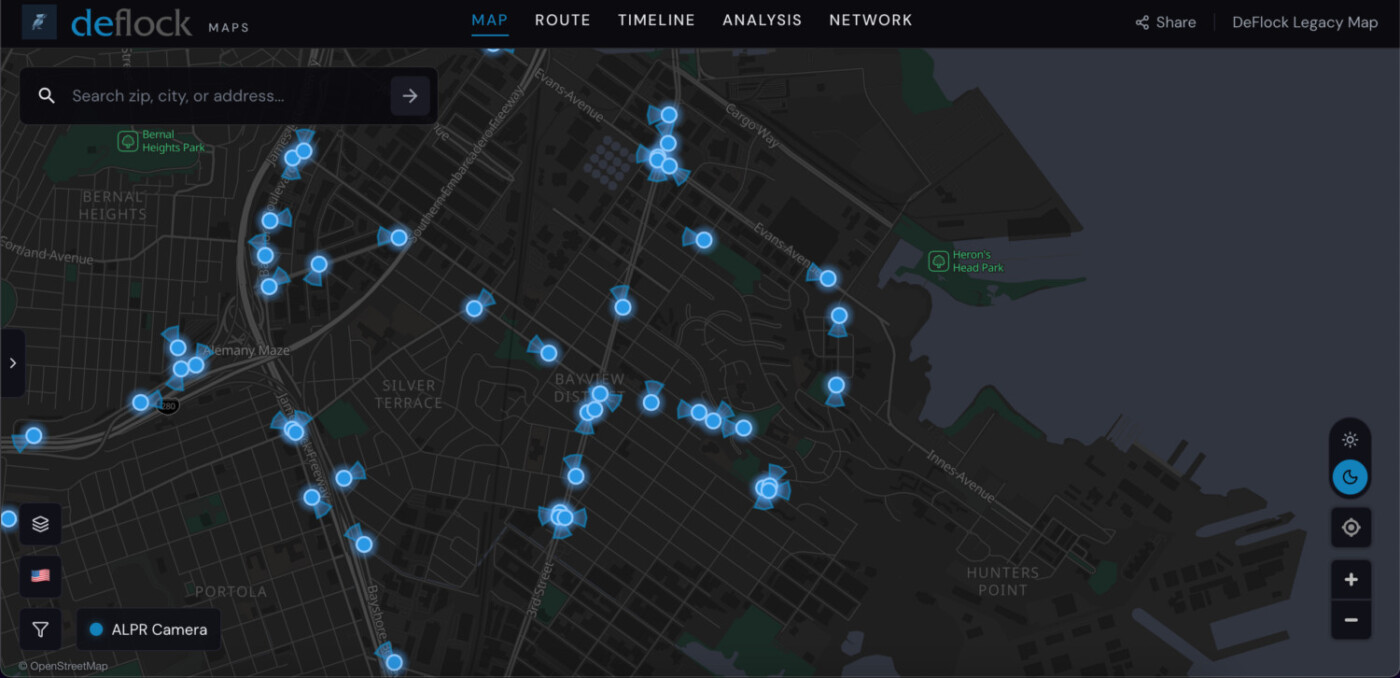
Seventeen license-plate readers are mapped in Hunters Point as SFPD’s network of 500 AI-enhanced Flock cameras spreads across San Francisco. Residents and researchers question whether this corporate-backed surveillance dragnet delivers public safety or puts whole communities under watch. The post Hunters Point’s panopticon appeared first on San Francisco Bay View.
 Black News
by Zaire Saunders
In March 2024, San Francisco initiated the use of Flock Safety cameras to read license plates with the ability to capture passing vehicles’ make and model. Now, in 2026, SFPD is the sole owner of 500 artificial intelligence-enhanced surveillance cameras across the city.
Flock Safety, the company behind the nation’s increased surveillance, states on its webpage, “The nation’s largest connected LPR network helps law enforcement, businesses, and communities securely share vehicle evidence, uncover more leads, and solve more cases together. Customers stay in control of how their data is shared and accessed.”
Hunters Point alone has 17 Automatic License Plate Readers, or ALPRs, counted and mapped out. The data comes from Deflock.org, a crowdsourced ALPR map.
Still, many within the community of Bay View Hunters Point remain unaware of Flock’s ALPR presence.
“I promise you. If I asked 10 people right now, they wouldn’t even know they’re there,” said a woman selling oysters on the street at Third and Palou. “They didn’t notify us. We already have it rough with paying ticket prices. We don’t get a lot of funding like other communities. They’re coming for our money.”
In regard to money anxieties, she isn’t alone. A cashier working at a local neighborhood business also stressed the economic capabilities of Flock’s ALPRs.
“It’s militaristic. But they will monetize it. They’re gonna squeeze money out of you. They’re not putting these here without trying to make money. The potential for adding a ticket charge to their system will be child’s play for Flock.”
According to an independent study of ALPRs in Piedmont, California, done in 2021, less than 0.3% of ALPR hits translate to useful investigative leads, therefore failing to justify taxpayers’ costs for such systems.
Although a 2024 study conducted by Flock Safety found a 9.1% increase in crime-clearance rates for a police department using one Flock ALPR, Dr. Johnny Nhan of Texas Christian University, who participated in the study on the company’s reliability and impact, has since questioned the validity of the conclusions.
“The more complicated question would be what percentage of crime and crime types is Flock responsible for. There are just so many uncontrolled variables that it’s hard for me to methodologically isolate the percentage, especially related to any reductions in crime,” said Dr. Nhan. “My study and interest was more on the privacy side of things.”
San Francisco police say their usage of the hundreds of Flock cameras comes with oversight, restrictions on how arrests are made and securely protected data.
But in November 2025, a security researcher discovered Flock logins for sale on a Russian forum. In addition, vehicle data is collected whether you’re suspected of committing a crime or not. Millions are tracked in their day-to-day lives as they commute to jobs, head to recreational activities or – in the case of Grocery Outlet’s use of SAFR facial recognition technology – even when customers are shopping.
Anti-Flock protesters have cited the use of AI-supported Flock cameras as a dragnet, named after the technique fishermen use when dragging a net through the bottom of the ocean in hopes of capturing a large quantity indiscriminately. SFPD’s watchful eye through ALPRs lends itself to the definition.
According to the Flock company website, estimates are that anywhere from 5,000 to 7,000 law enforcement agencies throughout the United States have made contracts with them. The data captured by the ALPRs is entered into a nationwide database, allowing any agency with a contract access.
And although California’s 2015 privacy law – SB 34 – prohibits sharing license plate data with federal and out-of-state agencies, in June 2026 SFPD admitted to ALPR data being seen by those same restricted agencies.
Further privacy concerns have landed in courts across the country. Many raise the possibility of ALPRs violating the Fourth Amendment. Thirty courts across the U.S. have sided with the surveillance company in that Flock ALPR cameras do not violate the Fourth Amendment, with many maintaining that “photographing a license plate on a public road is not a Fourth Amendment search: plates are exposed to public view, and there’s no reasonable expectation of privacy in them.”
The role of ICE also has been called to attention. The organization has already used Flock cameras in its tactics against immigrants. While ICE does not have a formal contract with Flock, it has used data from the nationwide pool through requests from local and state law enforcement.
A man interviewed, but wanting to be identified only as “The watermelon man,” said he “was under the impression of cameras anyway.”
“I think it’s a positive and negative,” he continued. “It’s an invasion of privacy, but on the other hand if something goes down then they’ll be able to go back to the cameras.”
One patron visiting the Bay View Branch of the library offered her thoughts on the surveillance, saying, “They’re all around. It’s all eyes on us – we don’t know who’s behind those cameras.”
Unfortunately, the community paying the city’s taxes is not behind the cameras. For residents of Hunters Point, they are victims of a corporate-backed citywide surveillance system.
Thankfully, identifying Flock ALPRs is an easy task. They are often teardrop-shaped, black, placed on streetlights and traffic lights and supported with solar panels. For a larger list of ALPR suits and evidence used, readers can check out the website Black Dog Forensics.
Zaire Saunders is a writer in San Francisco, California. He can be reached at Zsaunders46@gmail.com
The post Hunters Point’s panopticon appeared first on San Francisco Bay View.