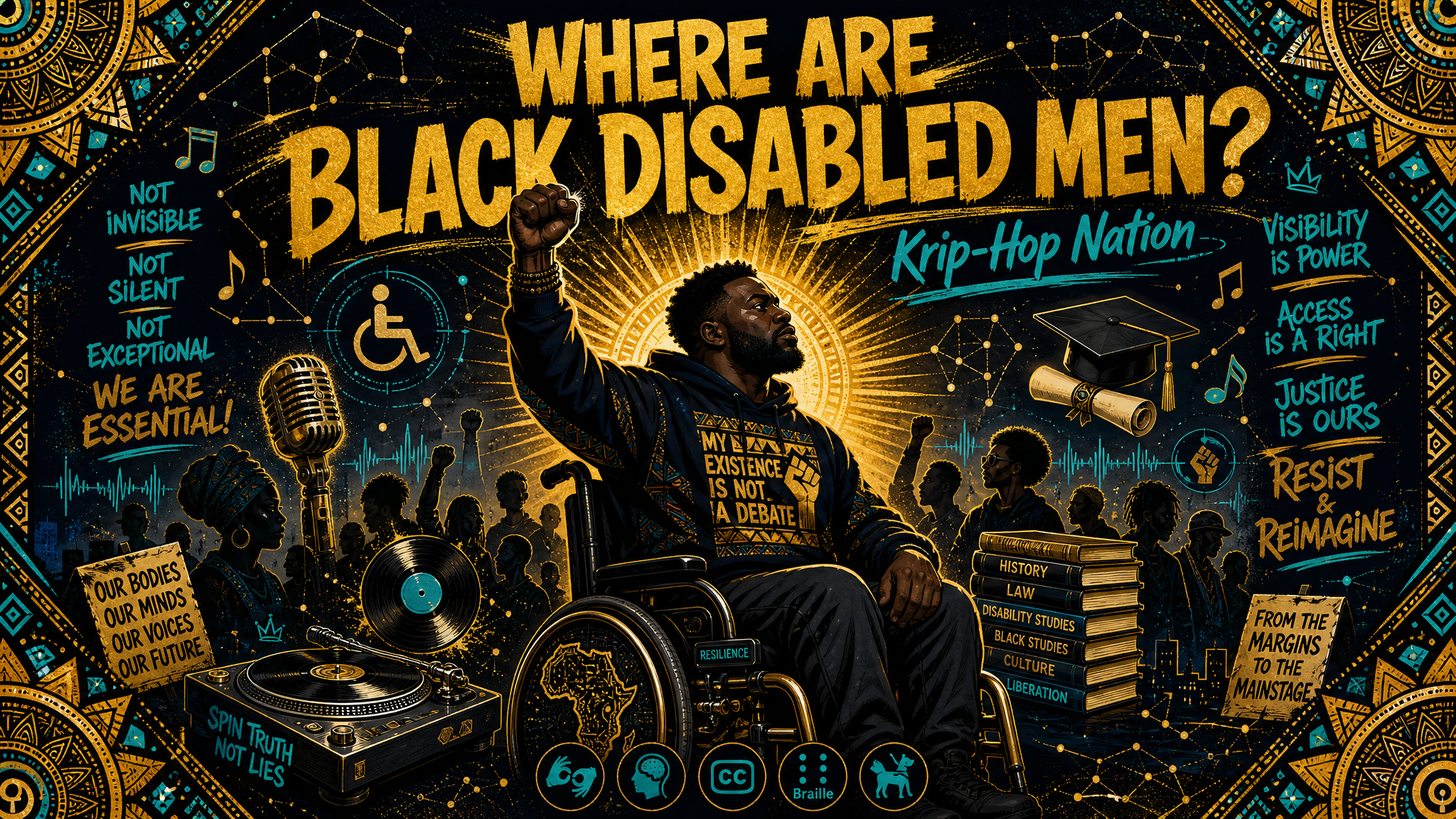
This essay introduces Afro-Krip Black August as a concept within Krip-Hop Theory that reimagines Black August by placing Disability-Centered Black Liberation at the center of Black freedom struggles. Building on the revolutionary legacy of George Jackson and the historical significance of Black August, the essay argues that racism, colonialism, policing, imprisonment, and educational exclusion are disabling systems that disproportionately shape the lives of Black disabled communities. Through the framework of the Black Krip Radical Tradition, Afro-Krip Consciousness, and Krip-Hop Theory, the essay expands Black August to recognize disabled Black resistance, knowledge production, and cultural organizing as essential to liberation. It also connects these ideas to contemporary struggles, including the fight for Michael Manning’s freedom, demonstrating that Black liberation remains incomplete unless it fully includes the leadership, experiences, and political visions of Black disabled people.
Keywords: Afro-Krip Black August; Krip-Hop Theory; Disability-Centered Black Liberation; Black Krip Radical Tradition; Afro-Krip Consciousness; George Jackson; Black August; Michael Manning; Black Disability Justice; Disabled Black Resistance; Prison Industrial Complex; Educational Incarceration; Special Education and the School-to-Prison Pipeline; Racial Capitalism; Colonialism; Disability Justice; Krip Knowledge Production; Decolonization; Pan-Africanism.
Afro-Krip Black August is a concept within Krip-Hop Theory that extends the historical meaning of Black August by placing Disability-Centered Black Liberation at the heart of Black freedom struggles. Inspired by the writings and revolutionary legacy of George Jackson, Afro-Krip Black August recognizes that systems of imprisonment, racial capitalism, colonialism, and state violence not only criminalize Black people but also produce disability and deepen the marginalization of disabled Black communities.
Black August has long been a time of remembrance, political education, discipline, and revolutionary commitment. Krip-Hop Nation builds upon that tradition by insisting that disability is not a secondary issue within Black liberation but one of its central political questions. Black August therefore becomes a time to remember not only imprisoned revolutionaries but also the ways prisons, policing, special education, psychiatric institutions, environmental racism, poverty, and colonialism create disability within Black communities. This perspective is grounded in what I call Disability-Centered Black Liberation, the principle that disability is foundational, not supplemental, to Black freedom struggles. Anti-Black racism, ableism, colonialism, capitalism, and state violence have always operated together to shape Black life. Any movement for Black liberation that ignores disability remains incomplete.
Afro-Krip Black August rests upon five interconnected principles. First, it recognizes that disability is politically produced through racism, incarceration, colonialism, environmental injustice, and state violence. Second, it insists that disabled Black people have always been revolutionary participants whose contributions have too often been erased from history. Third, it understands political education as a revolutionary practice rooted in Black August traditions. Fourth, it centers prisons, schools, neighborhoods, Hip-Hop culture, and community organizing as sites of revolutionary knowledge production. Finally, it argues that Black liberation can only be realized through Disability-Centered Black Liberation.
Building upon what I call the Black Krip Radical Tradition, Afro-Krip Black August argues that disabled Black people have always participated in resistance not as exceptions, but as organizers, artists, educators, political prisoners, cultural workers, and intellectuals. Their experiences are indispensable to understanding both the history and the future of Black liberation. Rather than viewing disability as an individual medical condition, Afro-Krip Black August understands disability as a political condition often produced through systemic violence.
The lives of Black political prisoners make this reality unmistakably clear. George Jackson himself understood that prisons function as institutions of political repression designed to discipline Black resistance. His writings reveal how imprisonment transforms the body and the mind while exposing the violence of the state. His revolutionary commitment continues to shape Black August as a tradition of study, discipline, and collective struggle.
This understanding is equally visible in the life of Mumia Abu-Jamal. Decades of incarceration, medical neglect, untreated illness, and aging behind prison walls have transformed him into a disabled elder. His disability is not merely a personal medical condition; it is evidence of institutional violence. His body bears witness to what prisons do. Afro-Krip Black August therefore recognizes that incarceration itself produces disability, making disability justice inseparable from prison abolition.
Afro-Krip Black August also recognizes that educational incarceration begins long before prison. Disabled Black students are disproportionately placed into segregated special education classrooms, subjected to heightened surveillance, criminalized through exclusionary discipline, and funneled into juvenile and adult incarceration. What is commonly described as the school-to-prison pipeline is, from a Krip-Hop perspective, also a disability-to-prison pipeline. Schools often function as pre-prisons where Black disabled children are disciplined rather than nurtured. Disability-Centered Black Liberation therefore requires transforming educational systems as much as dismantling prisons.
This understanding also shapes my own organizing through Krip-Hop Nation. For years, I have worked in the freedom campaign for Black and Black disabled prisoners like Michael Manning, a Black disabled man who was wrongly incarcerated. His struggle represents far more than an individual case. It demonstrates how disability justice, prison abolition, and Black liberation are inseparable. On top of that, my years of writing letters to political prisoners like Tookie Williams, Carrie Buck, and Mumia Abu-Jamal, to name a few, made me realize that I needed to create a term that reflected what I witnessed in my early days of prisoners’ rights organizing. The call to end prison must include disabled and Deaf people behind bars, many of whom are Black. Thus emerged the need to “Krip” Black August, creating Afro-Krip Black August. Knowing that the school-to-prison pipeline also runs directly through special education, where the majority of students are Black and Brown, the term Afro-Krip Black August makes sense.
Afro-Krip Black August honors Black political prisoners, revolutionary ancestors, and all those disabled through racism, incarceration, colonialism, and state violence while insisting that disabled Black political prisoners belong at the center, not the margins, of our movements.
Afro-Krip Black August also expands Black August through political education. Black August has always emphasized study, and Krip-Hop Nation deepens this commitment by calling for the reclaiming of Black disabled knowledge. For too long, the histories, theories, artistic contributions, and survival strategies of disabled Black people have been ignored or erased. Afro-Krip Black August insists that recovering this knowledge is itself an act of liberation. It also advances what I call the Stages of Black Krip Radicalization, a political process through which disabled Black people move from surviving oppression toward Afro-Krip Consciousness, collective resistance, and revolutionary leadership.
Krip-Hop Nation has long demonstrated that scholarship can emerge through rap lyrics, spoken word, radio broadcasts, documentaries, workshops, community organizing, oral histories, and street culture. This is what I call Krip Knowledge Production, revolutionary knowledge created by Black disabled people in marginalized spaces outside traditional academic institutions. Rather than treating universities as the sole source of legitimate knowledge, Krip-Hop Theory recognizes prisons, neighborhoods, performance spaces, community organizations, and Hip-Hop culture as vital sites of intellectual production. Knowledge does not belong exclusively to the academy; it is created wherever oppressed people organize, survive, imagine, create, and resist.
Like George Jackson, Afro-Krip Black August understands political education as revolutionary practice. Study is not separate from struggle; it is one of the conditions of liberation. Krip-Hop Nation extends this tradition by insisting that the study of Black disability histories, cultures, political thought, and resistance is itself a revolutionary act.
Afro-Krip Black August also advances the development of Afro-Krip Consciousness, a process that moves far beyond awareness, identity, or pride. It is a revolutionary political consciousness that enables Black disabled people to understand how racism, ableism, colonialism, capitalism, and incarceration operate together as interconnected systems of domination. Afro-Krip Consciousness transforms disability from a category of oppression into a source of political analysis, collective identity, cultural production, and revolutionary action.
In this way, Afro-Krip Black August follows the decolonizing vision of Frantz Fanon while extending it through Krip-Hop Theory. Fanon called for the creation of a new human liberated from colonial domination. Afro-Krip Black August builds upon that call by demanding the emergence of a new Black disabled human, one no longer defined by colonial ableism or racial capitalism, but by collective liberation, Black Disability Culture, revolutionary culture, self-determination, and freedom.
Ultimately, Afro-Krip Black August is more than an annual observance. It is a political framework, a method of study, a cultural practice, and a revolutionary way of seeing. It expands the legacy of Black August by centering disabled Black people within the ongoing struggle for freedom. Through Krip-Hop political education, Hip-Hop culture, community organizing, prison abolition, disability justice, and the continued work of Krip-Hop Nation, Afro-Krip Black August insists that Black liberation cannot be achieved without Disability-Centered Black Liberation.
Afro-Krip Black August reminds us that every struggle for Black freedom is also a struggle over whose bodies, minds, and lives are considered worthy of liberation. To honor Black August fully is to recognize that the struggle for freedom must include those whose bodies and minds have been shaped by the violence of prisons, colonialism, racism, and ableism. Until disabled Black people stand at the center of that struggle, not at its margins, the project of Black liberation remains unfinished.

 Black News