Dangote confirms March crude supply to Africa’s largest refinery doubled
The Dangote Petroleum Refinery received ten cargoes of crude last month from the Nigerian National Petroleum Company Limited (NNPC), according to the owner of the facility and Africa’s richest man, Aliko Dangote.
 Black News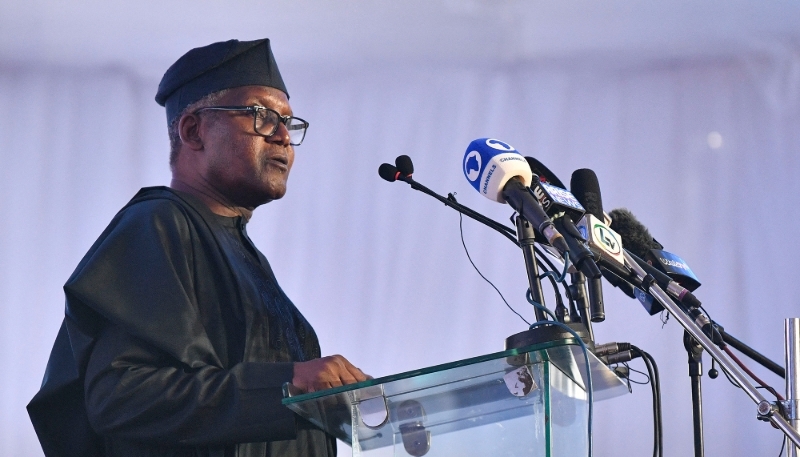

The Dangote Petroleum Refinery received ten cargoes of crude last month from the Nigerian National Petroleum Company Limited (NNPC), according to the owner of the facility and Africa’s richest man, Aliko Dangote.
- The Dangote Petroleum Refinery received ten crude cargoes from NNPC last month, a significant increase compared to previous months.
- This uptick in supply is crucial for Nigeria's efforts to boost domestic gasoline output amid global energy market instability.
- Despite the increase, the refinery still falls short of the 13 to 15 monthly cargoes needed to fully meet Nigeria's fuel requirements.
- Supply to the refinery has often remained at around five cargoes per month, and inconsistencies persist despite attempts to improve allocations.
This figure represents a major increase in crude supply to Africa’s largest refinery, as Nigeria cranks up attempts to boost domestic gasoline output, as war in the Middle East continues to weigh down the global energy market.
DON'T MISS THIS: Africa’s largest refinery drives $3.74 billion crude imports into Nigeria
Aliko Dangote acknowledged the increased deliveries, indicating a temporary improvement in feedstock supply at the world's largest single-train refinery, as seen on Bloomberg.
This development signifies that the facility will achieve an operational level more commensurate with Nigeria's fuel requirements, as the current supply aligns more closely with the metrics identified by David Bird, the company's Chief Executive Officer, as essential for reaching full refining capacity.
Back in March, the refinery's CEO, David Bird, identified inefficiencies in the naira-for-crude arrangement as a drag on profitability.
He stated that the refinery needed to receive 13 to 15 cargoes each month to meet national demand.
“What we see under that agreement, we should be getting about 13 to 15 cargoes a month. And that’s what we could process to meet the domestic fuel requirements of Nigeria.
Currently, we’re only getting five. So, that’s an underperformance against that pre-agreed volume contract,” David Bird stated.
![CEO of Dangote Refinery, David Bird during a media briefing [Source AriseNews YouTube]](https://ocdn.eu/pulscms/MDA_/b944c9df5f927f58d08eec354ff9f354.png)
Even with the increase, current supply levels, however, remain much below that threshold, frequently hovering around five cargoes outside of the March increase.
This disparity emphasizes the significance of constant crude allocations if the refinery is to fulfill its intended role in changing Nigeria's downstream industry.
Despite the March surge, uncertainty remains over crude supply to the plant.
According to previous reports, the NNPC has upped its cargo allocations from five to seven for May loading.
However, senior refinery officials informed The PUNCH that they were unable to confirm any such increase, indicating persistent communication and coordination issues.
The supply inconsistency comes at a critical time for Nigeria, which is working to stabilize its local gasoline market in the face of global oil volatility, especially tensions with Iran.
A consistent flow of crude is required for the refinery to continue production and satisfy local consumption.