Funding gaps still haunt Malawi
The United Nations (UN) says funding constraints remain a major limitation to the country’s commitment to the 2030 Agenda for Sustainable Development and its long-term development strategy, Malawi 2063 (MW2063). The UN’s Malawi’s 2026 Voluntary National Review update indicates that despite progress on 17 Sustainable Development Goals (SDGs), high public debt and heavy reliance on … The post Funding gaps still haunt Malawi appeared first on Nation Online.
 Black News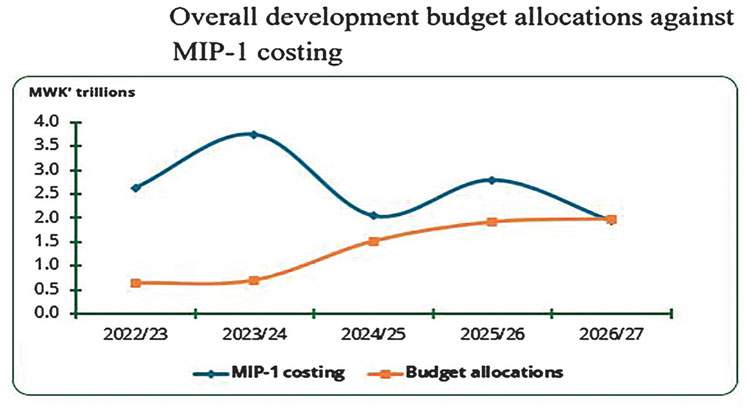
The United Nations (UN) says funding constraints remain a major limitation to the country’s commitment to the 2030 Agenda for Sustainable Development and its long-term development strategy, Malawi 2063 (MW2063).
The UN’s Malawi’s 2026 Voluntary National Review update indicates that despite progress on 17 Sustainable Development Goals (SDGs), high public debt and heavy reliance on external financing are limiting the Malawi Government’s ability to scale development programmes and respond effectively to shocks.
Prior to the review presentation in July, the UN concedes that while investments in social protection, infrastructure and resilience have delivered gains, their expansion is slowed by inadequate and unpredictable funding.
Reads the update in part: “Malawi has recorded notable progress across several SDGs, particularly in social and resilience-related sectors.
“Evidence also reveals progress in improving urban planning, housing regularisation, disaster preparedness and environmental management, including expanding land use planning frameworks, strengthening risk mapping and promoting urban greening initiatives.”
The update said that despite these gains, Malawi faces significant and persistent challenges.
From 2015 to date, progress across the 17 SDGs has been uneven and fragile, with some goals showing momentum while others stagnate or even regress.
The SDGs, which have a deadline of 2030, are designed to provide a universal call to action to end poverty, protect the planet and ensure that all people enjoy peace and prosperity by 2030.
Malawi began to domesticate the SDGs through the Malawi Growth and Development Strategy III and later in MW2063, currently being implemented under MW2063 First 10-year Implementation Plan (MIP-1).
Ironically, statutory obligations such as wages, debt interest, pensions have consumed an average of 94 percent of domestic revenue over the past four years, leaving minimal room for discretionary spending.
However, in 2026/27 fiscal year, this ratio is projected to decline to 78.9 percent, creating K1.36 trillion in new fiscal space, the most significant expansion in the MIP-1 era.
On the other hand, the development budget has recovered, rebounding from a collapse to 20.9 percent in 2025/26 to 30.9 percent in 2026/27, the highest share since MIP-1 began at a time the share of development budget financed by donors, has declined from 71.2 percent in 2025/26 to 59.9 percent in 2026/27, marking significant progress towards the threshold of 50 percent.
A joint analysis by the National Planning Commission and Economics Association of Malawi show that over the past five years, only 44 percent of the total funds needed to finance the MIP-1 interventions have been allocated, leaving a financial gap of K7 trillion.
“This, coupled with the misaligned allocations to MIP-1 priorities, has proven to be costly and has led to the underachievement of the MIP-1 target,” reads the analysis in part.
For instance, in 2022, the total estimated cost of MIP-1 implementation was about K2.5 trillion while only about K640 billion was allocated in the national budget for MIP-1-related interventions, representing an underfunding gap of about 80 percent during that period.
In an interview yesterday, Scotland-based Malawian economist Velli Nyirongo observed that underfunding slows progress, weakens key systems and makes it harder for Malawi to move from ambition to real transformation outlined in MW2063.
“Limited and unreliable funding slows down the pace at which key projects and reforms can be carried out,” he said.
The High-level Political Forum Secretariat, which meets under the auspices of the UN Economic and Social Council, is the main UN platform on sustainable development.
Malawi will be among 36 countries to present their voluntary national reviews to the UN High-level Political Forum on Sustainable Development in July 2026 in New York, USA.
The post Funding gaps still haunt Malawi appeared first on Nation Online.