AU, UN Express Concern over Tensions in Tigray, Urge Pretoria Agreement Implementation
The African Union and United Nation have urged the federal government and Tigray’s political leaders to use established mechanisms to address their differences, calling for the full implementation of the Pretoria Agreement. On Wednesday, Mahmoud Ali Youssouf, chair of the AU Commission, and UN Secretary-General Antonio Guterres convened the 10th AU-UN Annual Conference at AU […]
 Black News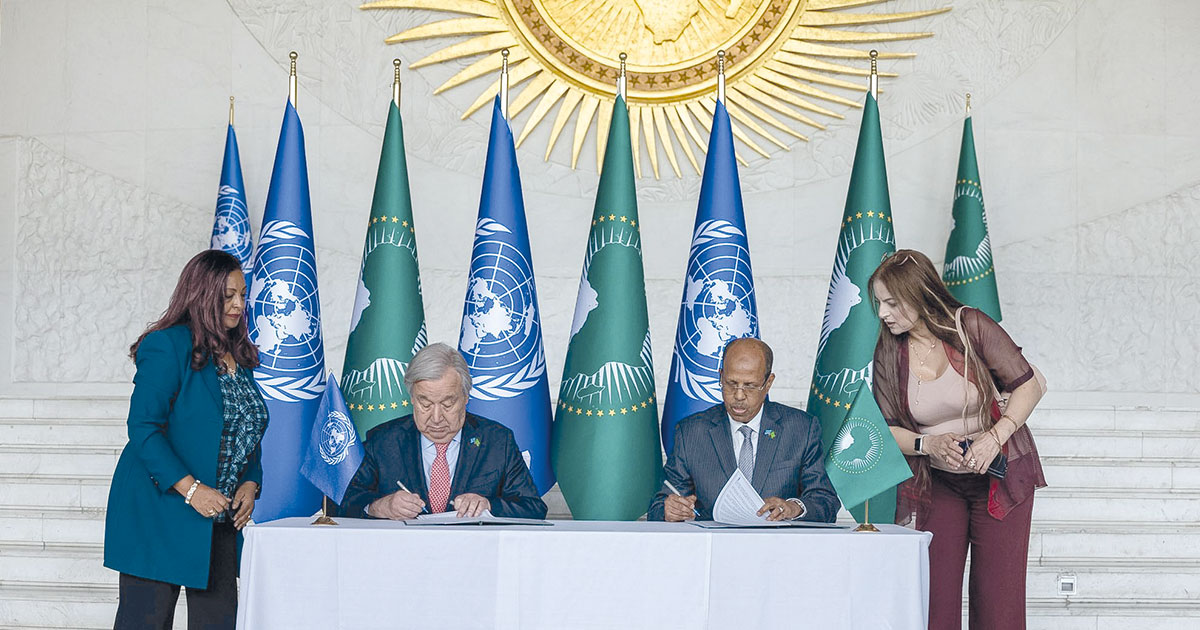
The African Union and United Nation have urged the federal government and Tigray’s political leaders to use established mechanisms to address their differences, calling for the full implementation of the Pretoria Agreement.
On Wednesday, Mahmoud Ali Youssouf, chair of the AU Commission, and UN Secretary-General Antonio Guterres convened the 10th AU-UN Annual Conference at AU headquarters in Addis Ababa. Following the meeting, which will be the last for outgoing Guterres, the two leaders issued a joint statement expressing concern over mounting tensions in Tigray.
On the Horn of Africa, Guterres and Youssouf “underscored the importance of the full implementation of the Cessation of Hostilities Agreement (CoHA – Pretoria Agreement) and called on the signatory parties to use the established mechanisms to address any disagreement. They also expressed concern regarding the increase of interstate tensions within the region and agreed to strengthen coordinated preventive action by both organizations,” according to the statement.
Relations between the signatories of the Pretoria Agreement signed in November 2022, ending the two-year northern war, have deteriorated markedly over the past two years. The Tigray People’s Liberation Front (TPLF) accuses the federal government of failing to see through terms relating to the return of internally displaced persons (IDPs) and the restoration of disputed territories. It has also accused federal officials of cutting off budgetary support and fuel supply to the region.
In turn, the federal government has accused TPLF of colluding with foreign entities, including Eritrea and the Sudanese military, in a bid to destabilize Ethiopia. Exactly a year ago, election officials revoked TPLF’s party license for “involvement in rebellion.”
The conditions have led to the exclusion of constituencies in Tigray from the seventh national election scheduled to take place in a couple of weeks, leaving Tigray’s administrative vacuum in deeper limbo.
Last month, the federal government extended Tadesse Werede’s term as head of the Pretoria Agreement-mandated Tigray Interim Administration (TIA) by a year. TPLF rejected the “unilateral” decision, and just a few weeks afterwards, it moved to reinstate the pre-war regional administration and elect its chairman, Debretsion Gebremichael (PhD), as president.
The friction in Tigray also has various implications for conflict, instability, and geopolitical alignment in the Horn of Africa and Gulf regions, analysts observe.
Earlier this month, the Ministry of Foreign Affairs issued a statement condemning TPLF alleged military cooperation with Eritrea and the Sudanese Armed Forces (SAF).
“The Sudanese armed forces have also provided arms and financial support to [TPLF] mercenaries, thereby facilitating their incursions along Ethiopia’s western frontier. The activities of TPLF mercenaries in Sudan are a matter of public record, and there is simple and credible evidence showing that Sudan is serving as a hub of various anti-Ethiopian forces. It is evident that these hostile actions, as well as the recent and earlier series of allegations by officials of Sudanese Armed Forces, are undertaken at the behest of external patrons seeking to advance their own nefarious agenda,” reads the statement.
TPLF has since denied the allegations.
This week’s statement from the AU and UN stressed coordinated efforts are critical to prevent a regional spillover of the Sudan conflict, which is now in its third year.
Guterres and Youssouf called upon Sudan’s conflict parties “to place the supreme interests of the Sudanese people at the forefront and to engage constructively in efforts aimed at achieving peace. In this regard, they underscored the importance of revitalizing an inclusive inter-Sudanese dialogue, rooted in reconciliation and aimed at fostering the conditions for a consensual political solution through the facilitation efforts of the Quintet. They further agreed to strengthen coordinated regional and international peace efforts in order to prevent further regional spillover and reaffirmed their commitment to continue working together, including within the Quintet framework, towards a swift, peaceful and sustainable resolution of the conflict.”
They also welcomed the appeal made by leading Sudanese civilian actors during the Third International Sudan Conference, held in Berlin, Germany, last month, calling for de-escalation and an end to the conflict.
The two chiefs underscored the primacy of political solutions to conflicts across Africa, as well as the need for predictable, sustainable, and adequate financing for AU-led peace support operations, including through the implementation the UN Security Council Resolution 2719 (2023) on a case-by-case basis.