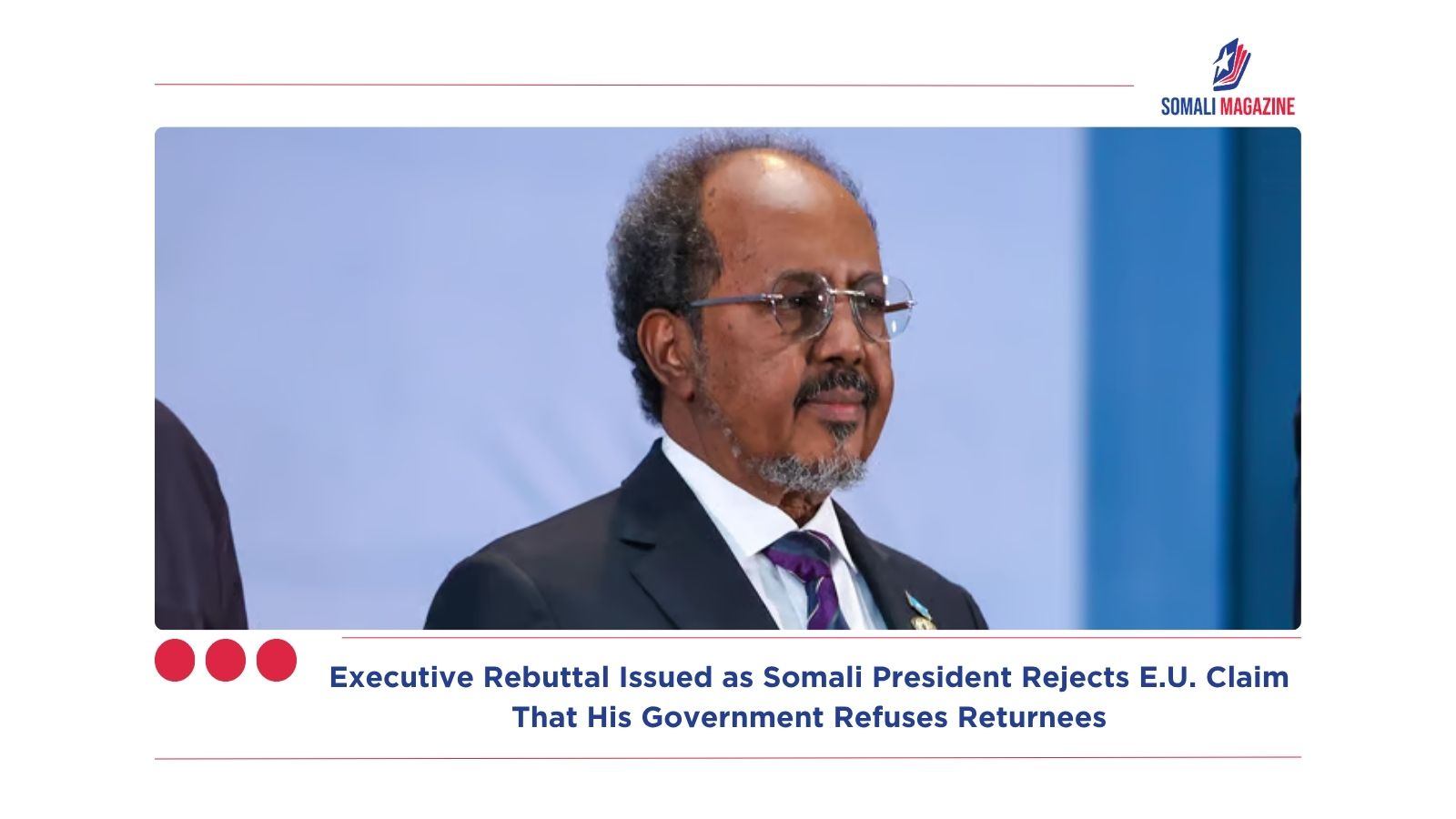
Somali President rejects E.U. claim that his government refuses returnees following a highly controversial decision by the European Council to temporarily freeze standard consular benefits for passport holders from the Horn of Africa. Speaking from the capital city of Mogadishu during an emergency address to state ministers and national security teams, President Hassan Sheikh Mohamud strongly criticized the multi-layered European Council visa restrictions, describing the underlying assessment of state performance as an inaccurate and unfair portrayal of the country’s ongoing compliance efforts. Federal executive leaders maintain that the central government has consistently acted in good faith regarding international migration management, actively facilitating voluntary repatriation programs while navigating profound local security, humanitarian, and economic headwinds. The presidency’s formal counter-argument suggests that the severe administrative sanctions completely mischaracterize complex logistical delays as deliberate institutional non-cooperation, ignoring the practical challenges of safely integrating returning citizens into a post-conflict society.
The escalating diplomatic dispute erupted immediately after the European body finalized a sweeping policy update aimed at exerting major systemic leverage against non-compliant states of origin. Following a comprehensive administrative review, European authorities unilaterally suspended multiple-entry allocations, introduced mandatory processing fees for high-ranking government officials holding service or diplomatic credentials, and tripled standard processing timelines to forty-five calendar days. European policy advocates aggressively defended the stringent measures, arguing that irregular arrivals from the East African nation had more than doubled over the past twelve months, largely driven by transnational human smuggling networks operating across unregulated continental border corridors. While Brussels insists that these targeted constraints are explicitly intended to encourage immediate structural reforms in Mogadishu’s civil registries, local authorities counter that top-down diplomatic ultimatums fundamentally undermine years of highly collaborative, mutually beneficial strategic partnerships built between the two regions.
To formally address the escalating impasse, federal administrative offices are preparing a comprehensive policy brief detailing the country’s documented participation in verified bilateral readmission frameworks. Internal ministry sources reveal that state agencies intend to demonstrate that thousands of individuals have been safely repatriated through structured, legal channels, completely contradicting the strict narrative pushed by European migration enforcement departments. Furthermore, Somali foreign service leaders warn that the sudden implementation of rigid diplomatic processing protocols will disproportionately penalize legitimate business professionals, technical specialists, and students requiring routine international mobility. As both executive teams position themselves for high-stakes renegotiations, prominent regional analysts warn that a prolonged breakdown in institutional trust could severely complicate broader international security agreements. For now, the executive branch remains firmly resolved to contest the European declaration, asserting that meaningful migration resolution requires comprehensive support rather than unilateral punitive measures.


 Black News