Kibo’s compendium of Kwengletarianism
Kwengletaria:Ragamyff — As UK rap’s latest prodigious MC announces his most ambitious project to date, Rob Kazandjian spends time with Kibo in a north London pub to chat about his rise, as well as the inspirations and ideologies underpinning his music.
 Black News
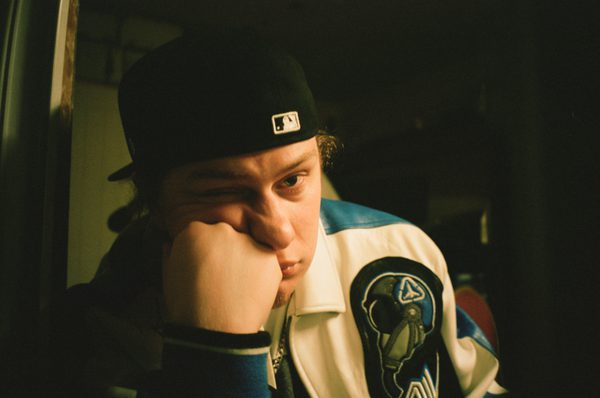
Kwengletaria:Ragamyff — As UK rap’s latest prodigious MC announces his most ambitious project to date, Rob Kazandjian spends time with Kibo in a north London pub to chat about his rise, as well as the inspirations and ideologies underpinning his music.
“You’re not imagining you’re somewhere else,” Kibo says, espousing the tenets of the homebrewed philosophy that informs his upcoming project – Kwengletaria:Ragamyff – while perched on a barstool, his pint glowing amber like a liquid lightbulb on the table between us. “You’re just injecting something into the place where you are to make it feel more interesting. You’re drawing mythology out of mundanity. I feel like that’s Key Stage One of Kwengletarianism,” the charismatic MC adds, before taking a contemplative sip of lager.
The Crown Pub in Cricklewood, where we meet is, to be fair, pretty interesting. With a history that dates back to 1751, it was rebuilt in striking red sandstone in 1899. Inside there are ornate ceilings, a suggestively curved bar, and mirrors on the walls etched with birds and flowers that come to life in the evening light. It was a focal point for the area’s Irish community in the mid-20th century. The exploits of the Irish labourers who gathered outside The Crown Pub every morning in the hope of picking up casual work and returned in the evening to enjoy the fruits of their graft is immortalised in a ballad called McAlpine’s Fusiliers, where there were “glasses flyin’ and biddies cryin’.”
Today, though, the pub is in a post-St Patrick’s day stupor; special green-and-white menus lay discarded on tables like forgotten funeral programs and the only Guinness left on the premises is canned. The gaff is empty, but for some workmen clanging metal pipes about and an old boy in a wooly hat nursing a pint of ale. Then there’s Kibo, who’s of Irish heritage himself and vaguely hungover, holding court in a pair of Iceberg jeans and a blood-red Avirex jacket that gives him the frame of a Megazord from Power Rangers. “Kwengletarianism is rooting escapism in your environment,” he continues, clearly on a roll. “So you’re not disassociating from a place to go to fucking Asgard. You’re injecting a level of fantasy into your reality to unlock your own Kwengletaria. The closest synonym to Kwengletaria is paradise. And everyone has their own idea of what paradise is.”
Read next: Wu-Tang Clan forever, and ever
Since emerging on a murky balcony overlooking the London borough of Harrow a decade ago and freestyling over the Pingu theme, Kibo has grown into underground UK rap’s digital shaman, taking the boundlessness he discovered as a schoolboy surfing the internet and applying it to music. He lays verses like larger-than-life comic strips over kaleidoscopic rap-and-grime adjacent beats; you might find him nutmegging Lionel Messi before ziplining into the party and then leaving with two bedazzling women to make a “buff ting sandwich”. On Kwengletaria:Ragamyff, the abstract absurdity of his writing blossoms into full blown magic realism, the action unfolding over productions that draw on everything from mellow grime and RnG to Makina and euphoric EDM. Here, he falls from the sky in a Gundam suit into a reimagined Harrow of chip shop palaces, enchanted park benches and Bakerloo dragons, where the off license glows like Valhalla, angels wield steel chairs like WWE superstars in raves, wings burst forth from holes poked in tracksuits and the skyline glitters with constellations of red stars.
With only two previous projects to his name — the cult classic, 2022’s FBFR: Fuego Baby Furtado Returnz! (Sorry 4 Da Longness) and 2017’s End64, squirrelled away on SoundCloud like a rare Pokémon – Kibo is arguably more renowned for his status as a bonafide setmaster, the “Victory Lap Grim Reaper”, a rambunctious MC capable of summoning a barrage of gun fingers in a live setting by simply standing still and striking his signature “showerman pose”. He’s had Dave call him “superhuman” and JME & Skepta have demanded reloads during a cypher. In this fast food era of UK rap where virality offers artists an expressway to success, however brief, he’s enjoyed a string of such moments, but has chosen a slower path. “Too many man wanna chat about motion / How many of you man can stay still?” Kibo asks over a soulful soundscape co-produced by mellow grime wizard Wilfred on ‘Chancer’, the second single from Kwengletaria:Ragamyff.
“It’s easy to roll downhill,” he says. “When everything is pushing you in a certain direction, it’s very easy to just go with it. It’s a lot more difficult to actually stop and say: yeah, this is the fastest way there, but is that even where I’m going?” The stillness of the “showerman pose” amidst the joyful chaos of a TravsPresents set or on the Big Smoke Festival stage has become emblematic of his career in general. “I had so many opportunities where everyone said, ‘you need to capitalise!’ Those moments pushed me into that stillness. I took time to stop and think. Like: what is the point of it?” he muses. “I’ve been doing this since I was a teenager. I’m not just gonna decide to take this waterslide now because it gets to the bottom the fastest. Maybe I don’t want to be at the bottom. Maybe I want to do a couple loop-the-loops, you know? I had to stop and pick my waterslide. I probably wouldn’t have made this project if I hadn’t,” he adds, his tone more serious. “I decided I’m gonna lay the foundations upon which I can do whatever the fuck I want for the rest of my career. I wanted to establish the first chapter of everything.”
Read next: POZER: “Music was like an anchor”

“I’ve never heard someone say they’re excited to be from Wealdstone until I started screaming it. It’s empowering. It shows you that you can be from anywhere and do something meaningful, and put it on your back.”
Kwengletaria is Kibo’s origin story, and Harrow is central to it; a place he describes as being on “the elbow” of London, with a musical history that ranges from the sublime, in Jai Paul, to the ridiculous, in Peter Andre, divided between swathes of leafy suburbia and areas where “you’ve got to turn your music down a bit and keep your wits about you.” Hailing from HA3 (his postcode) is something Kibo’s immensely proud of, but his career has run parallel to the rise and splintering of the UK drill scene, and he’s aware of the complexity attached to flying your manor’s flag. “Rap music is so territorial, and I think that’s a good thing. It’s the genre where the place you’re from means the most. I think that’s a powerful thing,” he explains. “But in recent times, especially in London, the way that music culture and life in general has moved, repping your ends is a loaded thing.”
The way of living Kwengletarianism, Kibo explains, is that “you can be him, or her, or them. You can be the guy. But it doesn’t stop everyone else from being the guy, too. They’re just their own guy.” So, his approach as a Harrow bannerman is an antidote to the misconception that championing your neighbourhood involves denigrating somewhere else; it comes from pure reverence for the only place he’s ever known. “It’s been cool to make this project because it’s completely removed from that bullshit,” he says, frankly. “I’m talking about where I’m from because I live there, my dad grew up there and went to the same school as me, my grandad moved there. I’m third generation HA3. I’m deep in there. It’s everything I am.” With no significant rap lineage to speak of, Kibo is a pathfinder for the enclave, his music the sonic equivalent to a cave painting or carving HA3 into a tree trunk. It says: we were here, too. “I rep this place because people come up to me, and they’re like, ‘I’m from Harrow. I’m from HA3. I’m from HA4.’ I’ve never heard someone say they’re excited to be from Wealdstone [Kibo’s locality] until I started screaming it,” he says, passionately. “It’s empowering. It shows you that you can be from anywhere and do something meaningful, and put it on your back.”
With its location on London’s north west periphery, Harrow gave Kibo the opportunity to experience the hectic buzz of the city but also “log off” when he needed to decompress. The core of Kwengletarianism, he says, like Aristotle describing the Golden Mean, “exists in the middle of a Yin and Yang between the kweffiness [shenanigans] and the cotch [downtime].” Essentially, it’s a philosophy of balance that informs Kwengletaria:Ragamyff. “The first thing I came up with for the project was a colour scheme,” he reveals. “There were two colours: light blue and this weird off-white. They were the colours of the sky between half three and half six when I was coming home from school, and also the colours of the first computer I ever had. That created this juxtaposition between the most outside I’d been as a kid, and the most inside. I relate that to the happiest times of my life, taking in the outside by being outside, and then taking in the outside through the internet. That became the original dichotomy of the project.”
Kibo was granted a precious hour of internet time after school on that first computer, tucked away in a corner next to the back door of his family home. “I’d be on the Digimon or Dragonball Z or Naruto Wiki page, stuffing my face with the internet, putting imagination ammunition in my brain,” he remembers, the warmth of the memory radiating in his smile. “And then I’d go out into the garden. My mam used to say I’d be ‘off zappin’ aliens’. I was just living in that world. That’s the earliest version of Kwengletarianism. I’m doing the same thing. That’s the project, right there. For me, fantasy and imagination is just me repurposing the stuff that inspired me as a kid.”
Holding that formative period in his mind, Kibo felt compelled to tell his coming-of-age tale, illuminated by a rolodex of personal childhood references, from shiny Dragonite Pokemon cards and Gundam battle suits to the Heartbreak Kid Shawn Michaels, Dizzee Rascal and Harry Redknapp. Each of the tracks on Kwengletaria:Ragamyff feels sonically distinct, capturing a specific feeling or moment, with Kibo co-producing across the project. The frivolous optimism of opener ‘Headside In Da Skiez (Babysham Supernova)’ is tinted with UK garage. ‘ShubzOnline’ is a 160BPM adrenaline-and-cognac soaked drill-Makina hybrid. While the claustrophobic mood of ‘Parrow On Da Hill’ is amplified by a warped rap production. “I wrote the project like a soundtrack to a film that doesn’t exist. Like, I needed a song for each scene. And I was building soundscapes around how we traverse each of those moments,” he explains. “Because it’s so rooted in my upbringing and me growing up as a young person, a lot of it is going back to those soundscapes. It sounds like this place, or this time in my life, or these colours. It’s the story of how I figured everything out. I didn’t figure this stuff out by sitting on a mountain and crossing my legs. It took having the space to create and make music. I figured this shit out in my homie’s shed, at the radio station, at the afters.”
The payoff, that moment of discovery in the narrative arc, arrives on ‘Iridescence’. “It’s one of the best songs I’ve ever made.” Kibo says, unequivocally. “I love that song.” It feels like a drug that hasn’t been invented yet, a double drop of beautiful, undiluted euphoria, where the barrier between fantasy and reality melts away amidst the strobe lights and white smoke of the club. “I pree a beacon, I can see the other side,” he raps in a half whisper over celestial synths, before the drums rush through like a racing heartbeat. “In that moment, I don’t really understand my relationship with my environment and my lifestyle. It feels like the only thing I know and it’s become my career. But at the same time it feels destructive and exhausting,” he says, reflecting on the song’s meaning. “And then in the stillness I realise I’m focusing on the wrong elements of it. ‘Iridescence’ is the moment of being out and focusing on the part that matters. It’s that feeling of connection you get with the music, with the people around you, and with yourself.”

“I didn’t figure this stuff out by sitting on a mountain and crossing my legs. It took having the space to create and make music. I figured this shit out in my homie’s shed, at the radio station, at the afters.”
That feeling of connection is the heartbeat of Kwengletaria:Ragamyff. On the project, Kibo has established a livewire between the now and his inner child. With that comes the freedom to be the fullest, most extravagant version of himself. It means that as Kwengletaria:Ragamyff enters its final act, he can rap about riding the underground to paradise on ‘Bakerloo Dragon’ or capturing the mist in the palm of his hand on ‘Red Starz’ with such unselfconscious, vivid clarity that it feels real.
“I realise that this is why I do it, this feeling,” he continues, on a roll again, fireworks going off behind his eyes. “All the other bullshit is just the sprinkles. It doesn’t matter. This feeling is the pudding right here.”
Kwenglateria:Ragamyff is out July 3.
Rob Kazandjian is a freelance writer and host of Huck’s Hard Feelings column on masculinity and fartherhood.
Buy your copy of Huck 83 here.
Enjoyed this article? Follow Huck on Instagram and sign up to our newsletter for more from the cutting edge of sport, music and counterculture.
Support stories like this by becoming a member of Club Huck.