From Shanghai to Africa: Inside the Growing Push to Make Smartphones Affordable for Millions
On 24 June 2026, at MWC Shanghai, GSMA Africa and Invictus Global Media Group convened the Digital Africa Summit Roundtable on Smartphone Affordability as a Gateway to the Digital ......
 Black News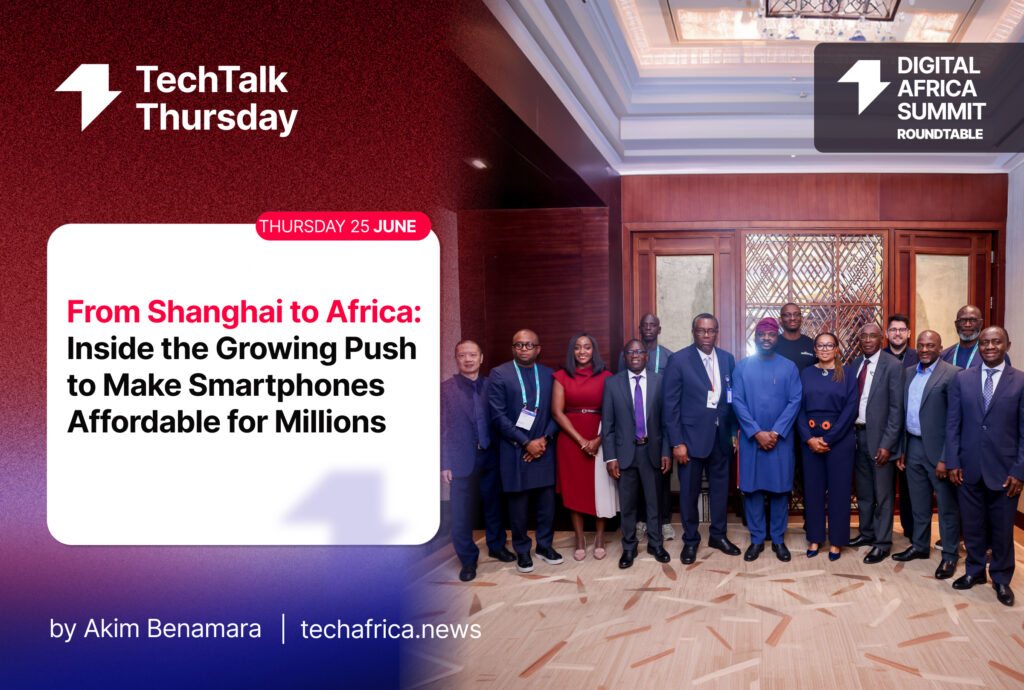
On 24 June 2026, at MWC Shanghai, GSMA Africa and Invictus Global Media Group convened the Digital Africa Summit Roundtable on Smartphone Affordability as a Gateway to the Digital World. Shanghai was a deliberate choice. It is home to some of the world’s largest device manufacturers, the source of chipsets, the start of the supply chain. Bringing Africa’s affordability crisis into that room placed the problem directly in front of the people best positioned to solve it. TechAfrica News was present as official media partner.
The scale of the challenge is by now well documented. Sixty-three percent of Africans live within range of mobile broadband but remain offline. For the lowest-income households, a smartphone can cost the equivalent of up to 80% of monthly earnings. Device-related duties costed the an estimated $20 billion in 2025 alone. Networks have been built. Coverage has expanded. What has not kept pace is access to the device itself.
GSMA Africa has made smartphone affordability a central pillar of its policy agenda for the continent. Through direct government engagement on device taxation, financing models and market regulation, it has pressed consistently for the structural changes needed to bring device prices within reach of low-income consumers. The GSMA Handset Affordability Coalition, which brings together mobile operators, device manufacturers and ecosystem partners behind the shared target of affordable 4G smartphone across Africa, is one of the most concrete expressions of that push.
The roundtable in Shanghai was yet another step in moving from data and advocacy to commitments.
Nigeria steps forward
One of the most direct interventions at the roundtable came from Chief Idris Ibikunle Olorunnimbe, Chairman of the Nigerian Communications Commission.
Nigeria, he noted, is the largest mobile market on the continent. More than 170 million mobile connections. Over 150 million Nigerians on mobile internet. The networks are there. The coverage is there. And yet, by the GSMA’s own surveys, the primary barrier keeping Nigerians offline is neither data pricing nor infrastructure. It is the price of the smartphone.
He was candid about the grey market. In Nigeria it is large, and in his framing, it is a symptom long before it is a crime. When formally approved devices are priced out of reach by foreign-exchange volatility, import duties and thin distribution, people buy whatever they can find. Enforcement is not the answer in isolation. The conditions that drive buyers to grey channels have to be addressed first.
The infrastructure to tackle the problem at scale already exists. The GSMA operates a central Device Registry, a global database that tracks the status of mobile devices using their unique IMEI identifiers, enabling the mobile ecosystem to assign, understand and check the status of devices in use across the world’s networks. The registry maintains a block list of IMEIs reported as lost, stolen or otherwise unsuitable for use, which operators can share across borders to deny those devices service on any participating network. Critically, African carriers that do not yet enforce the registry create a regional asymmetry that effectively makes the continent an export market for blacklisted devices, a gap that closing would directly reduce the flow of stolen and counterfeit handsets into African markets.
The NCC is building its national layer on top of that foundation. Its Type Approval Regulations, refreshed in 2024, set clear benchmarks for device safety, radio performance and network compatibility. A Device Management System in development will strengthen Nigeria’s ability to identify stolen, cloned and non-type-approved handsets and connect that data to the broader regional picture. The aim is a formal device market credible enough that consumers choose it.
But the core of Chief Olorunnimbe’s argument was about production. Nigeria cannot import its way out of the affordability problem. When a device is built with Nigerian raw materials and Nigerian labour, more of its cost is priced in Naira.
“Now let me turn to the heart of what I came to say. We will not solve affordability at scale by importing our way out of it. We have to make more of the phone here, at home. The logic is simple. When a device is built in Nigeria, more of its cost is denominated in Naira. It stops rising and falling with every move in forex. That is how you take the volatility out of the price, bring the price down, and keep it down.”
– Chief Idris Ibikunle Olorunnimbe, Chairman, the Nigerian Communications Commission.
He acknowledged Nigeria’s previous attempts at local manufacturing and was direct about why most fell short: quality. The target is not a locally made phone that asks consumers to settle for less. It is a phone that matches imported devices on quality and beats them on price.
Then came the offer. Any manufacturer willing to commit to building a smartphone factory in Nigeria, with construction beginning before November 2026, the government is committed to providing support in the form of incentives to encourage and sustain such investments in Nigeria. Whatever was needed to get the facility operational, he said, they would pursue together.
On financing, he was equally specific. The NCC has challenged financial institutions, licensed credit bureaux, mobile operators and technology partners to build a trusted device financing framework with local nuances that would thrive in the country. Airtel, MTN and CREDICORP already have device-on-credit schemes running. What is needed now is scale: a Nigerian walks in, pays a modest deposit, takes home a quality 4G phone, and clears the balance over six or twelve months. That, he argued, is how tens of millions of people cross from a feature phone to 4G and into the digital economy.
“One of the most striking moments of the roundtable came from Chairman Olorunnimbe of the NCC. He made a direct offer to the table: any manufacturer willing to commit to building a smartphone factory in Nigeria will have the full support of government, through incentives designed to motivate and sustain that investment. He also made the case for practical device financing strategy. That framing, paired with political goodwill, is exactly the kind of concrete, country-level commitment this conversation needs.”
-Angela Wamola, Head of Africa, GSMA
Kenya connects the dots to AI
Stephen Isaboke EBS, Principal Secretary for Broadcasting and Telecommunications, Ministry of Information, Communications & The Digital Economy, Kenya, extended the frame. Affordability is not a standalone access issue in Kenya’s view. It sits at the foundation of a broader national strategy, and the link to Kenya’s AI policy, currently under development is direct. A population priced out of smartphone access cannot meaningfully participate in an AI-enabled economy. The device is not the end goal. It is the entry point.
“Kenya’s perspective reinforced a point that resonates across the continent. The Principal Secretary affirmed that affordability is a critical national strategy and notably, Kenya is currently developing its AI policy. That linkage matters: you cannot build an AI-enabled digital economy on top of a population that cannot afford the device in their hand. Getting smartphone affordability right is not a precursor to the digital economy. It is the digital economy.”
–Caroline Mbugua HSC MBA, Senior Director, Public Policy and Communications, Africa, GSMA
A framework for what comes next
Chief Olorunnimbe closed with a call to collective action. Build the device registries. Share stolen and counterfeit device data across African borders. Harmonise type approval so that a handset certified in one market is trusted in the next. And pair every device strategy with a financing strategy, because a cheaper phone that a consumer still cannot pay for on the day has not solved the problem.
This edition of the Digital Africa Summit Roundtable brought those commitments to life through the voices of the leaders in the room: Chief Idris Ibikunle Olorunnimbe, Chairman of the Nigerian Communications Commission; Stephen Isaboke EBS, Principal Secretary for Broadcasting and Telecommunications, Ministry of Information, Communications & The Digital Economy, Kenya, Kenya; Tobechukwu Okigbo, Chief Corporate Services and Sustainability Officer, MTN Nigeria; Silavwe Evans, CEO, Infratel Corporation; Barthé Ntshabali, Senior Policy Manager, Central Africa, GSMA; and under the leadership of Angela Wamola, Head of Africa, and Caroline Mbugua, Senior Director, Public Policy and Communications, Africa, both of the GSMA.
That framing captures what the Digital Africa Summit is built to do. It is not a conference. It is a convergence point, bringing African policymakers, regulators and industry leaders into direct dialogue with the global partners, investors and manufacturers who hold part of the answer. Each edition moves the conversation from the continental to the concrete, from shared diagnosis to named commitments.
“Smartphone affordability in Africa is not an individual market problem, it requires everyone in the room. Manufacturers, regulators, policymakers, investors and operators all hold a piece of the solution. Shanghai proved that when you put the right people together, the conversation moves from diagnosis to commitment.”
-Akim Benmara, Founder and CEO, Invictus Global Media Group
Coming out of Shanghai, GSMA Africa is calling on African governments to make smartphone affordability a policy priority: reducing device costs through taxation reform, providing the incentives needed to attract manufacturing investment, prioritising digital literacy, and pairing every national AI strategy with a credible smartphone affordability strategy. One cannot succeed without the other.