How a Shs 1tn Stanbic fund is turning students into entrepreneurs
Uganda’s largest commercial bank has unveiled a Shs 1 trillion financing package targeting women, youth, and farmers, a massive capital injection designed to expand small-scale enterprises and create jobs nationwide. The three-year initiative, dubbed the Positive Impact Agenda, commits Stanbic Bank Uganda to mobilizing the funds by 2028 through strategic partnerships. Chief Executive Officer Kenneth […] The post How a Shs 1tn Stanbic fund is turning students into entrepreneurs appeared first on The Observer Media Ltd.
 Black News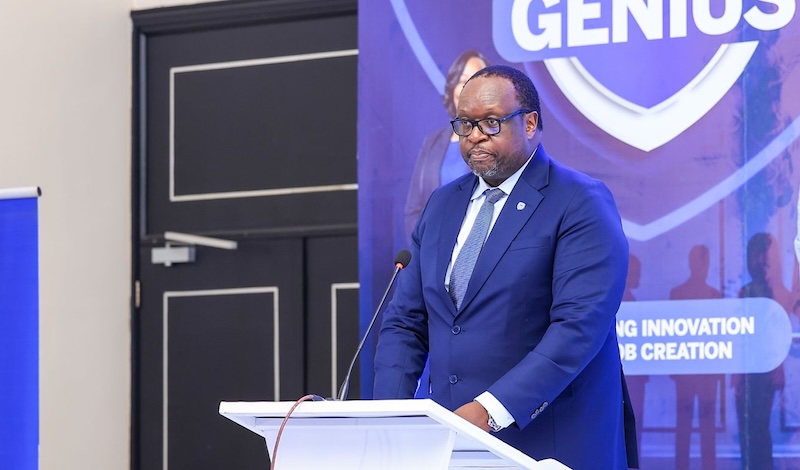


Uganda’s largest commercial bank has unveiled a Shs 1 trillion financing package targeting women, youth, and farmers, a massive capital injection designed to expand small-scale enterprises and create jobs nationwide.
The three-year initiative, dubbed the Positive Impact Agenda, commits Stanbic Bank Uganda to mobilizing the funds by 2028 through strategic partnerships.
Chief Executive Officer Kenneth Mumba Kalifungwa announced the commitment during the grand finale of the 11th Stanbic National Schools Championship at Mestil Hotel in Kampala, where Sedes Sapientiae Academiae Secondary School, Rushere, was crowned the 2026 national champion.
The Shs 1 trillion mobilization marks a pivotal shift in how private capital aligns with national development targets. Uganda is attempting to expand its economic output tenfold, growing from approximately $50 billion to $500 billion by 2040.
Achieving that target requires shifting credit away from pure consumption toward productive sectors capable of absorbing thousands of young job seekers entering the labour market each year.
Under its current strategy, Stanbic maintains Shs 5.3 trillion in active lending in Uganda, with over Shs 1 trillion currently deployed directly into agriculture, manufacturing, science, and mining.
The bank now intends to increase the share of its total loan portfolio dedicated to these primary growth sectors from the current 20 per cent to 32 per cent by 2029.
By funnelling fresh capital into financial inclusion, climate resilience, and enterprise development, the strategy seeks to turn informal rural and youth-led activities into viable commercial businesses.
For ordinary Ugandans, particularly young people, women, and smallholder farmers, the initiative expands access to commercial credit, a barrier that has long hindered small business growth.
The practical intent of this capital pipeline was on full display at the National Schools Championship, which operated under the theme “Flex Your Genius”.
The competition challenged secondary school students to move beyond the traditional mindset of studying solely to seek employment, encouraging them instead to build practical commercial enterprises that solve local community problems.
This year’s finalists, selected from over 500 schools nationwide, presented prototype solutions addressing critical national challenges, including smart solar irrigation, agricultural mechanisation, plastic waste recycling, post-harvest crop preservation, food processing, and waste management.
Sedes Sapientiae Academiae took top honors ahead of seven other regional finalists, including Aga Khan High School, Bishop Dunstan Nsubuga Memorial Secondary School, St Kizito High School Namugongo, Iganga Secondary School, Kakira Secondary School, St Theresa Girls Secondary School Nsenyi, and Kyebambe Girls Secondary School.
Government and private sector leaders highlighted how these youth-led innovations bridge the gap between classroom theory and economic reality. Sarah Kagingo, vice chairperson of the Private Sector Foundation Uganda, urged students to build sustainable enterprises that turn local problems into employment.
Chief guest Eng. Jonard Asiimwe Akiiki, Minister for Science, Technology and Innovation, reminded participants that Uganda’s future economy will depend on the skills and ideas of its people, not raw natural resources alone.
Meanwhile, Ministry of Education and Sports Commissioner for Secondary Education Juliet Muzoora noted that the championship validates the national competency-based curriculum by showing that learners from all regions, including hard-to-reach areas, can develop practical financial and entrepreneurial skills with structured support.
As Stanbic enters its 35th year of operation in Uganda, the bank will roll out its Shs 1 trillion mobilization framework alongside its expanded sectoral lending targets, while championship finalists move on to refine their enterprise models for commercial deployment.
The post How a Shs 1tn Stanbic fund is turning students into entrepreneurs appeared first on The Observer Media Ltd.