
Nigerian billionaire says Dangote refinery ended Africa’s “economic slavery”
For decades, Africa’s biggest oil producer imported most of its fuel like a country without crude oil. Now, Nigerian billionaire Femi Otedola says the man who finally changed that reality is Aliko Dangote.
 Black News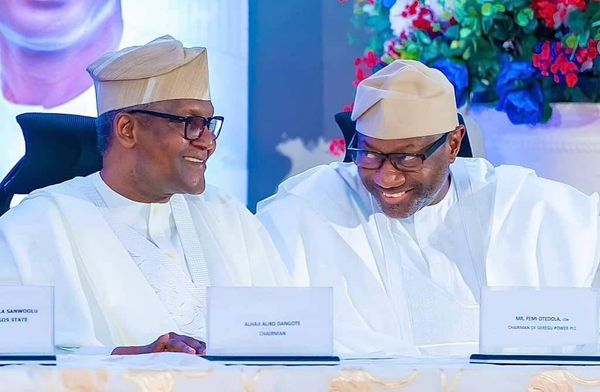

For decades, Africa’s biggest oil producer imported most of its fuel like a country without crude oil. Now, Nigerian billionaire Femi Otedola says the man who finally changed that reality is Aliko Dangote.
- Femi Otedola has described Aliko Dangote’s refinery as one of the most important industrial projects in Africa’s history.
- The billionaire said Nigeria’s dependence on imported fuel amounted to “economic slavery” despite decades of oil wealth.
- His comments come as the Dangote refinery transforms regional fuel trade, cuts imports and deepens a fierce battle over market dominance.
- The remarks also reopen debate over Nigeria’s failed state refineries and years of policy reversals that scared away industrial investment.
Speaking during a visit by executives of First HoldCo to the sprawling Dangote refinery and fertiliser complex in Lagos, Otedola described the project as a historic industrial breakthrough that rescued Nigeria and Africa from what he called “economic slavery.”
“What you’ve done is you’ve delivered us from economic slavery in Africa,” Otedola told Dangote.
The remark goes beyond praise between two billionaires.
It reflects a deeper shift underway in Nigeria’s economy as the 650,000-barrels-per-day refinery, Africa’s largest, begins altering fuel trade patterns, foreign exchange demand and industrial power dynamics across the continent.
For years, Nigeria’s fuel dependence symbolised one of the biggest contradictions in global energy markets: a major crude exporter spending billions of dollars importing petrol because its state-owned refineries barely functioned.
Successive governments spent enormous sums attempting to revive refineries in Port Harcourt, Warri and Kaduna, yet the facilities remained largely dormant. Lawmakers have repeatedly launched probes into billions of dollars spent on refinery rehabilitation with little visible output.
That failure created a massive import market controlled by traders, middlemen and fuel importers for decades.
Dangote’s refinery is now disrupting that structure.
DON'T MISS THIS: Why Otedola sold Geregu shares to bet big on Dangote’s $20bn refinery
The refinery changing Africa’s fuel market
The refinery, estimated to have cost around $20 billion, began large-scale operations in 2024 after years of delays and financing pressure.
Since then, Nigeria’s petrol imports have dropped sharply, while exports of refined products to African countries have increased.
Recent industry data showed Nigeria’s dependence on imported petrol falling to some of its lowest levels in years as the refinery ramped up production capacity.
Dangote has also expanded exports beyond Nigeria, supplying fuel to countries across West, Central and East Africa amid global supply disruptions linked to Middle East tensions.
The refinery’s growing influence is now so significant that it is increasingly shaping pricing conversations, import policies and competition across Nigeria’s downstream oil sector.
Otedola suggested the project represented the type of industrial ambition Nigeria repeatedly failed to protect.
“In Nigeria today, we should be watching CNN and saying the largest refinery in the world is in Nigeria,” he said.
He also described the refinery, the Dangote fertiliser plant and Eko Atlantic as projects capable of redefining Nigeria’s global image.
“Visionless people destroyed it”
Otedola also revisited one of Nigeria’s most controversial privatisation reversals.
The billionaire disclosed that he partnered with Dangote in 2007 to acquire government-owned refinery assets before the deal was later cancelled.
“In 2007, I teamed up with Aliko and we acquired the refineries. I had a 20 per cent stake,” he said.
“Unfortunately, a team of visionless people destroyed it.”
The deal, initially approved under former President Olusegun Obasanjo, was later reversed during the administration of late President Umaru Musa Yar’Adua after resistance from labour unions and political groups.
Nearly 20 years later, the same refineries remain among Nigeria’s most expensive industrial failures.
The contrast between those collapsed state assets and Dangote’s privately financed refinery has become central to Nigeria’s broader economic debate: whether Africa’s largest economy should aggressively protect local industrial champions or prioritise open competition regardless of scale.
That debate has intensified in recent months.
Monopoly fears grow as refinery gains power
As Dangote refinery expands, so have concerns about market concentration.
The refinery has repeatedly pushed regulators to restrict fuel imports and prioritise locally refined petroleum products. Dangote argues that continued import licences undermine domestic refining and discourage investment.
But the position has triggered backlash from fuel marketers, importers and even the state-owned oil company, NNPC.
In court filings this week, NNPC accused the refinery of attempting to dominate Nigeria’s fuel market through legal action aimed at challenging import licences issued to rival marketers.
Fuel marketers have also warned that limiting imports could weaken competition and create supply risks if the market becomes too dependent on a single supplier.
Still, supporters of the refinery argue that Nigeria cannot industrialise while relying heavily on imported refined products despite its vast crude oil reserves.
That argument increasingly resonates beyond Nigeria.
Dangote recently revealed that investor demand for the refinery’s planned public listing has already crossed billions of dollars, underscoring growing confidence in the project’s long-term influence on African energy markets.
For many investors and policymakers, the refinery is no longer just a business story.
It has become a test case for whether Africa can finally build, and sustain, industrial projects powerful enough to reshape global trade flows instead of merely exporting raw materials.













![Taylor Polidore Williams Says Indie Film ‘HPV: Her Pretty Vagina’ Is Bigger Than Entertainment: ‘I Knew It Was A Necessary Conversation’ [Exclusive]](https://bossip.com/wp-content/uploads/sites/28/2026/05/17794757122146.jpg?quality=80&strip=all&w=1024&crop=0,0,100,683px#)