Nigeria’s Trade Policy 2023–2027: A Roadmap for Economic Transformation
Nigeria’s Trade Policy 2023–2027 (TPN), developed by the Federal Ministry of Industry, Trade and Investment, is a comprehensive framework designed to harness trade as a powerful engine for economic growth, job creation, and poverty reduction. With a vision of making trade a catalyst for a diversified and competitive economy, the policy charts a bold course […]
 Black News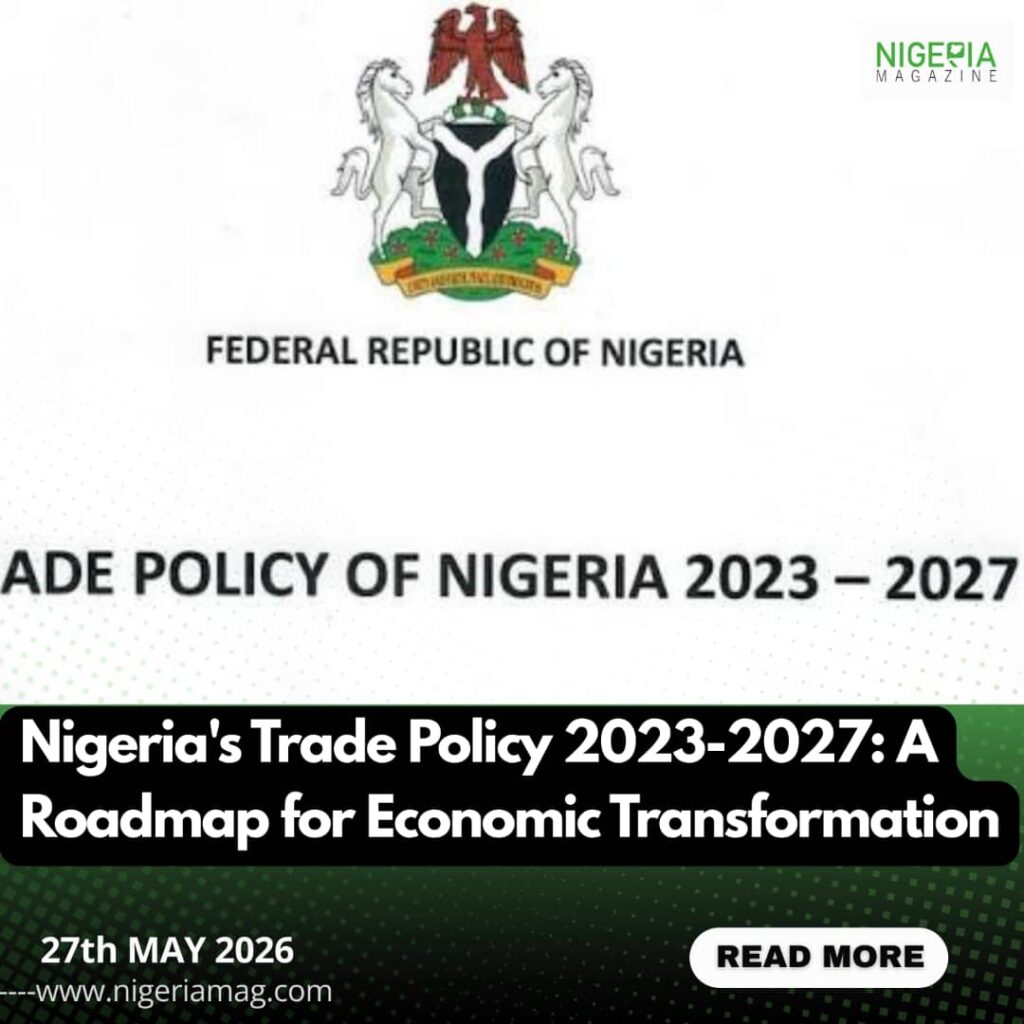
Nigeria’s Trade Policy 2023–2027 (TPN), developed by the Federal Ministry of Industry, Trade and Investment, is a comprehensive framework designed to harness trade as a powerful engine for economic growth, job creation, and poverty reduction. With a vision of making trade a catalyst for a diversified and competitive economy, the policy charts a bold course for Nigeria’s integration into the global marketplace.
The Economic Context
Nigeria, Africa’s largest economy, faces significant structural challenges. Despite its vast natural resources, over 200 million people, and status as Africa’s biggest oil exporter, the country struggles with heavy dependence on oil, which accounts for over 50% of government revenue but less than 10% of GDP. Unemployment stands at around 33%, poverty exceeds 40%, and Nigeria’s share of global merchandise trade remains below 1%; far below its true potential.
What the Policy Aims to Achieve
The TPN 2023–2027 sets out to diversify Nigeria’s export base beyond oil and gas, promote Made-in-Nigeria products both locally and internationally, boost job creation, and deepen integration into regional and global value chains. It also aims to strengthen Nigeria’s participation in the African Continental Free Trade Area (AfCFTA), ECOWAS, and WTO frameworks.
Key Pillars of the Policy
Trade Agreements and Market Access
Nigeria commits to deepening multilateral, regional, and bilateral trade relationships, leveraging frameworks like AfCFTA, ECOWAS, and various Bilateral Investment Treaties to open new markets for Nigerian goods and services.
Import and Export Reform
On the import side, the policy targets progressive liberalisation while protecting domestic industries from unfair trade practices. On the export side, incentive schemes such as the Export Expansion Grant, Pioneer Status, Currency Retention Scheme, and Free Trade Zones are designed to encourage non-oil exports and value-added manufacturing.
Trade in Services
Recognising that services contribute over 50% of GDP, the policy prioritises growth in financial services, fintech, telecommunications, digital economy, tourism, transport, and business services; sectors with enormous untapped export potential.
Digital Economy and ICT
The policy embraces digitalisation as a core trade enabler, promoting e-commerce, digital trade skills, data protection, and IT infrastructure development. Nigeria’s booming fintech sector, which attracted 42% of Africa’s tech funding in 2021, is highlighted as a key growth driver.
Support for MSMEs, Women, and Youth
Micro, Small and Medium Enterprises contribute nearly 50% of GDP and 76% of employment. The policy commits to mainstreaming MSMEs, women, and youth into trade and development strategies, recognising them as critical drivers of inclusive growth.
Complementary Policies
The framework also addresses intellectual property rights, competition policy, trade facilitation, transport infrastructure, agricultural value chains, manufacturing, and human capital development; all essential ingredients for a thriving trade environment.
Implementation will be led by the Federal Ministry of Industry, Trade and Investment, supported by a robust institutional framework involving the Presidential Economic Advisory Council, Trade Policy Advisory Council, Nigerian Office for Trade Negotiations, and regular National Stakeholders Consultations.
Nigeria’s Trade Policy 2023-2027 is more than a government document; it is a national call to action. If effectively implemented, it holds the promise of transforming Nigeria from a commodity-dependent economy into a diversified, competitive, and globally connected trade powerhouse. The question is no longer whether Nigeria has the potential; it is whether the political will and institutional capacity exist to turn this vision into reality.