The African bloc born from military coups is showing surprising economic resilience
According to the ECOWAS Bank for Investment and Development's (EBID) most recent annual report, the three member nations of the Alliance of Sahel States (AES), Burkina Faso, Mali, and Niger, will have a combined economic growth rate of 5.5% in 2025.
 Black News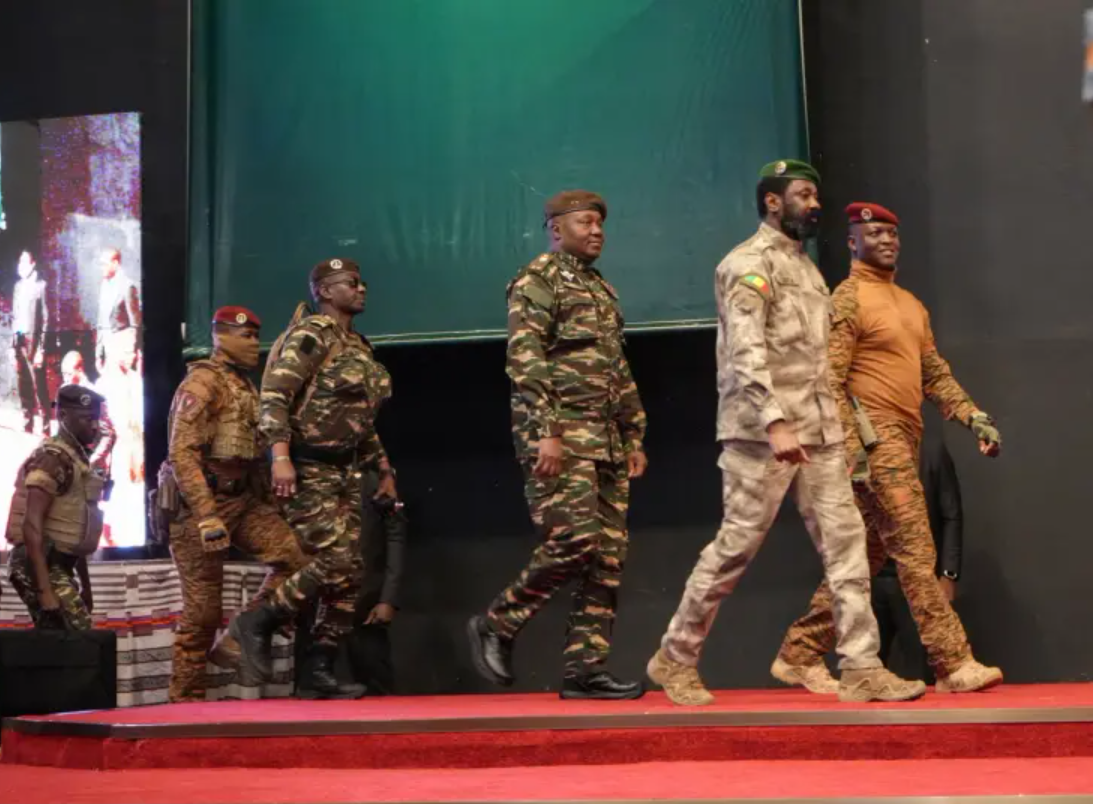


According to the ECOWAS Bank for Investment and Development's (EBID) most recent annual report, the three member nations of the Alliance of Sahel States (AES), Burkina Faso, Mali, and Niger, will have a combined economic growth rate of 5.5% in 2025.
- The three AES member nations, Burkina Faso, Mali, and Niger, are projected to have a combined economic growth rate of 5.5% in 2025 according to EBID.
- Niger leads the group with a projected 6.9% GDP growth in 2025, driven by increased crude oil exports and strong agriculture, although it's lower than the previous year's 10.3%.
- Burkina Faso saw GDP growth rise to 5.0%, supported by stable agricultural output, services expansion, and mining boosted by higher global gold prices, despite challenges for Western-owned mines.
- Mali's GDP growth slightly declined to 4.9% but remained solid due to robust agriculture and a growing services sector.
The data show that the Sahel bloc's economy remains resilient, with each nation benefiting from strong performance in agriculture, mining, energy, and services despite ongoing security and political concerns.
Niger's GDP grew at the quickest rate of the three, with a 6.9% increase projected for 2025.
While this was a drop from the spectacular 10.3% growth registered in 2024, the rate remained one of the fastest in West Africa, placing third among the region's 15 economies.
The EBID credited Niger's success to increased production, growing crude oil exports, and the agriculture sector's ongoing strength, which remained a vital pillar of the country's economy.
DON’T MISS THIS: Burkina Faso claims that the $125,000 plan to assassinate Traoré was caught on tape
Burkina Faso achieved an economic growth rate of 5.0%, up from 4.8% the previous year, as the West African country benefited from a broad-based resurgence across various sectors.
According to the study, excellent weather conditions and government-backed agricultural programs helped keep farm output stable, while the services sector expanded.
Mining activities, aided by higher world gold prices, also boosted total GDP, considering that mining in the country since the military government took over has been a debacle.
Given that a core part of the government’s objectives is to rid the country of Western influences, mines owned by Western companies have for the past couple of years been faced with unfamiliar operating conditions.
Similarly, Mali too has been a path to localize its industries, especially mining; however, the country’s GDP, as opposed to its fellow West African junta states, dipped to 4.9% in 2025, somewhat lower than the 5.0% achieved in 2024.
Despite the minor deceleration, the country's development remained solid, owing mostly to strong agricultural production and ongoing momentum in the services sector, as seen on Sputnik.
According to the most recent data, the three AES economies have maintained their strength, with agriculture continuing to be a key source of development within the union.
At the same time, increased commodity exports and increasing service sectors have boosted economic activity as countries seek their development goals in an ever-changing regional scene.
From ECOWAS to the AES

The new growth estimates come as Burkina Faso, Mali, and Niger expand collaboration within the Alliance of Sahel States (AES), a regional grouping formed following a dramatic break from the Economic Community of West African States (ECOWAS).
The political fallout began with a succession of military takeovers: Mali had coups in August 2020 and May 2021, Burkina Faso had two coups in January and September 2022, and Niger's elected government was deposed in July 2023.
In response, ECOWAS placed sanctions on the juntas and requested a timeline for restoring constitutional authority.
Following Niger's coup, the bloc escalated its response by mobilizing its standby force and threatening military involvement if diplomatic attempts failed to restore President Mohamed Bazoum.
The three military governments rejected ECOWAS' position, accusing it of serving foreign interests while failing to provide appropriate backing for their struggle against Islamist insurgencies.
In September 2023, they signed the Liptako-Gourma Charter, which established the Alliance of Sahel States as a mutual defense treaty.
The alliance eventually expanded into a larger framework for political, economic, and security cooperation, and the three nations announced their desire to depart ECOWAS in January 2024.
Their exit became effective on January 29, 2025, following the mandatory one-year notice period, despite ECOWAS's offer of a six-month grace period in a final attempt to encourage them to stay.
Since then, the AES has implemented shared projects such as cooperative military cooperation and its own biometric passports.