What Trump’s ICE Agents Really Are: Immigrant Cruelty Enforcers
By Rob Okun Photos: Wikimedia Commons With tactics reminiscent of the round-ups of Jews, Roma, and gays in Nazi Germany, Immigrant Cruelty Enforcers (ICE) are snatching green card holders, undocumented workers, and longtime residents driving to work or dropping off their children at school bus stops—yanking them from their cars as soon as their children board the bus. The latest community to be terrorized is Danbury, a diverse city in southwestern Connecticut, equidistant between the state capitol in Hartford and New York City. With nearly 90,000 residents—roughly 35 percent foreign-born—Danbury has long modeled what working-class multicultural vitality looks like, home to thriving Brazilian, Ecuadorian, and Portuguese communities. During the last week of August, cruelty agents of the state turned this quiet industrial hub and university center into a spectacle of state-sponsored terror and intimidation. Between August 24 and 28, masked agents in unmarked vehicles staged targeted sweeps outside local grocery stores like Ctown—whose clientele is primarily Latino and Caribbean—along commercial corridors, and at neighborhood school bus stops. Parents were ripped from their cars at curbsides, leaving terrified students to watch from bus windows as their mothers and fathers were handcuffed. Across Connecticut, more than 100 people were swept up in days—more than half from Danbury alone. (The other targeted Connecticut cities are Bridgeport, Norwalk, and Stamford.) “We really have been describing it as the administration terrorizing our city, because that is what it felt like,” said Juliana Soares, lead organizer for Danbury Unites for Immigrants in an interview on Connecticut Public Radio. “The streets were empty. Kids stayed home from practice… They were seeing this happen from inside the bus as masked agents shut down the street to just abduct people.” The cruelty agents also fanned out in the heart of Danbury’s educational institutions. Dr. Carina Bandhauer, chair of social sciences at Western Connecticut State University, said, “The day before our bright-eyed, eager [first-year students] moved into their dorms, over 20 ICE agents in tactical gear—with guns and tasers—descended upon the streets surrounding our campus.” In testimony before the Connecticut legislature, Bandhauer, founder of the UndocuAlly Task Force, testified: “The only time this city is not safe is when ICE is here.” A summer of ruthless raids included cruelty agents in Maine killing Johan Sebastián Durán Guerrero—a 25-year-old Colombian national who wasn’t even the target of the federal warrant!—and Lorenzo Salgado Araujo, a 52-year-old construction worker shot dead in Houston. The deaths sparked protests across the country, mirroring the solidarity the people of besieged Minneapolis modeled last winter. State authorities and civil rights groups are demanding investigations, but the Trump administration is dragging its feet, allegedly conducting an “internal review” behind closed doors. This brutality is part of a nationwide pattern of lethal overreach. The rogue posse has drastically scaled up its lawless detentions, logging record-breaking monthly totals—50,925 in August, according to the Deportation Data Project, run by UC Berkeley and UCLA and official documents from DHS. Other locales recently targeted include Sacramento, California; northern Utah; Lewiston and Portland, Oregon; New York City and New York state; Aurora and Denver, Colorado; Phoenix and southern Arizona; and Raleigh, North Carolina. Inspired by the resistance movement in Minnesota, communities are fighting back. On September 2, Danbury acted with collective defiance. More than 60 immigrant-owned businesses closed down for a citywide “Day Without Immigrants” strike, documented in video reporting from the rally. That evening, more than 1,000 residents, clergy, and labor organizers marched through downtown to Library Plaza. Standing with the protesters was Mayor Roberto Alves, who arrived in the US as an undocumented child and lived without legal status into his twenties. Alves condemned the secrecy of the raids—ICE, he said, doesn’t tell the city when agents are coming, going, or whom they’ve taken, because “they want to scare us.” But he said: “We’re stronger together.” Connecticut’s congressional delegation was outraged. Sen. Chris Murphy blasted the immigrant cruelty agents for pulling parents from school bus stops and “intentionally traumatizing kids.” Sen. Richard Blumenthal followed up with field hearings in the city, building an official federal record of ICE brutality and Trust Act violations, Connecticut Public Radio reported. Concerned about this lawless band of cruelty agents? Demand answers to questions like these: – When ICE agents bypass local law and state sanctuary protections, how can municipal leaders safeguard residents from state-sanctioned kidnapping? – How much longer can masked, unbadged, bodycam-free
 Black News
By Rob Okun
Photos: Wikimedia Commons
With tactics reminiscent of the round-ups of Jews, Roma, and gays in Nazi Germany, Immigrant Cruelty Enforcers (ICE) are snatching green card holders, undocumented workers, and longtime residents driving to work or dropping off their children at school bus stops—yanking them from their cars as soon as their children board the bus.
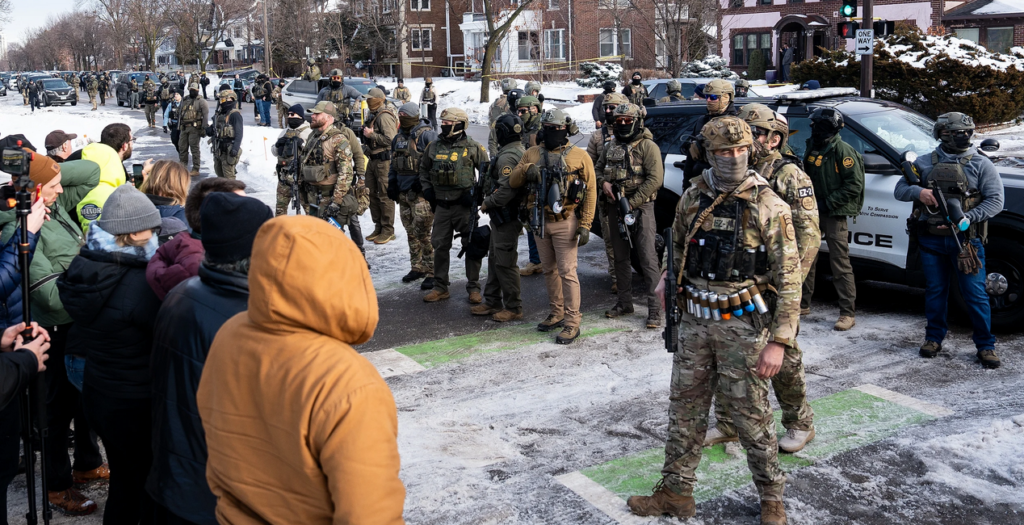
The latest community to be terrorized is Danbury, a diverse city in southwestern Connecticut, equidistant between the state capitol in Hartford and New York City. With nearly 90,000 residents—roughly 35 percent foreign-born—Danbury has long modeled what working-class multicultural vitality looks like, home to thriving Brazilian, Ecuadorian, and Portuguese communities. During the last week of August, cruelty agents of the state turned this quiet industrial hub and university center into a spectacle of state-sponsored terror and intimidation.
Between August 24 and 28, masked agents in unmarked vehicles staged targeted sweeps outside local grocery stores like Ctown—whose clientele is primarily Latino and Caribbean—along commercial corridors, and at neighborhood school bus stops. Parents were ripped from their cars at curbsides, leaving terrified students to watch from bus windows as their mothers and fathers were handcuffed. Across Connecticut, more than 100 people were swept up in days—more than half from Danbury alone. (The other targeted Connecticut cities are Bridgeport, Norwalk, and Stamford.)
“We really have been describing it as the administration terrorizing our city, because that is what it felt like,” said Juliana Soares, lead organizer for Danbury Unites for Immigrants in an interview on Connecticut Public Radio. “The streets were empty. Kids stayed home from practice… They were seeing this happen from inside the bus as masked agents shut down the street to just abduct people.”
The cruelty agents also fanned out in the heart of Danbury’s educational institutions. Dr. Carina Bandhauer, chair of social sciences at Western Connecticut State University, said, “The day before our bright-eyed, eager [first-year students] moved into their dorms, over 20 ICE agents in tactical gear—with guns and tasers—descended upon the streets surrounding our campus.” In testimony before the Connecticut legislature, Bandhauer, founder of the UndocuAlly Task Force, testified: “The only time this city is not safe is when ICE is here.”

A summer of ruthless raids included cruelty agents in Maine killing Johan Sebastián Durán Guerrero—a 25-year-old Colombian national who wasn’t even the target of the federal warrant!—and Lorenzo Salgado Araujo, a 52-year-old construction worker shot dead in Houston. The deaths sparked protests across the country, mirroring the solidarity the people of besieged Minneapolis modeled last winter. State authorities and civil rights groups are demanding investigations, but the Trump administration is dragging its feet, allegedly conducting an “internal review” behind closed doors.
This brutality is part of a nationwide pattern of lethal overreach. The rogue posse has drastically scaled up its lawless detentions, logging record-breaking monthly totals—50,925 in August, according to the Deportation Data Project, run by UC Berkeley and UCLA and official documents from DHS. Other locales recently targeted include Sacramento, California; northern Utah; Lewiston and Portland, Oregon; New York City and New York state; Aurora and Denver, Colorado; Phoenix and southern Arizona; and Raleigh, North Carolina.
Inspired by the resistance movement in Minnesota, communities are fighting back. On September 2, Danbury acted with collective defiance. More than 60 immigrant-owned businesses closed down for a citywide “Day Without Immigrants” strike, documented in video reporting from the rally. That evening, more than 1,000 residents, clergy, and labor organizers marched through downtown to Library Plaza.
Standing with the protesters was Mayor Roberto Alves, who arrived in the US as an undocumented child and lived without legal status into his twenties. Alves condemned the secrecy of the raids—ICE, he said, doesn’t tell the city when agents are coming, going, or whom they’ve taken, because “they want to scare us.” But he said: “We’re stronger together.”
Connecticut’s congressional delegation was outraged. Sen. Chris Murphy blasted the immigrant cruelty agents for pulling parents from school bus stops and “intentionally traumatizing kids.” Sen. Richard Blumenthal followed up with field hearings in the city, building an official federal record of ICE brutality and Trust Act violations, Connecticut Public Radio reported.
Concerned about this lawless band of cruelty agents? Demand answers to questions like these:
– When ICE agents bypass local law and state sanctuary protections, how can municipal leaders safeguard residents from state-sanctioned kidnapping?
– How much longer can masked, unbadged, bodycam-free tactical units operate before due process is permanently erased for citizens and non-citizens alike?
– What is the human and economic cost to a democracy when cities like Danbury must shut down just to prove their immigrant neighbors are the backbone of the community?
There are more questions than these to be asking. What are yours?
Even with her torch held high in New York Harbor, it’s not clear if Lady Liberty can see Danbury. But what is clear is visitors looking closely at the beloved beacon report seeing her weeping. Oh, America, what is becoming of our country?

Rob Okun (robokun50@gmail.com), syndicated by PeaceVoice, is editor emeritus of Voice Male, which has long chronicled the profeminist men’s movement.