They cancelled the election
Portia Wood, an attorney and founder of Legacy Wealth Institute / Black Trust Fund Kids The post They cancelled the election appeared first on AFRO American Newspapers.
 Black News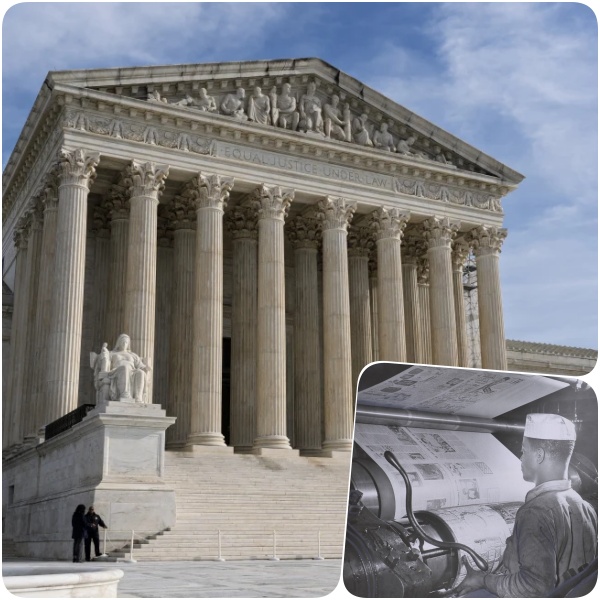

The Voting Rights Act: Part One of a Five-Part Series
By Portia Wood
Special to the AFRO
On April 29, 2026, the Supreme Court handed down its decision in Louisiana v. Callais. The 6-3 ruling, written by Justice Samuel Alito who was joined by every member of the conservative supermajority, effectively dismantled Section 2 of the Voting Rights Act — the last remaining enforcement mechanism in the 1965 law that made Black political representation in this country possible.
The majority did not formally declare Section 2 unconstitutional. They were too careful for that. What they did instead was hold that compliance with Section 2 cannot justify the use of race in redistricting under the 15th Amendment — meaning the tool Congress gave Black voters to fight discriminatory maps is now legally incompatible with using it.
The right exists on paper. The remedy is gone.
Damon Hewitt, president and executive director of the Lawyers’ Committee for Civil Rights Under Law, told the AFRO what that looks like in practice: “This is a really slick opinion. It ends up being a rewriting of the VRA that usurps Congress’ power to write laws. We’re left with rights on paper but very few remedies, in fact. This is about as bad as it gets.”
He called it “evil genius.” That’s not hyperbole. It’s an accurate legal description.

What Section 2 actually was
To understand what was just lost, you need to know what Section 2 did. After Shelby County v. Holder gutted Section 5 in 2013 — ending the preclearance process that required states with a history of discrimination to get federal approval before changing voting laws — Section 2 became the only significant federal protection left. It allowed individuals, civil rights organizations, and the federal government to challenge discriminatory voting practices in court after the fact. No preclearance, but a real legal path.
Section 2 was the provision that forced Louisiana to redraw its congressional maps to create two majority-Black districts in 2024, after a federal court found that the state’s one-district map diluted Black voting power in a state that is one-third Black. It was the provision that had been used for 60 years to challenge gerrymandered maps, voter roll purges, polling place closures and registration barriers across the country.
After Callais, those challenges are now functionally impossible. Any state legislature that wants to draw a map excluding Black voters just has to call the motive partisan instead of racial. The Supreme Court has already told them that works.
What happened in the 72 hours after
The speed of what followed tells you how long this was planned.
On April 30 — the day after Callais — Louisiana Gov. Jeff Landry and Attorney General Liz Murrill announced they were suspending the state’s May 16 U.S. House primary by executive order. The election was already underway. Absentee ballots had been mailed. Qualifying was closed. Candidates had organized campaigns, raised money, and were preparing to ask voters for their support. Early voting was scheduled to begin May 2. None of that stopped Landry. He invoked an emergency powers statute to cancel the election, pushing it to July 15 at the earliest, pending a special legislative session to draw new maps.
The goal, reported plainly by Verite News and Democracy Docket: eliminate U.S. Rep. Cleo Fields’ Black-majority 6th Congressional District and replace it with a majority-White Republican seat.
Voters had already cast ballots. Those ballots were nullified by executive order.
The ACLU, the ACLU of Louisiana, and the Legal Defense Fund filed an emergency motion in state court on May 2 challenging the suspension. Their filing stated: “Emergency powers are not a blank check to rewrite election rules after voting has begun, nor do they authorize the Governor to cancel votes that have already been cast to suit his political purposes.”

Meanwhile, Florida didn’t wait for a special session. The Florida legislature passed new congressional maps on April 29 — the same day the ruling dropped. Not the day after. The same day. Alabama, Mississippi, Tennessee, South Carolina and Georgia called for special legislative sessions within 48 hours. The Trump Justice Department’s Civil Rights Division publicly announced its intent to use Callais to “dismantle” Section 2 protections in additional districts before the 2026 midterms.
The maps were already drawn. They were waiting for the clearance.
Democracy Docket described the situation best: “We are entering an era where political actors are being allowed to build the election airplane as they fly it.”
What Justice Kagan called it
The three liberal justices — Kagan, Sotomayor and Brown Jackson — dissented. Kagan wrote 48 pages that legal scholars are already describing as one of the most significant dissents in the Court’s modern history. She opened by establishing what the Voting Rights Act was “one of the most consequential, efficacious, and amply justified exercises of federal legislative power in our Nation’s history,” born “of the literal blood of Union soldiers and civil rights marchers.” She quoted what the Act had done — Black voter registration in Mississippi rising from 6.7 percent in 1965 to 60 percent within a decade — and then she named what the majority had just undone.
The ruling “demolishes the foundational right Congress granted of racial equality in electoral opportunity,” she wrote. “Only they have the right to say it is no longer needed — not the Members of this Court.”
The AFRO-American Newspaper published coverage of the Callais decision the same day it dropped. Its publisher, Frances Murphy Toni Draper, had written an editorial warning this moment was coming six months earlier, in October 2025, when the case was argued. The AFRO has been covering the fight for voting rights longer than any of the justices who just decided it have been alive.
The next article in this series goes back to where the fight started and why that history explains everything about what just happened.
— — —
The AFRO-American Newspaper is one of the oldest Black-owned family businesses in the United States. It has been covering Black voting rights since before the Voting Rights Act existed. If this series matters to you, that’s the institution that made it possible. Subscribe, donate, and share at afro.com/donate.
The opinions expressed in this commentary are those of the writer and not necessarily those of the AFRO.
The post They cancelled the election appeared first on AFRO American Newspapers.