70-year-old Osu death trap demolished …15 more to go
A 70-year-old dilapidated four-storey building located at Osu in the Korle Klottey Municipality of the Greater Accra Region was yesterday demolished by city authorities. The building formed part of 16 defective structures identified and earmarked for demolition by the Korle Klottey Municipal Assembly (KoKMA). The demolition exercise, carried out by KoKMA, was supervised by officials … The post 70-year-old Osu death trap demolished …15 more to go appeared first on Ghanaian Times.
 Black News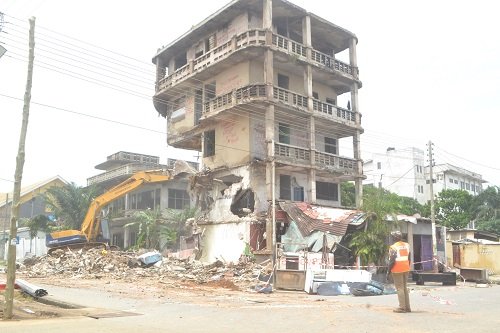

A 70-year-old dilapidated four-storey building located at Osu in the Korle Klottey Municipality of the Greater Accra Region was yesterday demolished by city authorities.
The building formed part of 16 defective structures identified and earmarked for demolition by the Korle Klottey Municipal Assembly (KoKMA).
The demolition exercise, carried out by KoKMA, was supervised by officials from the National Disaster Management Organisation (NADMO), the Ghana Prisons Service, the Ghana Police Service, and other agencies. It followed a number of concerns raised by residents over the threat posed by the building.
Speaking during the exercise, the Head of Works at the Assembly, Mr Anthony Komasi, said the owners had been served several notices over the years to either renovate or demolish the structure due to its deteriorating condition.
He explained that the final notice was issued in April this year, after earlier markings and warnings, and the occupants were asked to vacate the premises before the end of April.
“We have engaged them for a long time and notices have been served on the owners. Considering the season, it was necessary to bring the building down,” he stated.
Mr Komasi said although some occupants were still living in the building until recently, they eventually vacated after learning that the Assembly was ready to carry out the demolition.
According to him, the Assembly had the legal authority under its building regulations and by-laws to order the demolition of structures that pose a danger to the public.
He noted that owners of unsafe buildings could either demolish such structures themselves or allow the Assembly to undertake the exercise and later surcharge them for the cost.
“In this case, the family agreed to carry out the demolition themselves, and we are only providing technical supervision. If they had failed to comply, the Assembly would have done it and charged them accordingly,” he explained.
Mr Komasi disclosed that delays in the demolition were caused by disagreements among family members over who should lead the process, but stressed that the Assembly remained resolute in ensuring the structure was brought down.
He said investigations by structural engineers confirmed that the building had suffered severe structural failure, particularly in its columns and slabs.
“You can clearly see the columns cracking and deteriorating, with the iron rods inside corroding, meaning the structure could no longer be supported,” he said.
Mr Komasi further explained that the building’s proximity to the sea accelerated corrosion of the reinforcement rods due to exposure to salty conditions.
“The slabs were also failing. Beneath them, the metal reinforcements had rusted, exposing the columns and making the entire structure extremely dangerous for human habitation,” he added.
He cautioned property owners against ignoring visible cracks and signs of deterioration, stressing that early structural assessments and regular maintenance were critical to preventing disasters.
Mr Komasi noted that the age of a building alone did not necessarily determine whether it should be demolished.
“A building can be six months old and still become dangerous if poor materials or methods are used, while some buildings over 100 years old remain strong because they have been properly maintained,” he stated.
He revealed that the Assembly had identified other dangerous structures within the municipality which would soon be subjected to similar action as part of efforts to protect lives and property.
Mr Allotey-Gaisie said the demolition took time due to logistical challenges, including the issuance of notices over an extended period.
“The Assembly has targeted about four buildings in similar conditions to be demolished to save both lives and property in those areas,” he noted.
According to the Assemblyman for the Osu Alata Electoral Area, Ishmael Telfer, the exercise brought relief to residents due to the danger the building posed.
BY VICTOR A. BUXTON
Follow our WhatsApp Channel now! https://whatsapp.com/channel/0029VbAjG7g3gvWajUAEX12Q

The post 70-year-old Osu death trap demolished …15 more to go appeared first on Ghanaian Times.