Ministry of Justice Advances Criminal Mediation Training Under Phase II Programme
Four-day programme strengthens practitioner and institutional capacity ahead of Restorative Justice reforms BASSETERRE, Saint Kitts and Nevis — The Ministry of Justice and Legal…
 Black News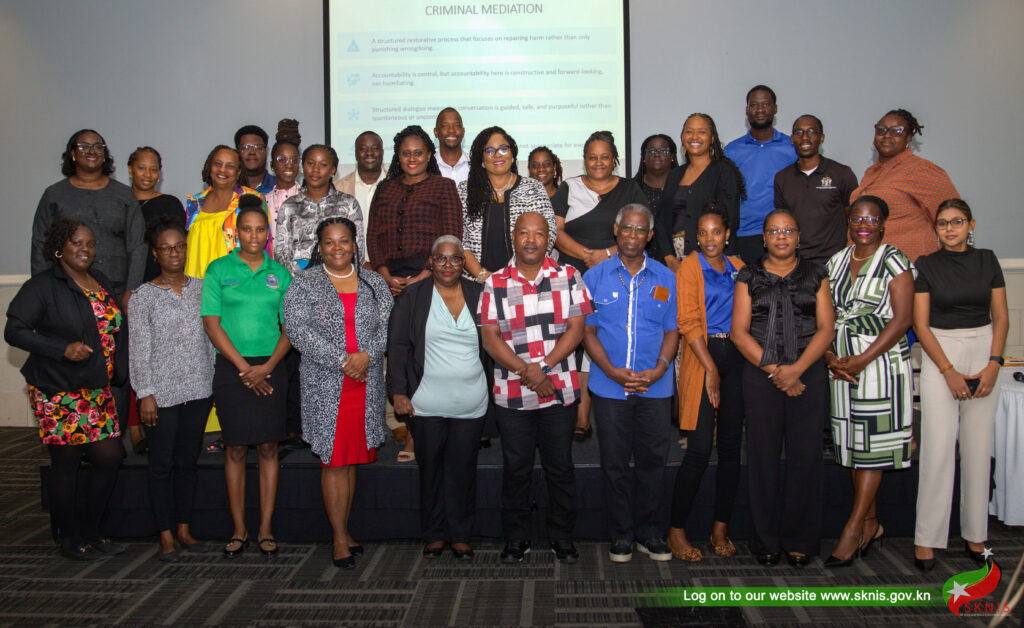

Four-day programme strengthens practitioner and institutional capacity ahead of Restorative Justice reforms
BASSETERRE, Saint Kitts and Nevis — The Ministry of Justice and Legal Affairs has commenced Phase II of its Criminal Mediation Training Programme, marking another important step in strengthening the institutional and professional capacity needed to introduce restorative and alternative justice mechanisms in Saint Kitts and Nevis.
The four-day programme, being held from August 24 to 27, 2026, builds on the foundational training delivered during Phase I. This second phase places greater emphasis on practical application, institutional readiness, and the development of a competent cohort of criminal mediation practitioners.
The programme is supported through the Justice Action Coalition Initiative, implemented by the United Nations Development Programme (UNDP) Barbados and the Eastern Caribbean, as part of broader efforts to strengthen access to justice and advance more responsive and people-centred justice services throughout Saint Kitts and Nevis.
Supporting the Wider Justice Reform Agenda
The training forms part of the Government’s broader justice reform agenda and is being undertaken in preparation for the anticipated introduction and implementation of the forthcoming Restorative Justice Bill.
The proposed legislation is expected to provide an important framework for the continued development of restorative justice in Saint Kitts and Nevis.
In preparation for implementation, the Ministry is working to strengthen both the legal and policy framework and the human and institutional capacity required to support it. This includes preparing practitioners, establishing clear referral pathways, defining institutional responsibilities, strengthening safeguards, and identifying the operational arrangements necessary for restorative and alternative justice mechanisms to function effectively.
Criminal and community mediation form part of this wider approach.
While formal investigation, prosecution, and adjudication remain essential to the rule of law, appropriate cases may benefit from structured alternative justice processes that promote accountability, address harm, support rehabilitation, and give affected persons a meaningful opportunity to participate in resolving matters.
Speaking at the opening of the programme, Permanent Secretary in the Ministry of Justice and Legal Affairs, Ms. Nerissa Williams, underscored the importance of building both professional and institutional capacity.
“We are building the human and institutional capacity required to make alternative justice a credible and effective part of the administration of justice. This requires not only capable practitioners, but clear referral pathways, strong safeguards, defined institutional responsibilities and effective coordination across the justice system.”
Moving from Foundation to Practical Application
Phase II represents a deliberate move from foundational learning to hands-on practical application.
Participants are examining the national criminal mediation framework, referral and case-management processes, institutional roles and responsibilities, safeguarding requirements, and the management of vulnerabilities and power imbalances.
The programme also provides intensive practical training in active listening, intentional questioning, reframing, emotional regulation, de-escalation, managing high-conflict situations and impasses, consensus building, and developing workable restorative agreements.
Participants will put these skills into practice through role-playing exercises and full-scale mediation simulations based on locally relevant police, probation, and community case scenarios.
Particular attention is being given to safeguards necessary for a credible criminal mediation process, including voluntariness, confidentiality, neutrality, participant safety, and the identification of vulnerabilities and significant power imbalances.
Participants are also being trained to recognise circumstances involving domestic or gender-based violence that may make mediation inappropriate.
Preparing for Implementation
A key objective of Phase II is to assess the country’s readiness to implement criminal mediation and wider restorative justice mechanisms.
The practical exercises will help identify areas where additional mentoring, supervision, or capacity development may be required. They will also allow the Ministry to identify operational issues that should be addressed as the broader restorative justice framework moves toward implementation.
The Ministry recognises that effective justice reform requires more than the adoption of legislation and policy. Sustainable implementation also depends on well-trained practitioners, clear institutional arrangements, appropriate safeguards, and strong coordination among the institutions and services supporting people who enter the justice system.
The outcomes of Phase II will therefore help guide the continued development of practitioner capacity and institutional arrangements needed to support the phased implementation of criminal mediation and the wider restorative justice framework in Saint Kitts and Nevis.
Through the UNDP and Justice Action Coalition Initiative, the Ministry of Justice and Legal Affairs will continue working with national and development partners to strengthen access to justice and advance justice responses that are accountable, accessible, restorative, and responsive to the needs of individuals and communities.