Russia tightens grip on Mali as it trains over 20 airborne troops with Mi-8AMTSh helicopter amid U.S. push to return to the Sahel
Russia has deepened its military footprint in Mali after instructors linked to Moscow trained more than 20 airborne troops using a Russian-marked Mi-8AMTSh helicopter, sharpening the contest for influence in the Sahel as the United States seeks a return to the region.
 Black News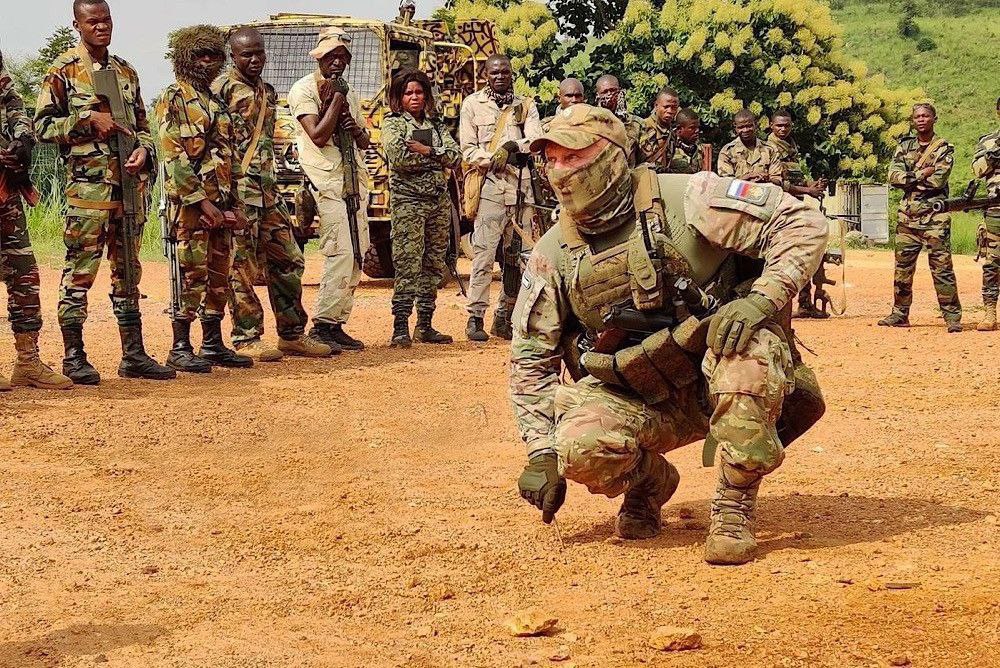

Russia has deepened its military footprint in Mali after instructors linked to Moscow trained more than 20 airborne troops using a Russian-marked Mi-8AMTSh helicopter, sharpening the contest for influence in the Sahel as the United States seeks a return to the region.
- Footage showed Russian equipment and personnel from Russia's Africa Corps supporting Mali's 33rd Airborne Regiment.
- Russia's Africa Corps is replacing Wagner as the primary instrument of Russian military influence in Mali and the broader Sahel region.
- Mali is expanding its arsenal with both Russian and Chinese military equipment, reflecting diversified international support for its military build-up.
- The U.S. is seeking to re-engage in the Sahel, shifting focus to security cooperation and aerial surveillance as Russia gains influence in Mali.
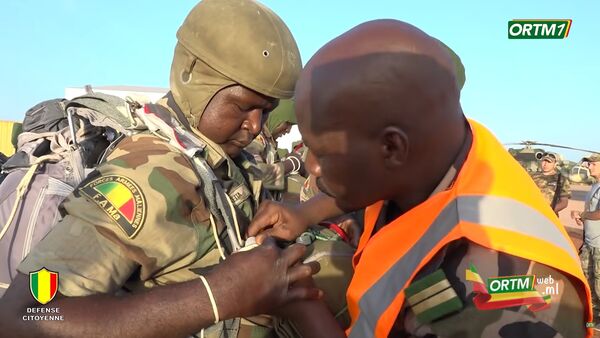
Malian state television showed more than 20 soldiers from the 33rd Airborne Regiment conducting parachute drills on June 28 at Bamako’s international airport, which also serves as Mali’s main air base.
According to Janes, the exercise used Russian D-6 Series 4 parachutes and a Russian-marked Mi-8AMTSh transport helicopter.
Personnel linked to Russia’s Africa Corps were also seen in the footage, underscoring Moscow’s growing presence in Mali’s military system.
Russia Expands Sahel Footprint
More broadly, the training reflects Russia’s push to consolidate influence across the Alliance of Sahel States, the bloc formed by Mali, Burkina Faso and Niger after military-led governments in the three countries broke from France and moved closer to Moscow.
Russia’s Africa Corps, which operates under the Russian Ministry of Defence, has increasingly replaced Wagner as Moscow’s main security instrument on the continent.
In Mali, that shift has formalised Russian military cooperation while giving Bamako a partner willing to provide training, equipment and political backing.
However, there is no publicly available information on the aviation assets directly available to Russia’s Africa Corps in Mali, where its contingent is estimated to number about 1,500 personnel.
Mali Expands Its Arsenal
Operationally, the value of parachute training remains limited because Mali has a small transport aviation fleet, making large airborne operations difficult beyond small tactical deployments.
Mali’s armed forces comprise about 19,000 troops, including only one airborne formation, the 33rd Airborne Regiment.
The army’s heavy equipment inventory includes T-72B3 main battle tanks, PT-76 light tanks, BRDM-2 reconnaissance vehicles, armoured personnel carriers, wheeled armoured vehicles, D-30 towed howitzers and BM-21 Grad multiple-launch rocket systems.
Still, Bamako has continued to expand its firepower. DefenceWeb reported in April 2026 that Mali had taken delivery of another large shipment of Chinese-made equipment, including Yitian-L short-range air defence systems, VN22 armoured vehicles and SR-5 multiple-launch rocket systems.
Military Africa also reported that the new Chinese hardware arrived through neighbouring Guinea and was meant to strengthen Mali’s capacity to secure territory against insurgent groups.
The acquisitions show that Mali’s military build-up is no longer only a Russian story. China is also gaining ground as a supplier, while Russia’s Africa Corps continues to provide training, battlefield support and political backing.
DON'T MISS: US courts Mali, Niger and Burkina Faso as Russia expands Sahel footprint
U.S. Looks For Re-entry
Meanwhile, Russia’s gains have forced Washington to rethink its position in the Sahel, with the Trump administration trying to rebuild ties with military-led governments that moved away from Western partners.
The reset shifts Washington’s focus from democracy pressure to counterterrorism, intelligence access and influence.
Reuters reported in March 2026 that the U.S. was close to a deal with Mali to resume aerial surveillance, including aircraft and drone operations over Malian territory to monitor jihadist groups affiliated with al-Qaeda.
Mali has therefore become a strategic prize for both powers.
For Russia, it provides a foothold in West Africa and access to the AES bloc, while for the U.S., it offers a chance to track extremist networks and curb Moscow’s influence in the central Sahel.