How to Deal With a Not-So-Great Iran Deal
Nathan Guttman reports on the recent temporary Iran deal, signed in Switzerland and not seen as adequate by Israelis nor Americans. The post How to Deal With a Not-So-Great Iran Deal appeared first on Moment Magazine.
 Black News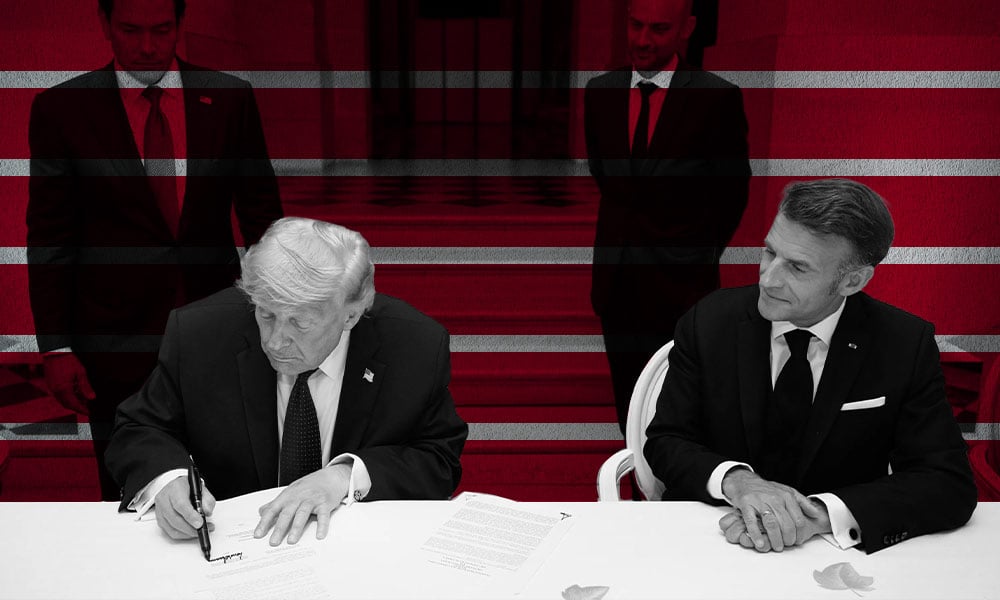

Jewish Politics & Power is published every other week. Sign up for our newsletter for updates.
1. A deal nonetheless
Sitting at the dinner table in Versailles Palace late Wednesday night, President Trump put his signature on the Memorandum of Understanding (MOU) aimed at ending the U.S.-Israeli war against Iran. Minutes later, in Tehran, Iranian president Masoud Pezeshkian signed the document as well, proudly presenting the paper to the cameras and posting it on social media.
The MOU is far from being a perfect document. In fact, it seems to represent a rare occasion in which the only thing all sides can agree upon is that the deal leaves the region in worse shape than before the war broke out.
Trump, eager to end a war that has been draining America’s economy and his own approval rating, admitted candidly that the specter of a global market collapse left him with no choice. “I didn’t want to see [an] economic catastrophe. If you kept this going, that could have happened,” he said hours before signing the deal.
Israel, Trump’s partner in this military adventure, made no secret of its concerns over a deal that does not specify the future of Iran’s nuclear program, ignores its ballistic threat to Israel and provides the Islamic Republic with the financial means to recover and rebuild its military might. At home, Democrats pounced on the opportunity to criticize an agreement that failed to achieve the goals of a war they had never supported in the first place, while Republicans struggled to argue that the MOU provides a pathway for a better final agreement at the end of the expected 60-day negotiation period.
The only side that seemed content with the interim deal was Iran, whose leaders embraced the MOU and then moved on to taunt the United States, delay talks and condition their participation in final-status talks on changing Israeli policies in Lebanon.
2. AIPAC and allies look for a silver lining
Once the MOU was signed, many eyes turned to the American Israel Public Affairs Committee. AIPAC, the largest pro-Israel lobby and the staunchest advocate for taking a tough stance toward Iran and for doing all that’s needed to eliminate the nuclear threat it poses, expressed its concern over the interim agreement.
“The initial Memorandum of Understanding (MOU) that has been reached with Iran raises significant questions,” AIPAC said in a memo. “The MOU provides for sanctions relief to Iran in exchange for the opening of the Strait of Hormuz and vague Iranian commitments on its nuclear program.” In the memo, AIPAC provides a detailed list of the MOU’s shortcomings, including what the lobby describes as “front-loaded concessions,” “limited nuclear language” and limits imposed in the agreement on Israel’s ability to operate militarily in Lebanon. The memo notes that the MOU says nothing about confronting Iran’s support for terrorist organizations or about its missile and drone capabilities; does not specify the conditions Iran needs to adhere to in order to get sanction relief; and bypasses the U.S. Congress, which does not seem to have any role in approving the deal. The deal, AIPAC concludes, also cements the standing of the current regime in Iran by promising no U.S. involvement in Iran’s internal affairs. “The MOU would leave the U.S. with no response to the brutal regime’s murder earlier this year of tens of thousands of Iranian protestors,” the memo reads.
The American Jewish Committee (AJC) took an even harsher approach and in a statement said it is “deeply concerned” and that the deal signed by Trump and Pezeshkian “appears to surrender significant U.S. leverage upfront.”
In recent years AIPAC has spent millions in efforts to defeat Democratic politicians who criticized the Netanyahu government’s actions or called for limiting American military aid to Israel. Now, it finds itself battling a Republican president who is bent on signing a deal seen as problematic for Israel and its U.S. supporters.
The apparent solution for AIPAC and other centrist pro-Israel Jewish organizations is to focus on the temporary nature of the MOU while building support for a tougher American stance in subsequent negotiations with Iran. In other words, instead of launching an all-out battle against the Trump administration, a battle the pro-Israel lobby has no chance of winning, the emphasis shifts to shaping the final deal and causing Trump, his vice president, JD Vance, who is in charge of the negotiations, and special envoys Steve Witkoff and Jared Kushner to toughen up and use this 60-day period to negotiate a deal that addresses their concerns and that fills in the gaping holes left in the MOU.
In a sense, the path forward for these advocates is similar to that charted by Lindsey Graham, the arch-hawk, pro-Israel, anti-Iran Republican senator from South Carolina. After expressing some early concerns over the MOU, Graham wrote on X that he was convinced by Witkoff that the interim deal is good for America’s economy, adding that the negotiations over a final deal are no more than an experiment that may or may not work but carry no immediate risk. “Whether or not the United States can reach an acceptable, verifiable deal with Iran regarding its nuclear program and other issues is yet to be determined, but I see little downside to trying,” Graham wrote.
This is pretty much where the pro-Israel lobby is right now: accepting the MOU as a done deal (as well as their exclusion from the process of negotiating it) and focusing on changing the outcome of the final deal, or thwarting it altogether if it does not address their concerns.
3. Will pro-Israel centrists go after Trump as they did with Obama?
This is all very different from the last time around.
In 2015, after the Obama administration negotiated a nuclear deal with Iran known as the Joint Comprehensive Plan of Action (JCPOA), pro-Israel advocates went to war. They tried to influence every senator not to support the deal, and backed Netanyahu when he broke with protocol and went to Congress asking members to defeat Obama’s deal.
Now, there is no such mobilization, and there likely will be none in the future. While there are many similarities between the JCPOA and the deal now being negotiated in Switzerland between the United States and Iran, the environment and circumstances are quite different.
The Obama-era deal was negotiated over the course of a year behind closed doors and presented as a done deal to Congress and the American people. Now, there is only an interim ceasefire and a framework but no final deal. This means there’s a lot more space for those opposing the deal to push for changes, without having to fight the entire deal and the president who negotiated it.
More importantly, the political climate has changed. Speaking at a White House press briefing last week, Vance told Israeli critics of the MOU to keep in mind that “Donald J. Trump is the only head of state in the entire world who is sympathetic to the State of Israel at this time” and reminding them that “two thirds of the defensive weapons that protect your homeland have been built by American hands and paid for by American taxpayers.” This blunt message was aimed at Israeli cabinet ministers who spoke out against Trump and the deal, but it holds true for pro-Israel American groups. Back in 2015, Netanyahu and AIPAC had choices. They could go against Obama and the Democrats, knowing that Republicans were on their side and that they had a safety net if ties with the Dems soured. Now, there’s nothing to fall back on. If Israel and AIPAC lose Trump and his few hawkish supporters within the party, there’s nowhere to turn: The Democrats won’t save them, and neither will the MAGA and isolationist factions of the GOP.
4. Dems and liberal Jews are also in a bind
For the left of center, last week’s signing of the MOU and Trump’s subsequent comments, in which he argued that Iran has the right to keep ballistic missiles, that the highly enriched nuclear material in Iran is “very unimportant” and that Netanyahu needs to act “sane” and “be more rational,” could have been seen as a great “told you so” moment.
Jewish liberals and Democrats in general have been arguing from day one that Trump is not a reliable partner for Israel, and to a certain extent his deal with Iran helps prove this point. “Donald Trump was so desperate to get a deal with Iran that he was unabashedly willing to push Israel aside, demonstrating—yet again—that Trump has no loyalty or commitment to anyone other than himself,” said Haile Soifer, head of the Jewish Democratic Council of America.
But there’s a catch.
Are Democrats—and their supporters in the Jewish community who are speaking out against the deal—trying to undermine the only way to get out of a war they have been trying to end for months? It’s a tricky maneuver that could land the Dems with the opposite outcome from the one they had worked for. And so their message is a little vague: Trump isn’t a friend of Israel, the deal is bad, but it’s still probably better than going back to war.

5. Sixty days is a long time
With the MOU signed and at least partially implemented, the focus of pro-Israel groups is on the long-term deal being negotiated. Here are a couple of developments worth watching as these talks go forward:
–Congress: a great part of the effort by AIPAC and other critics of the deal is focused on forcing Trump to require Congressional approval of the deal or of the parts of it pertaining to sanctions relief. Capitol Hill is a much more welcoming turf for Israel and its supporters, who can try to build a bloc of moderate Democrats and Republicans who share their concerns over the deal and who can signal the White House that if it isn’t improved in negotiations, it will stumble in Congress.
–Lebanon: Israel is still fighting Hezbollah in Lebanon and is likely to keep on doing so throughout the negotiation period despite Trump’s stern request to Netanyahu to take it easy. This could influence the outcome of the negotiations and, if fighting escalates, could derail the entire process.
–Lastly, Iran: The Islamic Republic has proved to be a tough negotiator. Tehran has given no indication that it would agree to all demands relating to its nuclear program or to the freedom of shipping in the region. Those opposing the deal in Israel and in the United States might find that their work has been done by Iran and that the ayatollahs’ resistance to compromise has made the entire debate irrelevant.
The post How to Deal With a Not-So-Great Iran Deal appeared first on Moment Magazine.