Rethinking African Migration to Europe: From Crisis Narrative to Strategic Opportunity
In European media and political debates, African migration is often framed as a growing…
 Black News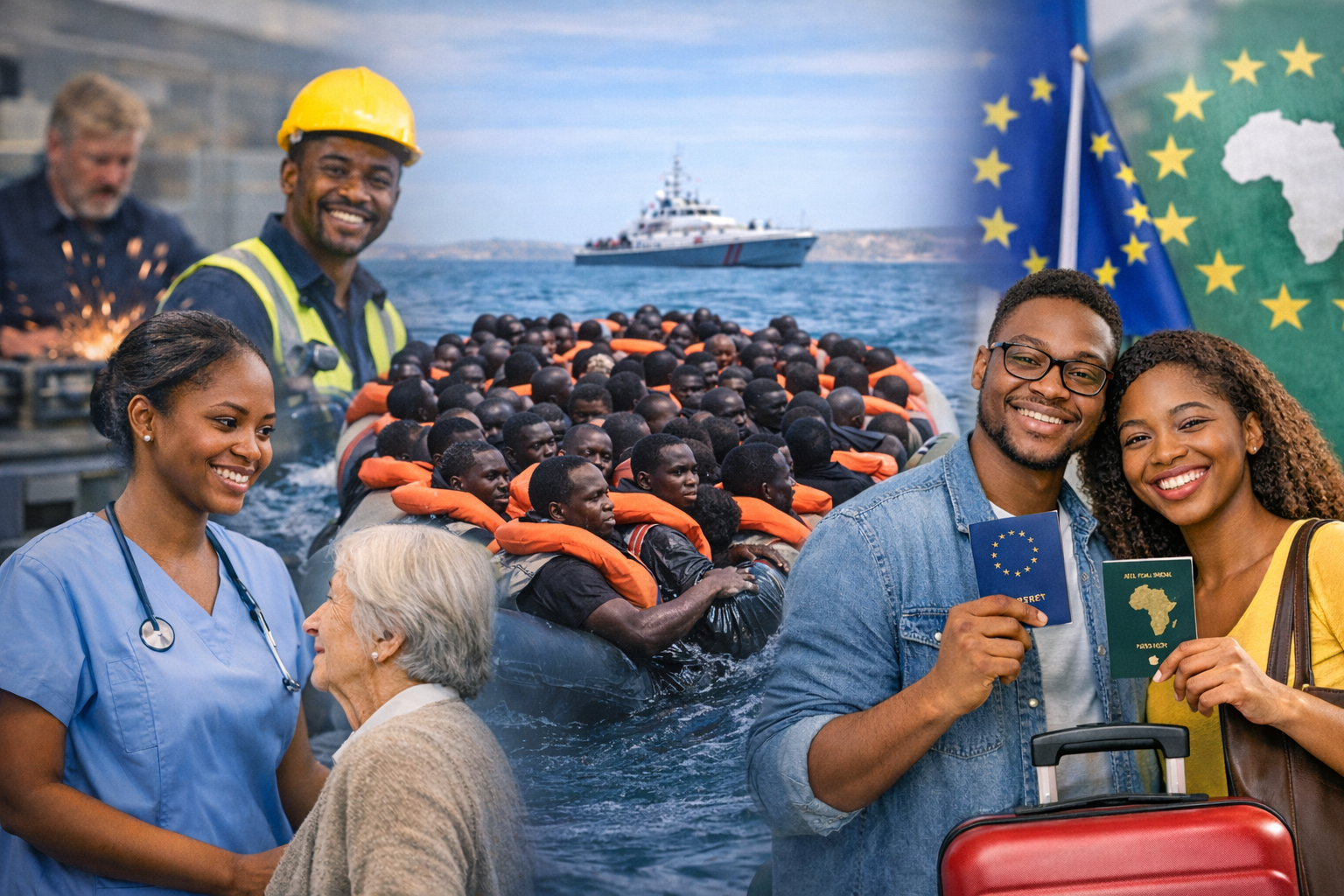
In European media and political debates, African migration is often framed as a growing crisis. Images of overcrowded boats crossing the Mediterranean, pressure on borders, and fears about integration dominate public discourse. In some circles, concerns extend beyond numbers to issues of crime, cultural cohesion, and social stability. These concerns—whether justified or overstated—have shaped public perception and policy. High-profile cases in Europe have intensified the debate, sometimes leading to broad generalisations about migrants from specific regions. This has created a charged environment where migration is frequently discussed more through emotion than evidence.
Yet when we move beyond headlines and examine the data, a very different picture emerges—one that is more complex, more balanced, and far more relevant for long-term policy.
The Reality: Most African Migration Happens Within Africa
Contrary to common perception, African migration is not primarily directed toward Europe. The overwhelming majority of movement takes place within the African continent itself.
Across West, East, and Southern Africa, millions of people move between neighbouring countries in search of work, education, and better living conditions. Regional agreements such as those within the Economic Community of West African States (ECOWAS) and the East African Community facilitate this mobility by enabling freer movement of labour and trade.
Economic hubs such as Côte d’Ivoire, Nigeria, Kenya, and South Africa attract large numbers of migrants from surrounding countries. These movements are typically:
- Regional
- Legal or semi-formal
- Economically driven
This reality challenges the dominant narrative of a mass exodus toward Europe.
Migration to Europe: Legal Pathways Dominate
While media coverage focuses heavily on irregular crossings across the Mediterranean, these journeys represent only a small share of overall migration.
Most Africans who move to Europe do so through structured and legal routes, including:
- Employment visas
- Student permits
- Family reunification
In fact, legal migration significantly outweighs irregular arrivals. Recent data also shows a decline in irregular border crossings, reflecting stronger cooperation between European and North African countries.
This means that African migration to Europe is largely:
- Planned
- Documented
- Economic in nature
Irregular migration, while tragic and dangerous, is not the dominant story.
Why Africans Move: Opportunity, Not Just Escape
Migration is rarely driven by a single factor. It reflects a combination of pressures and aspirations.
Push Factors
- Limited job opportunities
- Political instability or governance challenges
- Economic inequality
Pull Factors
- Access to education and skills
- Higher income potential
- Global exposure and mobility
Africa’s demographic structure plays a central role. With a median age of around 19, the continent has the youngest population in the world. Every year, millions of young people enter the labour market—far more than local economies can absorb.
Migration, therefore, is not simply about survival. It is often a strategic decision to improve life prospects.
Europe’s Demographic Reality: A Structural Need for Migration
At the same time, Europe faces its own structural challenges:
- Ageing populations
- Low birth rates
- Increasing labour shortages
Sectors such as healthcare, construction, agriculture, and technology are already experiencing workforce gaps.
In countries like Germany, projections indicate the need for hundreds of thousands of foreign workers annually in the coming decades.
This creates a clear complementarity:
- Africa provides a growing workforce
- Europe requires labour to sustain its economies
From Crisis to Complementarity
When viewed through this lens, migration is not a zero-sum problem but a potential partnership.
African migration contributes to:
- Filling labour shortages in Europe
- Supporting African economies through remittances
- Facilitating skills transfer and global networks
Remittances alone send billions of euros back to African countries each year—often exceeding official development aid and supporting households, businesses, and national economies.
This is not a crisis dynamic. It is an interconnected economic system.
A Smarter Approach: Managing Migration as Opportunity
To fully harness the benefits of migration, both Africa and Europe need to move beyond reactive policies.
Key Priorities
1. Expand Legal Migration Channels
Creating more structured pathways reduces irregular migration and supports labour market needs.
2. Align Skills with Demand
Training programmes in Africa should match European labour shortages, particularly in healthcare and technical sectors.
3. Strengthen Integration Systems
Successful integration benefits both migrants and host societies, improving social cohesion and economic contribution.
4. Support African Development
Investment in education, entrepreneurship, and job creation reduces forced migration while enabling mobility by choice.
5. Build EU–Africa Partnerships
Stronger cooperation frameworks can align migration with trade, investment, and innovation.
The Role of Narrative: Why Language Matters
Public discourse plays a powerful role in shaping policy. Constantly framing migration as an “invasion” fuels fear, polarisation, and ineffective decision-making.
A more balanced narrative—grounded in facts—can:
- Build public trust
- Encourage pragmatic solutions
- Strengthen international cooperation
Migration is not new. What matters is how it is understood and managed.
Conclusion: A Continent on the Move—for Good Reason
Africans are moving—mostly within their own continent, and increasingly through legal pathways to Europe—for work, education, and opportunity.
The idea of a “migration crisis” driven by Africa alone does not reflect reality. Instead, what we are witnessing is a global shift shaped by demographics, economics, and human ambition.
With Africa’s population projected to reach 2.5 billion by 2050, and Europe facing a shrinking workforce, cooperation is not optional—it is essential.
Handled wisely, migration can become one of the most powerful engines of shared growth between Africa and Europe.