The Supreme Court Guts Voting Rights Act By Restricting Black Representation In Louisiana
The ruling will seemingly affect the 2028 election season since some filing deadlines for this year’s congressional races have passed.
 Black News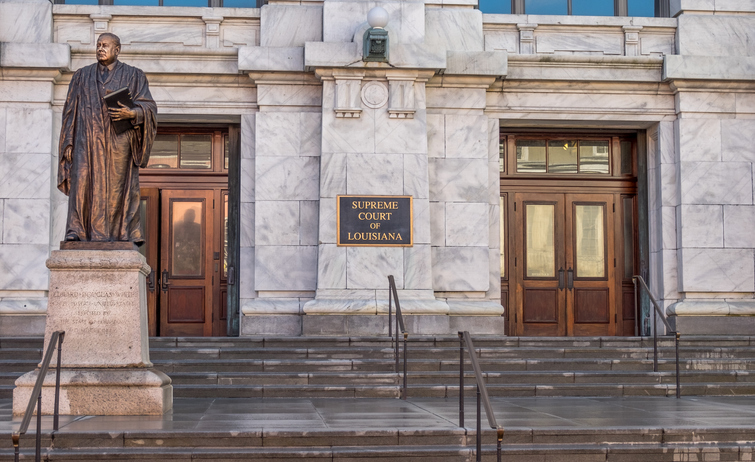
On April 29, the Supreme Court weakened Section 2 of the Voting Rights Act of 1965, created to increase minority representation in Congress and beyond, by striking down a majority Black congressional district in Louisiana and creating the opportunity for additional redistricting efforts in other states to keep Republicans in control, according to an Associated Press report.
Conservative Justice Samuel Alito wrote “that map is an unconstitutional gerrymander” after a 6-3 ruling in the Louisiana v. Callais Supreme Court case found that Louisiana’s Sixth Congressional District, represented by Democratic Rep. Cleo Fields, was too heavily based on race. Chief Justice John Roberts described the area as a “snake” that stretches over 200 miles to link parts of Shreveport, Alexandria, Lafayette, and Baton Rouge.
While President Lyndon B. Johnson, who signed the legislation into law 60 years ago, called it “a triumph for freedom as huge as any victory on any battlefield,” today’s conservative high court justices say otherwise.
“As I explained more than 30 years ago, I would go further and hold that [section two] of the Voting Rights Act does not regulate districting at all,” Justice Clarence Thomas wrote, according to Fox News.
The ruling will seemingly affect the 2028 election season, as some filing deadlines for this year’s congressional races have already passed. But Louisiana Gov. Jeff Landry is wasting no time to take advantage of the ruling. Hours later, he announced plans to suspend the May 2026 primary elections to allow state lawmakers to pass a new congressional map.
In a dissent for the three liberal justices, Justice Elena Kagan said the court’s “gutting of Section 2 puts that achievement in peril” in reference to the landmark legislation.
Leaders of Black Voters Matter feel the same.
“In today’s Callais decision, the conservative side of the US Supreme Court (SCOTUS) has declared their allegiance to the white supremacist’s movement, which seeks to return this country to a post reconstruction era where constitutional rights exist only on paper and states are free to construct laws that “appear” race neutral on their face, but prevents Black and Brown people from electing representation that increases their political power and ability to protect and resource their communities,” co-founders Cliff Albright and LaTosha Brown and National Legal Director April England-Albright, said in a statement.
“Two years ago, Black Voters Matter warned that this current SCOTUS was in on the GOP’s efforts to increase and enshrine white political power not seen in the U.S. since the horrid Dred Scott decision, which declared that the “Black Man had no rights that the White Man was bound to respect. So, just like the U.S. political landscape in 1900, all three branches of government have abandoned the experiment to create a multicultural democracy where all who live here share power and resources.”
As news hit social media, fellow conservatives, including African-American ones, celebrated as President Donald Trump has pushed for redistricting efforts to boost GOP chances of preserving control. “I’m a Black Republican who currently represents a majority-white district in the Ohio State House and is running to represent a majority-white district in Congress.
“The idea that Black Americans need special districts carved out just for them is complete nonsense. It’s a violation of the law and blatantly unconstitutional,” Rep. Josh Williams wrote on X.
“Glad the Supreme Court made the right decision.”
The White House also congratulated the ruling. “This is a complete and total victory for American voters. The color of one’s skin should not dictate which congressional district you belong in. We commend the court for putting an end to the unconstitutional abuse of the Voting Rights Act and protecting civil rights,” spokesperson Abigail Jackson said in a statement.
On numerous occasions, Trump has encouraged states to redraw their maps and called the decision the “kind of ruling I like.”
RELATED CONTENT: Trump Claims D.C. And Puerto Rico Statehood Would Lead To ‘Country-Destroying Sleazebags’ Taking Power