Who takes the IPU gravel from Dr Tulia
ARUSHA: THE Inter-Parliamentary Union (IPU) will choose its next president on Friday, with three senior parliamentarians from Azerbaijan, Australia and Chile competing to lead the global organisation of national parliaments for the next three years. The election, scheduled for October 9 during the 153rd IPU Assembly in Arusha, will determine the successor to Tanzania’s Dr … The post Who takes the IPU gravel from Dr Tulia appeared first on Daily News.
 Black News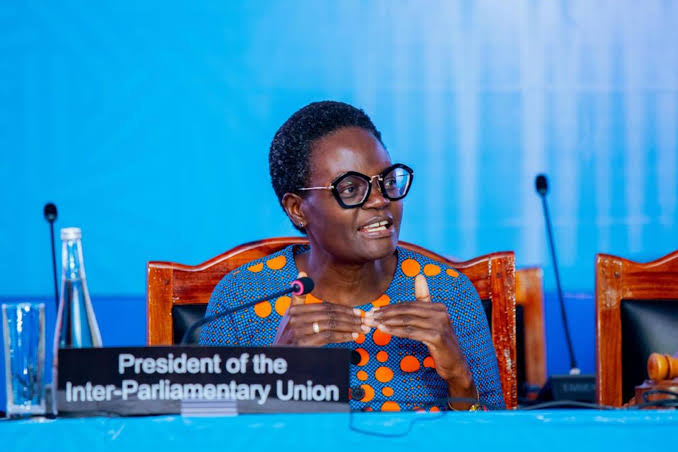
ARUSHA: THE Inter-Parliamentary Union (IPU) will choose its next president on Friday, with three senior parliamentarians from Azerbaijan, Australia and Chile competing to lead the global organisation of national parliaments for the next three years.
The election, scheduled for October 9 during the 153rd IPU Assembly in Arusha, will determine the successor to Tanzania’s Dr Tulia Ackson, whose threeyear term ends this month.
The candidates are Sahiba Gafarova, Speaker of Azerbaijan’s Milli Majlis; Milton Dick, Speaker of Australia’s House of Representatives; and Chilean Senator Rojo Edwards Silva.
The contest comes at a time when parliaments face a broad range of challenges, from geopolitical tensions and armed conflicts to declining public trust, technological disruption, climate change and pressure on democratic institutions.
The outcome will therefore be closely watched not only for who wins but also for the direction the IPU takes during the new president’s three-year mandate.
The IPU president is the organisation’s political head, chairs its statutory meetings and represents it at major international events.
The president also chairs the Governing Council and Executive Committee, which guide and monitor the organisation’s work.
The president is elected by the Governing Council for a single three-year term and must remain a sitting parliamentarian throughout the mandate. The IPU has 183 national member parliaments and 15 regional parliamentary bodies.
Three different parliamentary profiles
Gafarova brings extensive experience as a parliamentarian and parliamentary leader. She has been a member of Azerbaijan’s parliament since 2010 and became the first woman to serve as Speaker of the Milli Majlis in 2020. She was re-elected Speaker in 2024.
Her parliamentary work has included gender equality, violence against women, racism and xenophobia, as well as issues involving migration, refugees and internally displaced people.
Her profile also emphasises representative democracy, human rights, the rule of law and multilateral cooperation.
Dick offers a different background, having combined national and local political experience. He represented the federal electorate of Oxley in Queensland from 2016 and was elected Speaker of the House of Representatives in 2022.
He was re-elected Speaker without opposition in 2025. As Speaker, Dick has focused on impartiality, inclusion and improving standards of conduct within parliament.
He has also placed emphasis on parliamentary diplomacy, including parliamentary friendship groups and engagement with diplomatic representatives. His experience within the IPU could be particularly relevant to the election.
He currently serves as vice-president of the Executive Committee representing the AsiaPacific Group and chairs the Sub-Committee on Finance, where his responsibilities include issues related to cooperation, transparency and accountability. Edwards Silva brings experience from Latin America and the Caribbean.
The Chilean senator serves as president of the IPU’s Group of Latin America and the Caribbean, known as GRULAC, for the 2025- 2027 period.
He has been involved directly in IPU negotiations and deliberations, including serving as co-rapporteur of the Standing Committee on Sustainable Development.
He helped lead work resulting in a resolution adopted unanimously at the 152nd Assembly in Istanbul on the role of parliaments in building a fair and sustainable global economy.
He has also participated in negotiations on emergency items at previous IPU assemblies. The three candidates consequently offer different combinations of parliamentary leadership, regional representation and experience within the IPU itself.
A presidency under scrutiny
Whoever wins will inherit an organisation operating in an increasingly complex international environment. The Arusha Assembly itself reflects the breadth of issues facing parliamentarians.
Delegates are discussing military applications of artificial intelligence, oversight of extractive industries, AI and children’s rights, the future of work, climate-related food challenges, protection of mountain and ocean ecosystems, United Nations reform and maritime security during conflicts.
That agenda points to one of the central challenges for the next president: keeping the IPU relevant to problems that increasingly cross-national borders while ensuring that national parliaments remain central to international decision-making.
The president will also have to balance different political systems and regional interests within an organisation that brings together parliaments from across the world. That will make consensus-building a key part of the job.
The IPU has traditionally sought to provide a forum where parliamentarians can maintain dialogue even when relations between governments are strained. The next president will be expected to preserve that role while giving the organisation a clear voice on global issues.
ALSO READ: Dr Tulia pledges to support IPU’s efforts as she ends her 3-year presidency
Parliamentary diplomacy
One immediate priority is likely to be parliamentary diplomacy. Wars and geopolitical rivalries have made international dialogue more difficult, increasing the importance of channels that allow legislators to maintain contact across political divides.
The IPU’s role is not to replace governments or traditional diplomacy.
Rather, it provides parliamentarians with a platform to exchange views, build relationships and identify areas of cooperation.
The new president will therefore be judged partly on the ability to use the office to encourage dialogue without turning the organisation into an arena for competing geopolitical positions.
This will require political neutrality, patience and an ability to accommodate different perspectives.
Democracy and public trust
The presidency will also come with expectations on democracy and parliamentary effectiveness.
Parliaments are under pressure in many countries to demonstrate that they can respond to citizens’ concerns, scrutinise governments effectively and translate public priorities into legislation.
The IPU has long promoted stronger, more representative and inclusive parliaments.
The next president will be expected to advance that work while helping member parliaments respond to emerging threats to democratic institutions. Public trust will be particularly important.
In an era of misinformation and political polarisation, parliaments face the challenge of explaining their work more effectively and ensuring that citizens see them as institutions capable of delivering results.
The new president will therefore need to promote not only democratic principles but also practical parliamentary capacity.
Artificial intelligence is another issue likely to dominate the next president’s agenda. The Arusha Assembly is already examining military AI, AI and children’s rights and its impact on the future of work.
These discussions underline the speed with which technology is changing public policy. National parliaments will increasingly be required to legislate on technologies whose implications extend beyond traditional regulatory frameworks.
The next IPU president can therefore expect growing demand for parliamentary cooperation on AI governance, digital rights, misinformation, data protection and the changing nature of employment.
The challenge will be to encourage common approaches without imposing identical policies on countries with very different levels of technological development and regulatory capacity.
The next president will also begin the mandate alongside a new Secretary General, Anda Filip of Romania.
Filip became the first woman and first Eastern European to hold the post in the IPU’s 137-year history after being elected at the 152nd Assembly in Istanbul in April. She took office on July 1, succeeding Martin Chungong of Cameroon.
The Secretary General is the IPU’s chief executive and oversees the Secretariat, while the president provides political leadership.
The two will therefore need to work closely to turn the organisation’s strategic priorities into programmes and results, particularly as it prepares its 2027-2031 strategy. The election will also mark a leadership transition after Ackson’s presidency.
Ackson was elected IPU president in October 2023 in Luanda, becoming the first African woman to hold the position. She secured 172 votes against 11 for Somalia’s Marwa Abdibashir Hagi.
Her departure means the incoming president will inherit an organisation with an established agenda but will also have an opportunity to set new priorities. The IPU has historically seen its presidency rotate among geopolitical groups.
Over the past quarter-century, the position has been held by parliamentarians from several regions, including Europe, Asia, Africa and Latin America and the Caribbean.
Regional considerations could therefore form part of the broader political context surrounding Friday’s vote, although the decision ultimately rests with the Governing Council.
The three candidates enter the final stage of the contest with different records and experiences. Gafarova offers experience as a parliamentary speaker and an emphasis on inclusion, rights and multilateral cooperation.
Dick brings experience from one of the world’s established parliamentary systems, alongside direct involvement in the IPU’s Executive Committee and financial oversight.
Edwards Silva brings experience in IPU negotiations and leadership of the GRULAC group.
The choice facing the Governing Council is therefore not simply about choosing an individual, but about selecting the leadership approach best suited to guide the IPU through the next three years.
For the successful candidate, the central challenge will be to turn the IPU’s broad membership into a platform capable of sustaining dialogue, strengthening parliamentary institutions and giving legislators a meaningful role in addressing global problems.
In an international environment marked by division, the new president’s ability to build consensus may ultimately matter as much as any individual policy priority.
The result in Arusha will determine who takes on that task and how the IPU seeks to position itself in the three years that follow.
The post Who takes the IPU gravel from Dr Tulia appeared first on Daily News.







![I Placed My Black Son For Adoption After Rape — His Memoir, ‘Stranger In My Own Story,’ Helped Me Reclaim Mine [Op-Ed]](https://madamenoire.com/wp-content/uploads/sites/9/2026/09/17907998954811-rotated-e1790802025921.jpg?quality=80&strip=all&w=2448&crop=0,0,100,1322px#)