BRICS confronts Iran war fallout as oil risks raise fresh global economic concerns
Foreign ministers from BRICS nations gathered in New Delhi on Thursday, May 14, 2026, with the conflict involving Iran and growing instability in global energy markets emerging as central issues in discussions, as member states assess the economic implications of a prolonged crisis.
 Black News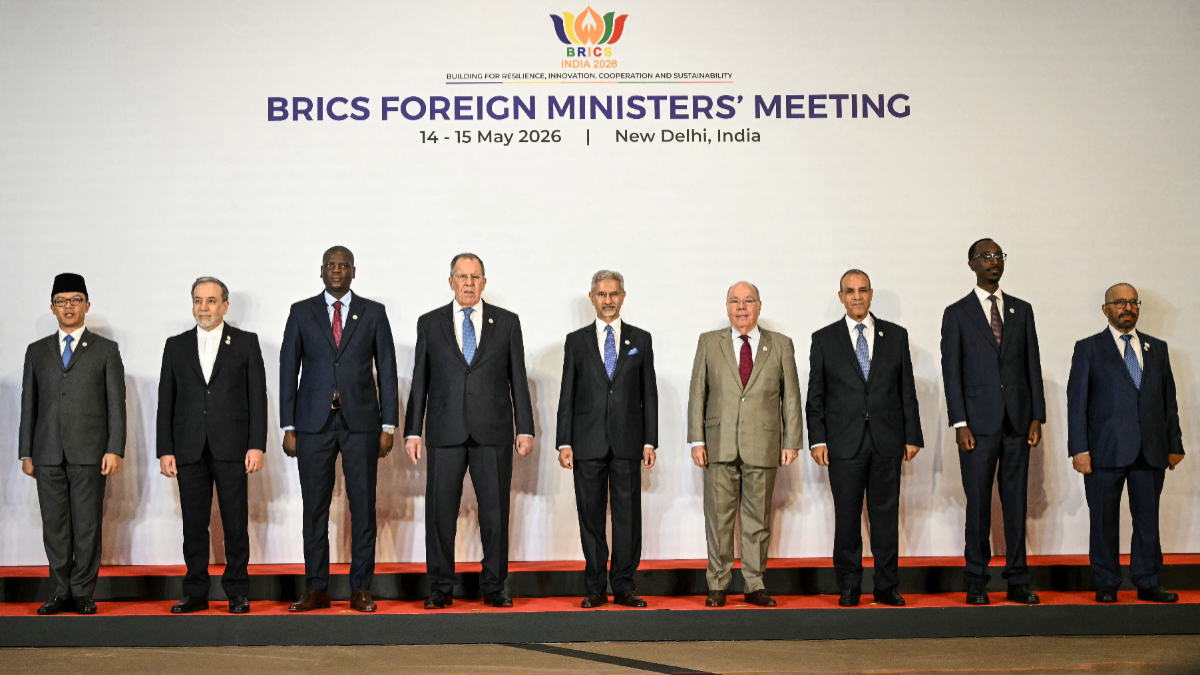
![Foreign ministers of the expanded BRICS gather in New Delhi as India leads discussions on the Iran conflict, energy security, and rising global economic uncertainty amid shifting geopolitical alliances. [Photo by Arun SANKAR / AFP via Getty Images]](https://ocdn.eu/pulscms/MDA_/56d50f9de1e1ccf322edc32eadb57630.jpg)
Foreign ministers from BRICS nations gathered in New Delhi on Thursday, May 14, 2026, with the conflict involving Iran and growing instability in global energy markets emerging as central issues in discussions, as member states assess the economic implications of a prolonged crisis.
- BRICS foreign ministers met in New Delhi as the Iran conflict and global energy instability dominated discussions.
- India warned of heightened uncertainty in trade, climate, and economic conditions shaping the global outlook.
- Energy security, particularly oil flows through the Strait of Hormuz, emerged as a key concern for member states.
- The expanded bloc continues to grapple with internal divisions while seeking a unified geopolitical voice.
The two-day meeting comes at a period of heightened geopolitical tension, with concerns over trade, energy security and economic growth increasingly shaping the agenda of the expanded bloc.
India, which currently holds the BRICS chairmanship, hosted ministers from a grouping that has grown beyond its original membership to include Egypt, Ethiopia, Iran, Saudi Arabia, Indonesia and the United Arab Emirates.
Business Insider Africa reports that South Africa's Minister of International Relations and Cooperation, Ronald Lamola, is also in attendance for the high delegation convergence.
Opening the meeting, India's Foreign Minister Subrahmanyam Jaishankar pointed to what he described as a rapidly changing international environment.
"We meet at a time of considerable flux in international relations," Jaishankar said.
He added that continuing conflicts and broader economic pressures were reshaping global conditions.
"Ongoing conflicts, economic uncertainties, and challenges in trade, technology, and climate are shaping the global landscape," he said.
Jaishankar also said expectations of the bloc had increased among developing economies.
"There is a growing expectation, particularly from emerging markets and developing countries, that BRICS will play a constructive and stabilising role," he said.
![Foreign ministers of the expanded BRICS gather in New Delhi as India leads discussions on the Iran conflict, energy security, and rising global economic uncertainty amid shifting geopolitical alliances. [Photo by Arun SANKAR / AFP via Getty Images]](https://ocdn.eu/pulscms/MDA_/5005dc421680140e3c7cffdad53fb6b6.jpg)
Among those attending the meeting were Iran's Foreign Minister, Abbas Araghchi, and Russia's Foreign Minister, Sergei Lavrov.
Energy security concerns have become a key issue for India as disruptions linked to tensions around Gulf shipping routes and the Strait of Hormuz continue to create uncertainty in oil and gas markets.
India remains one of the world's largest buyers of crude oil and depends heavily on Middle Eastern supplies. Supply disruptions have heightened concerns about inflationary pressures and their potential impact on economic growth.
Jaishankar said development issues remained central to discussions.
"Many countries continue to face challenges on energy, food, fertiliser, and health security, as well as also access to finance," he said.
The conflict has also affected India's energy strategy, with the country reportedly increasing purchases from Russia after previously attempting to reduce dependence on Russian crude under pressure from US trade policies.
Jaishankar held talks with Lavrov ahead of the wider BRICS discussions.
"Our political cooperation is even more valuable in an uncertain and volatile global environment," he said, adding that talks included trade, investment, energy and connectivity.
BRICS was established in 2009 as a platform for major emerging economies seeking greater influence within international institutions traditionally dominated by Western powers.
The expanded membership has increased the bloc's economic and political reach, but differences among members, particularly over the Middle East conflict and broader geopolitical issues, could complicate efforts to reach a common position.