AG James, Mamdani sue over new anti-immigrant benefits rule
NYC leaders challenge a new federal public charge rule that could affect immigrants seeking green cards, visas and access to public benefits. The post AG James, Mamdani sue over new anti-immigrant benefits rule appeared first on New York Amsterdam News.
 Black News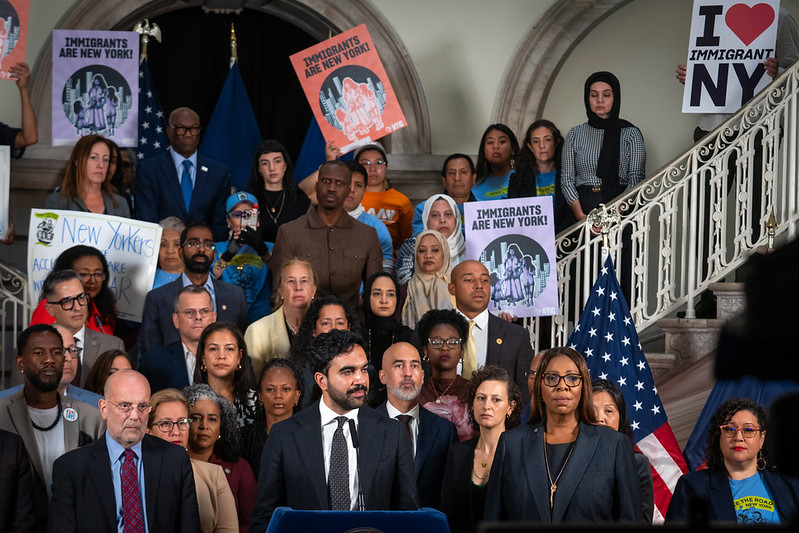

New York State Attorney General (AG) Letitia James, along with NYC Mayor Zohran Kwame Mamdani, are in a legal battle this week to push back against the Trump administration and protect the city’s immigrant families’ lawful access to public benefits.
The new U.S. Citizenship and Immigration Services (USCIS) and Department of Homeland Security (DHS) Public Charge Rule is set to go into effect this coming Friday, Sept. 18. It expands the list of public benefits, such as the Supplemental Nutrition Assistance Program (SNAP) or Medicaid, that might count against those seeking a green card or visa applicants, asylees, refugees, and immigrant juveniles in their journey to get citizenship.
“At a time when we are facing the reality of being the most expensive city in the United States of America, to see the federal government pursue rule changes and legislation that will make hungry New Yorkers hungrier, that will make poor New Yorkers poorer — it is a slap in the face to everything that we should be doing in this moment, which is to make it easier for working-class New Yorkers to afford their life here in this city,” Mamdani said at a press conference at City Hall on September 14.
According to recent city and American Community Survey (ACS) data, New York City’s population was about 8.4 million in 2023, with 6.5% being immigrants (roughly 3.1 million), primarily from Latin America, Asia, the Caribbean, Europe, and Africa. Neighborhoods throughout Queens and Brooklyn accounted for close to two-thirds of the city’s immigrant population, followed by the Bronx, Manhattan, and Staten Island.
Being a “public charge” should not be equated with dependency, said James. The first iteration of the Trump administration tried to introduce a similar anti-immigrant rule in 2019, just before the pandemic, she said, which city leaders successfully blocked in court. The earlier version of the public charge rule resulted in dropout rates from benefit programs as high as 35% among mixed-status families and as high as 60% among refugees, according to James’s office.
“That means immigrant New Yorkers may be forced to ask themselves impossible questions. Will getting health insurance hurt my chances of getting a green card? Will accepting food assistance when I fall on hard times be held against me?” said James. “No family should have to grapple with these questions, and the circumstances of this rule will extend far beyond individual immigration applications.”
The current lawsuit argues that this rule is a “capricious” violation of the Administrative Procedure Act and exceeds the legal authority of the DHS. James’s office said that in addition to immigrant families being fearful of using services, there could be an overwhelming long-term impact to safety-net hospitals; eligible students could lose out on free or reduced price lunches; and there could be a reduction in education funding, as well as direct costs to state and local governments.
The data shows that the poverty rate for the foreign-born population in NYC is slightly higher than that of citizens, and the poverty rate is even higher among certain groups, like Dominicans, Russians, Chinese, Koreans, and Mexicans. However, it’s documented that a “smaller share of foreign-born households receive public assistance” compared to those with citizenship or who are U.S-born in the city.
James and the coalition are asking the U.S. District Court for the Southern District of New York to block this “illegal” measure before this Friday, so New Yorkers can continue to access public services regardless of their immigration status.
The federal government is claiming the rule will push for immigrants to be “self-sufficient and not dependent on taxpayer-funded government benefits.” It also gives immigration officials power of discretion to decide which programs count against a person’s application.
In 2023, 69% of male New Yorkers over 16 were in the labor force. Among foreign-born males, the participation rate was higher, at 71%, than citizens or those born in the U.S., said city data. They were likely to be entrepreneurs, salary workers, government employees, or working in service jobs. For foreign-born women over 16, it was about 58%. Women were more likely to be self-employed business owners or in service roles.
“Oftentimes, the Black immigrant experience is left out,” said Public Advocate Jumaane Williams, speaking about Caribbean and African immigrants who would be affected. “With the combination of the raids that are happening, the combination of getting rid of TPS and now people trying to wade through legal arguments they may not understand, parts of our districts are ghost towns already as people are no longer coming out and supporting their businesses and now [will] have to make the decisions of whether they feed their children or not. The purpose of this is cruelty. That’s it. Cruelty and fear.”
In the meantime, Mamdani advised community members and asylum seekers against hastily withdrawing from public assistance programs, recommending instead that they consult a reliable legal provider before making any changes to their enrollment. The city also suggests contacting the Mayor’s Office of Immigrant Affairs (MOIA) hotline at 800-354-0365.
“I would like to take a moment to speak directly to those across our city who may be affected by the new public charge rule. Nothing about your or a family member’s eligibility to access benefits and services has changed,” said Mamdani.
The city said the rule does not apply to “people who already have a green card and are renewing it; people applying for U.S. citizenship; children of immigrants who are U.S. citizens; or immigrants with certain humanitarian protections, including asylum or refugee status, T visas (victims of human trafficking), U visas (victims of certain crimes), Violence Against Women Act self-petitioners, and those with Special Immigrant Juvenile Status.” It does apply to people applying for family-based visas as certain relatives of U.S. citizens and green card holders; employment-based visas for priority workers, skilled workers, and professionals; diversity visas; and S visas for witnesses and informants.
Mamdani added that in ongoing conversations with President Donald Trump about immigration policy, he’s been very clear about his “deep disagreements” with several policies, including the public charge rule.
The post AG James, Mamdani sue over new anti-immigrant benefits rule appeared first on New York Amsterdam News.