‘Art Splash’ Explores Identity and Heritage
Navigation between modernity and cultural preservation, issues of identity and the work of archiving ancestral knowledge persist in this year’s edition of ‘Art Splash’. The annual exhibition presents the output of Windhoek’s College of the Arts students and is on display at the National Art Gallery of Namibia. Featuring a selection of textiles, ceramics, linocut […] The post ‘Art Splash’ Explores Identity and Heritage appeared first on The Namibian.
 Black News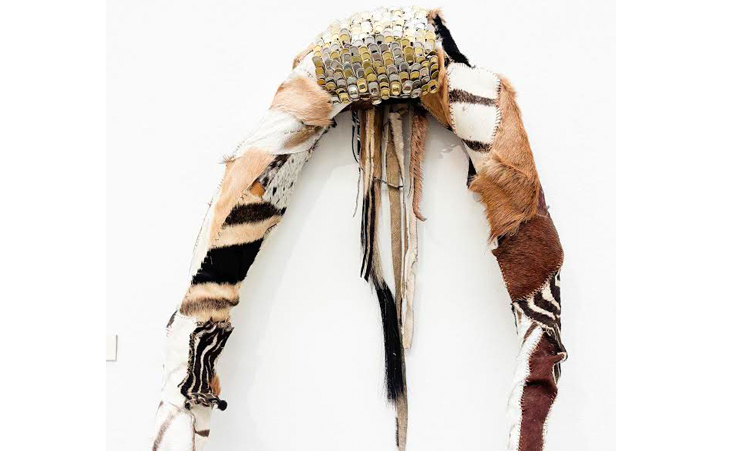
Navigation between modernity and cultural preservation, issues of identity and the work of archiving ancestral knowledge persist in this year’s edition of ‘Art Splash’.
The annual exhibition presents the output of Windhoek’s College of the Arts students and is on display at the National Art Gallery of Namibia.
Featuring a selection of textiles, ceramics, linocut and cardboard prints, installations, mixed media and photography, ‘Art Splash’ offers a preview of tomorrow’s professional artists as they develop their signature subject matter and methodologies.
Perhaps the most promising of this year’s student cohort is artist Vivian Rhoman, whose animal hide sculptures, inverted gate and striking world building reflect San iconography and dominate the main gallery.
Large scale, ambitious and assured in its visual language, Rhoman’s eye-catching installation considers the effects of post-colonial urbanisation as it reshapes culture, nature and identity.
“As cities expand and modern life accelerates, traditions, ancestral knowledge and our relationship with the natural world begin to fade. My work responds to this disconnection by drawing from San symbolism and their deep ecological wisdom, a culture rooted in harmony with land, animals and spirituality,” Rhoman says in an artist statement.
“Stitching is central to my visual language. I deliberately expose the seams to emphasise fragmentation and reconnection, revealing that what is broken can be reassembled, but its history remains visible. My own experience of feeling removed from my heritage and natural environment motivates me to create artworks that act as a bridge back to what is being forgotten.”
Artistic imperatives to preserve indigenous culture recur throughout this year’s ‘Art Splash’ showing.
In photographic portraits by Steven Banda and Angelo Neumbo, the artists incorporate traditional textiles and biblical iconography to explore ideas of identity building, religious faith and belonging between polarities of modernity and traditional culture.
“This work reflects the quiet tension between cultural inheritance and personal identity. It explores what it means to exist between expectation and self-definition, where tradition is both a source of belonging and pressure,” Banda says.
“In the first image, the subject is layered in Oshiwambo newspaper, my mother tongue, symbolising the weight of cultural expectations and generational judgement. The obscured face speaks to silencing, while long hair becomes a subtle act of defiance against imposed norms.”
In Neumbo’s photography, which depicts a young person with cultural markings on their face reading a burning newspaper, the inclusion of the newsprint refers to a perceived fault of the media.
“In the first piece, an upside-down, burning newspaper serves as a critique of a media landscape that distorts the truth and labels traditional heritage as primitive or ‘backward’,” Neumbo says.
“The collection culminates in an exploration of cultural syncretism, blending Christianity with my Oshiwambo heritage. Here, my hair serves as literal roots connecting the crown of thorns to the traditional odelela cloth, questioning whether we are losing our culture to modern faith or if we are firmly anchoring our traditions within it,” Neumbo says.
“Together, these images serve as a visual record of the struggle to remain rooted while the world attempts to set our foundations on fire.”
Also concerned with the state and stakes of culture in contemporary Namibian society is artist Kavenandangi Karuuombe, who carves a series of traditional Ovaherero tools in a bid to archive their forms and discuss their historic functions.
“The collection on display invites a contemporary exploration of the intersection between utility and identity. These aren’t merely implements for survival, they are a physical testament to a rich cultural heritage, where every curve of wood and shaping of horn tells a story of ingenuity, adaptation and an enduring connection to the land and its resources,” Karuuombe says.
“By examining these artefacts, we gain insight into the social fabric and historical struggles of the community. The pieces stand as silent witnesses to a history that has shaped modern Namibia, serving as a powerful reminder of ancestral strength and the importance of documenting and preserving cultural identity for future generations.”
In textiles by Maveja Tjimbi, owela is celebrated as the traditional game’s board, its seeds, structure and players become striking elements of design. Through Tjimbi’s stylish, modern and functional application, heritage is printed onto textiles that may become clothing, curtains, cushions, bedspreads, bags or tablecloths, which subtly incorporate elements of indigenous culture into the everyday.
While reflections on traditional culture and identity are some of this year’s dominant themes, ‘Art Splash’ presents work by numerous artists. Romany Mongonga’s linocut redesigns of alcoholic beverage labels highlight the issues and repercussions of underage drinking.
Patrick Shilongo’s cardboard and linocut print series of swimmers caught in flip turns, butterfly strokes and relay races are niche and of note, while Michael Abraham zooms in on local cityscapes in an exploration of urban geometry, shadows and silhouettes.
An auspicious and considered showing by this year’s Cota cohort, ‘Art Splash’ will be on display at the National Art Gallery of Namibia in Windhoek until 23 May.
– martha@namibian.com.na; Martha Mukaiwa on Twitter and Instagram; marthamukaiwa.com
The post ‘Art Splash’ Explores Identity and Heritage appeared first on The Namibian.