China hands over $56.5 million ECOWAS HQ in Nigeria, expanding influence in West Africa
China has formally handed over a newly completed $56.5 million headquarters complex to the Economic Community of West African States (ECOWAS) in Abuja, marking one of Beijing’s most prominent institutional projects in West Africa.
 Black News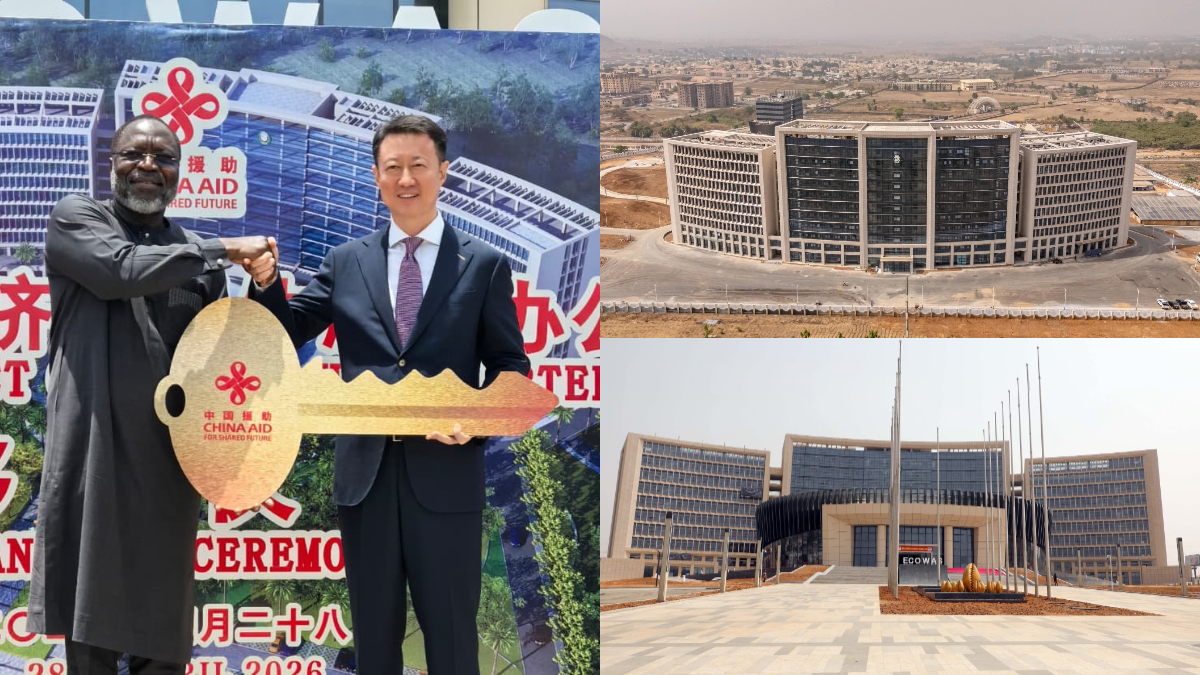
![The newly constructed ECOWAS Headquarters in Abuja, Nigeria, a gift from China. [X, formerly Twitter/TVC and Carlos Lopes]](https://ocdn.eu/pulscms/MDA_/0c6afb1980cf0c0acb3de9a6af5e4531.jpg)
China has formally handed over a newly completed $56.5 million headquarters complex to the Economic Community of West African States (ECOWAS) in Abuja, marking one of Beijing’s most prominent institutional projects in West Africa.
- China has formally handed over a $56.5 million ECOWAS Headquarters Complex in Abuja, completed in under two years.
- The project is positioned as a flagship infrastructure gift intended to strengthen regional administrative capacity.
- Chinese officials described the building as a symbol of demand-driven cooperation and non-interference diplomacy.
- ECOWAS leadership praised the speed of delivery and collaboration between Chinese and regional technical teams.
The facility, funded by the People’s Republic of China, was delivered in under two years and is expected to serve as the main administrative hub for the regional bloc.
At the handover ceremony, China’s ambassador to Nigeria, Yu Dunhai, described the complex as a flagship aid project designed to strengthen institutional capacity within ECOWAS.
He said the building would provide “a robust foundation” for advancing regional development goals, while framing the project as part of China’s broader engagement strategy with African institutions.
Beijing stresses the non-interference model
![The newly constructed ECOWAS Headquarters in Abuja, Nigeria, a gift from China. [X, formerly Twitter/Carlos Lopes]](https://ocdn.eu/pulscms/MDA_/3bbcd6dc360673041618469fdef92ff3.jpg)
Yu also emphasised Beijing’s longstanding diplomatic stance, stating that cooperation with African partners is based on “non-interference” and comes with “no political strings attached.”
He added that China supports African countries in pursuing development models suited to their domestic contexts and seeks to amplify the continent’s voice in global affairs.
The ECOWAS Commission President, Omar Touray, accepted the facility on behalf of member states, highlighting the pace of construction and the collaboration between regional and Chinese teams.
He noted that engineers and technical staff from both sides worked “day and night” to complete what he described as a regional landmark.
Touray also acknowledged the role of consultants and oversight teams in ensuring adherence to quality standards throughout the project, noting that joint coordination between ECOWAS officials and Chinese contractors was a key factor in meeting delivery timelines.
The complex is expected to be formally inaugurated later in the year by Sierra Leone’s President, Julius Maada Bio, who currently chairs the ECOWAS Authority of Heads of State and Government, alongside Nigeria’s President, Bola Ahmed Tinubu, and other regional leaders.
Nigeria’s Minister of State for Foreign Affairs, Bianca Odumegwu-Ojukwu, described the project as a reflection of expanding ties between China and West Africa.
She said the development illustrates “fruitful and progressive relations” between both sides, while signalling continued cooperation on infrastructure and institutional support.
![The newly constructed ECOWAS Headquarters in Abuja, Nigeria, a gift from China. [X, formerly Twitter/Carlos Lopes]](https://ocdn.eu/pulscms/MDA_/43250841666b960dc92af2650b82ff5f.jpg)
The handover comes amid growing Chinese investment across Africa, particularly in infrastructure, public buildings, and energy projects.
Analysts often view such projects as part of Beijing’s broader effort to deepen economic and political influence across the continent, though Chinese officials consistently frame them as mutually beneficial partnerships driven by local demand.
For ECOWAS, the new headquarters is expected to consolidate its operations in Abuja and enhance coordination among its 15 member states, at a time when the bloc faces mounting regional challenges, including political instability and pressures to deepen economic integration.