Dangote cuts petrol and diesel prices as Africa’s largest refinery expands market influence
Africa’s largest refinery has cut fuel prices again, strengthening its growing influence over Nigeria’s energy market at a time when many African economies are still struggling with high fuel costs, currency pressures and stubborn inflation.
 Black News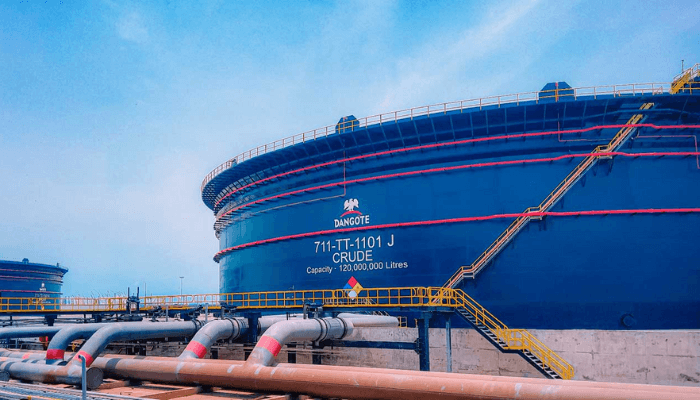

Africa’s largest refinery has cut fuel prices again, strengthening its growing influence over Nigeria’s energy market at a time when many African economies are still struggling with high fuel costs, currency pressures and stubborn inflation.
- Dangote Refinery has reduced petrol and diesel prices again, with diesel recording the biggest cut.
- The move comes as global oil prices ease amid renewed diplomatic efforts between the US and Iran.
- The refinery is becoming increasingly influential in Nigeria’s fuel market as imports decline.
- The development could provide relief for businesses facing high transport, logistics and power costs.
Dangote Petroleum Refinery announced on Saturday that it had reduced the ex-depot price of petrol to approximately $0.81 (N1,250) per litre from $0.83 (N1,275), while diesel prices were cut by a more significant 5.6% to about $1.10 (N1,700) per litre from $1.16 (N1,800).
The latest reduction comes as global oil markets show signs of stabilising following renewed diplomatic efforts between the United States and Iran, easing fears of disruptions along the Strait of Hormuz, a critical route through which roughly a fifth of the world’s oil supply passes.
While the petrol reduction is modest, the diesel cut could have wider economic implications.
Diesel powers trucks, factories, farms, mines and generators across Nigeria’s economy. Lower diesel costs can help reduce transportation expenses, ease pressure on manufacturers and support businesses that rely heavily on self-generated electricity.
For Nigeria, where energy costs remain one of the biggest drivers of inflation, the move could offer some relief to businesses and consumers already grappling with elevated living costs.
A different path from much of Africa
The reduction also highlights a growing divergence between Nigeria and several African countries that remain heavily dependent on imported fuel.
In countries such as Kenya, fuel prices continue to be influenced not only by global oil markets but also by taxes, levies, exchange-rate pressures and import costs.
Similar challenges persist across parts of East and Southern Africa, where governments and consumers remain exposed to swings in international energy prices.
Nigeria, despite being Africa’s largest oil producer, spent decades importing most of its refined petroleum products.
That dependence left the country vulnerable to foreign exchange shortages, supply disruptions and rising global fuel costs.
The emergence of the 650,000-barrel-per-day Dangote Refinery is beginning to alter that equation.
Built by Nigerian billionaire industrialist Aliko Dangote, the refinery has steadily increased supplies to the domestic market since commencing operations, reducing the need for imported fuel and reshaping competition within the downstream sector.
Dangote’s growing pricing power
The latest adjustment underscores how quickly the refinery is becoming a major price-setter in Nigeria’s fuel market.
Industry analysts expect fuel marketers and filling stations sourcing products from the refinery to gradually reflect the lower costs in retail pump prices, although the extent of those reductions may vary depending on logistics and distribution expenses.
The refinery said the review forms part of its efforts to improve supply efficiency, deepen domestic refining and provide cost relief to consumers and businesses.
Its growing role is being closely watched across Africa.
Several governments on the continent are seeking ways to reduce fuel import bills that drain foreign exchange reserves and expose economies to external shocks.
Nigeria’s attempt to build a domestic refining ecosystem is increasingly being viewed as a test case for how resource-rich African countries can capture more value from their natural resources.
Fuel prices remain far above previous levels
Despite the latest reduction, fuel prices remain significantly higher than levels seen earlier this year.
Before the recent spike in geopolitical tensions and oil market uncertainty, petrol sold for around N870 per litre in parts of Nigeria.
Prices have since climbed to around N1,370 and above in several cities, reflecting how global events continue to influence energy costs even in oil-producing nations.
Whether the latest reduction translates into broader consumer relief will depend on future crude oil movements, domestic supply conditions and the ability of marketers to pass lower costs through to motorists and businesses.
For now, the latest cut signals another step in Dangote Refinery’s emergence as one of the most influential energy assets on the African continent, and a growing force in determining how much millions of Nigerians pay for fuel.