Deadly Mali clashes expose growing Russia-West rivalry in Africa’s Sahel
Heavy fighting has erupted across Mali following a series of coordinated attacks by armed groups, prompting intervention by Russia’s Africa Corps and raising fresh concerns over foreign involvement in the Sahel’s worsening security crisis.
 Black News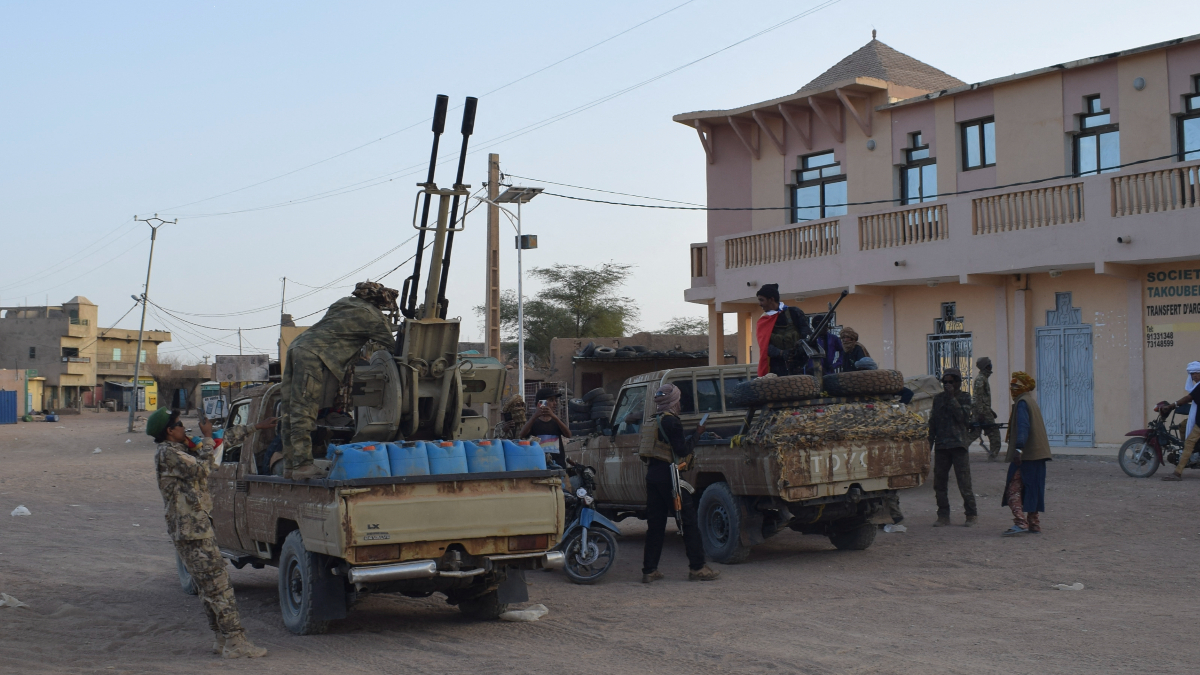
![Tuareg rebels of the Azawad Liberation Front (FLA) ride on the back of pickup trucks in Kidal, on April 26, 2026. [Photo by abdollah Ag Mohamed / AFP via Getty Images]](https://ocdn.eu/pulscms/MDA_/bb8826e35bd182bc0aad55aa03f38bd0.jpg)
Heavy fighting has erupted across Mali following a series of coordinated attacks by armed groups, prompting intervention by Russia’s Africa Corps and raising fresh concerns over foreign involvement in the Sahel’s worsening security crisis.
- Coordinated militant attacks across Mali have triggered heavy fighting and heightened political tensions.
- Russia’s Africa Corps claims it helped repel the offensive and prevent key state institutions from falling.
- Allegations of foreign involvement, including links to European and Ukrainian actors, remain unverified.
- The escalation underscores Mali’s deepening security crisis and its growing role in global geopolitical rivalries.
The clashes began on Saturday, April 25, 2026, when militants launched simultaneous assaults on multiple locations, including the capital, Bamako, as well as Kati, Gao, Kidal and Sévaré.
According to Russia's Pivot to Asia, the attacks mark one of the most extensive offensives in the country in recent years and underscore the fragile state of Mali’s security landscape.
Authorities say the violence resulted in the death of Defence Minister Sadio Camara, a development likely to deepen instability within the country’s military leadership. While official casualty figures remain unverified, Russia’s Africa Corps claimed the attacks were part of an attempted coup and said its forces played a role in preventing key government institutions from being overrun.
In a statement, the group said it had provided air support and held strategic positions along a roughly 2,000-kilometre фронт, adding that “the seizure of critical facilities, including the presidential palace in Bamako, was prevented.” It further alleged that militant casualties exceeded 1,000 and that more than 100 vehicles were destroyed. These claims could not be independently confirmed.
The Africa Corps also asserted that the attacking forces numbered between 10,000 and 12,000 fighters and accused European- and Ukrainian-linked operatives of supporting the offensive, including by using Western-made air defence systems. No evidence has been publicly presented to substantiate these claims, and there has been no immediate response from European or Ukrainian authorities.
The Russian Foreign Ministry echoed the allegations, stating that preliminary information suggested Western security services may have been involved in training elements of the attacking groups. The accusations reflect a broader geopolitical contest playing out in the Sahel, where Russia has expanded its footprint as Western influence, particularly that of France, has waned.
Mali, a former French colony, has in recent years shifted away from its traditional Western partners, citing dissatisfaction over security cooperation and allegations of external interference. The country remains a key player in Africa’s gold sector and an important agricultural producer, but persistent insurgency and political instability continue to threaten economic progress.
Russia’s Africa Corps, formed in 2023 following the restructuring of the Wagner network, operates in several African countries, including Mali and the Central African Republic, with a mandate that includes counter-terrorism support and military training.
The latest escalation highlights the growing complexity of the conflict, as local insurgencies intersect with international rivalries, leaving Mali at the centre of an increasingly contested geopolitical battleground.