“I didn’t care if I got sacked”: Sleazenation’s Scott King in conversation with Radge’s Meg McWilliams
Radgenation — For our 20th Anniversary Issue, Huck’s editor Josh Jones sits down with the legendary art director and the founder of a new magazine from England’s northeast to talk about taking risks, crafting singular covers and disrupting the middle class dominance of the creative industries.
 Black News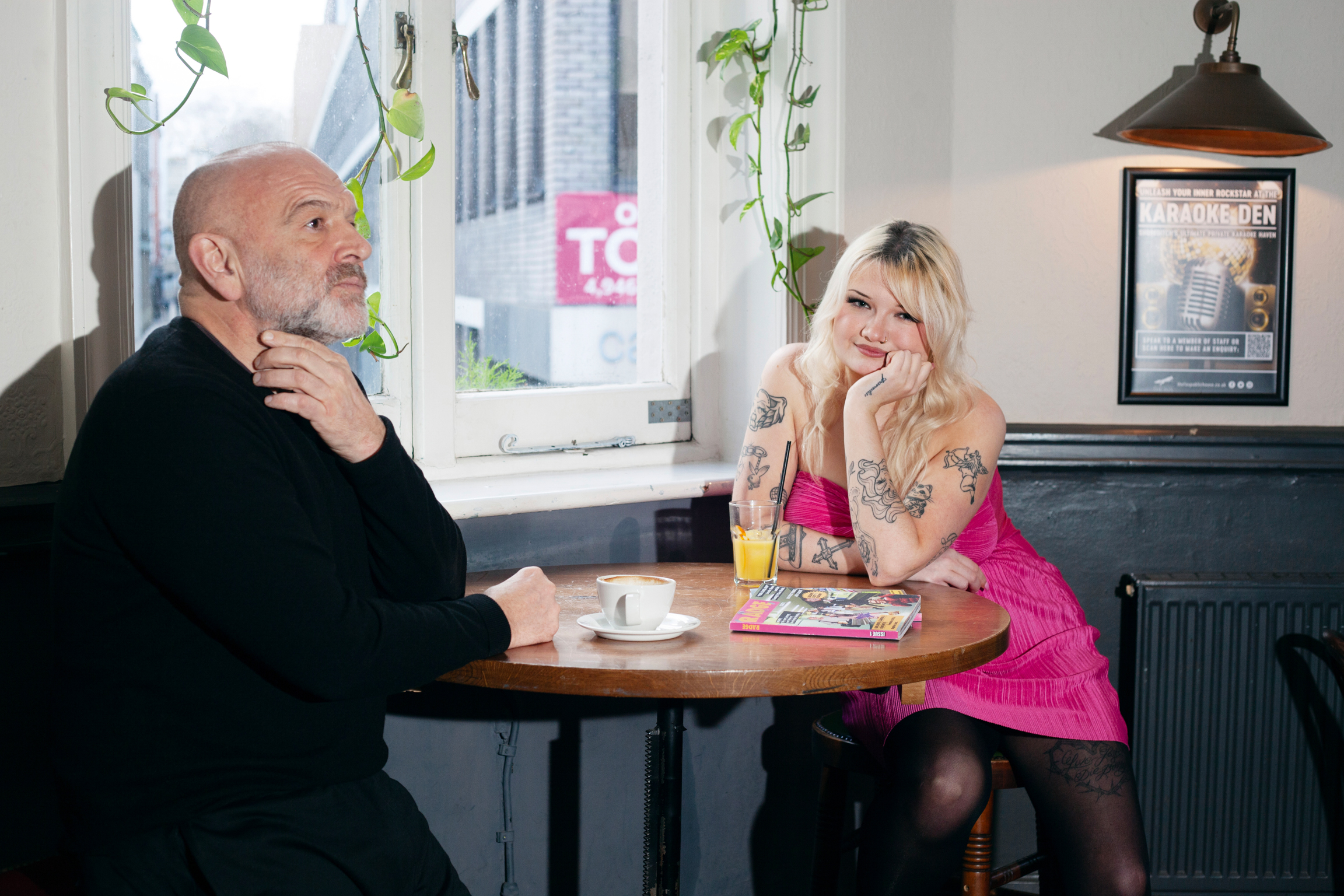

Radgenation — For our 20th Anniversary Issue, Huck’s editor Josh Jones sits down with the legendary art director and the founder of a new magazine from England’s northeast to talk about taking risks, crafting singular covers and disrupting the middle class dominance of the creative industries.
This story is originally published in Huck 83: Life Is a Journey – The 20th Anniversary Issue. Order your copy now.
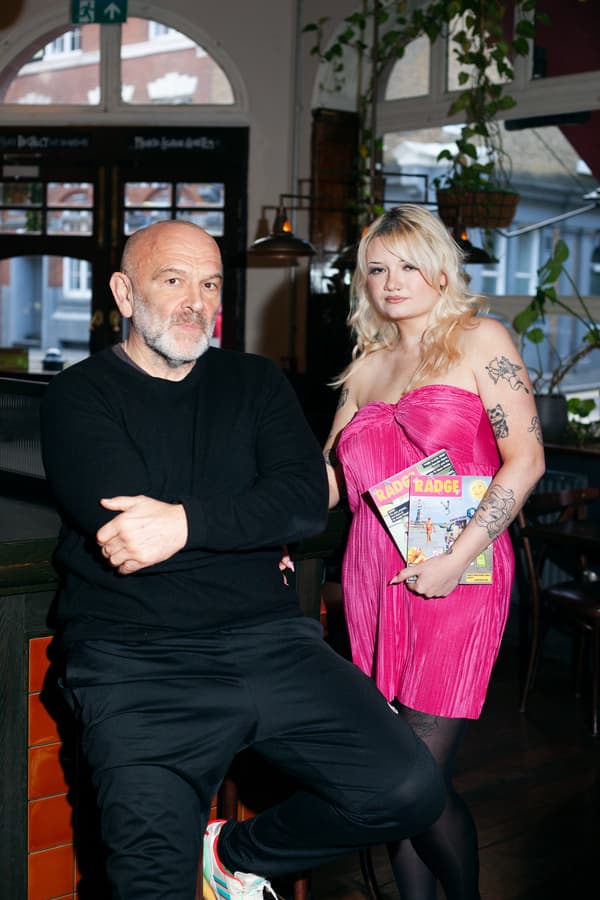
Huck brings two seemingly opposite people together – because this exuberant 24-year-old from England’s North East and a gruff Yorkshireman, a generation older, actually have a lot in common.
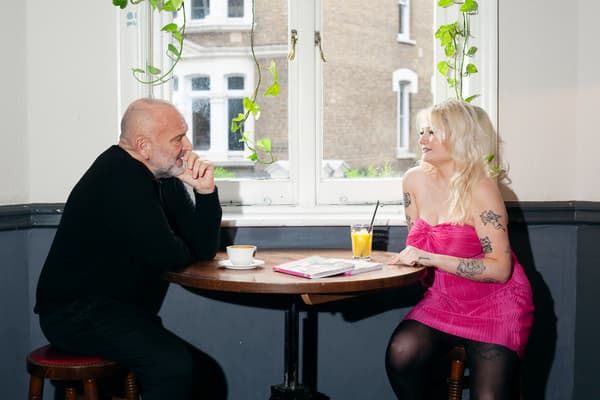
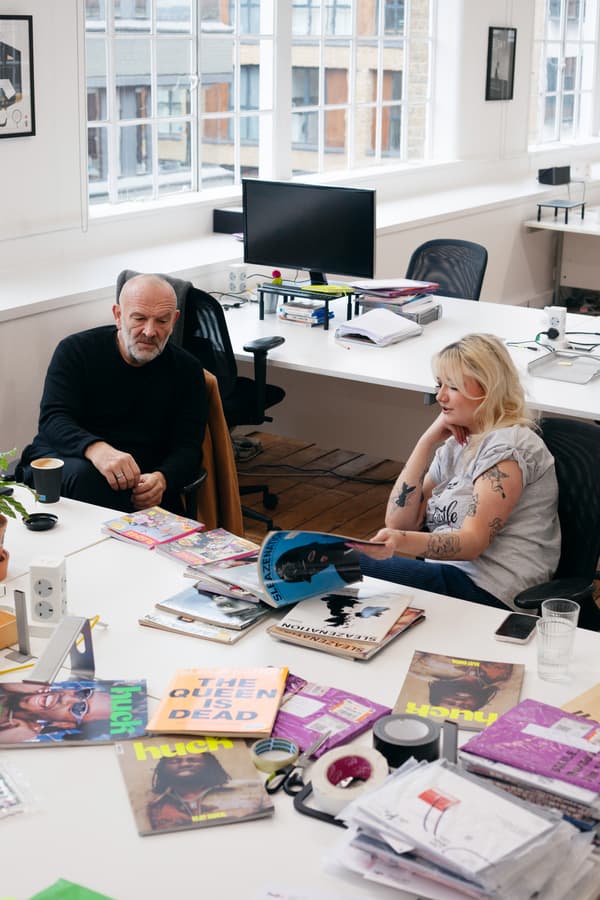
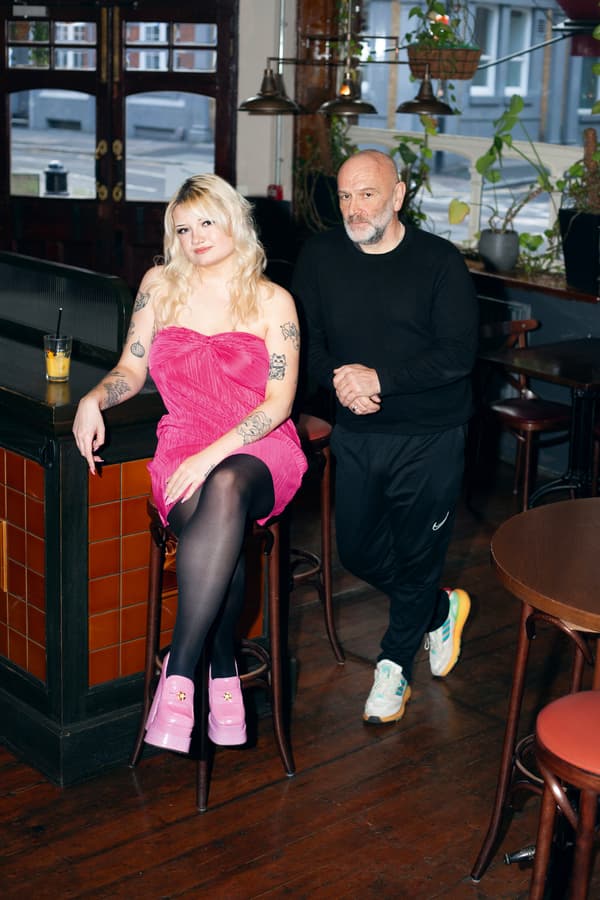
The pair are Scott King, the renowned art director who created some truly legendary magazine covers and features for late ’90s mould-breaking magazine Sleazenation, and artist Meg McWilliams who set out on her own with Radge Magazine, her new(ish), no-holds-barred celebration of northern working-class culture.
Sleazenation was a big part of Meg’s mood boards when starting Radge. So Scott, how does it feel for you to be still influential with what you’ve done?
SK: I’m very honoured that younger people like Meg are interested in that stuff. It’s particularly the covers that people still remember and are influenced by. When we did them, which weirdly was in this building, 25 years ago, I was very young. and I was very confident in myself and very confident these were great covers. I thought it was an unwritten rule because Sleazenation paid me very little, I could do what I wanted. That was always my attitude – I didn’t care if I got sacked and I’d push it as far as I could. I’m glad that attitude has seemingly had some kind of resonance and for it to have sort of taken a, even if very minor, foothold in magazine history. I’m very happy people are still interested in these covers and that attitude.
I like to think of it as fearlessness rather than arrogance, and I get that same vibe from Radge. Like, why do I have to adhere to these rules? It’s like, I’m gonna do it because I can do it.
SK: Arrogance and fearlessness are not the same. Meg, what you’re doing is fearless. It’s not arrogance. It looks like you’re doing your own thing, it’s standing up and saying something. With magazine covers there’s great pressure, even at Sleazenation, certainly towards the end of my time there, to put a star on the cover and list all the contents. They believed this would sell the magazine on the shelf. Of course, it never would. If Sleazenation had Kate Moss, Naomi Campbell or a mega pop star of the time on the cover, I dare say they would have sold more copies, but they’d also have lost their identity. But you can only forge your own identity yourself, and it can only be your language.
What was it about Scott’s Sleazenation work that inspired you with Radge?
MM: The fearlessness of it. I’ve always had a “don’t give a fuck” attitude and sometimes it’s got me in trouble. Like you said Scott, I felt, “What have I got to lose?” It’s my magazine. What am I going to lose other than money? But that’s it. I’m not going to lose anyone’s respect. In fact, I’ve gained respect. So I just love how your covers are humble but still powerful. You notice them straight away. If you took the Sleazenation masthead off it, you would still know it was a Sleazenation cover and I think that’s kind of what I wanted to put into Radge.
SK: That’s good thinking, and I think you’re right. Looking at Radge, these covers are absolutely yours.
MM: People have asked me about having a cover star on the front rather than inside and I never have. I think especially in today’s world, where we idolise people, I don’t want to stick someone on the front cover for fans to buy it. I want you to buy it because you’re a fan of Radge, not because you’re a fan of the person in it. I’ll stick their little heads on the cover in the collage to let you know they’re in there.
SK: I think that’s an interesting point you’ve said Meg, in that you’ve got nothing to lose. And that’s a really great position to start doing anything from, whether it’s forming a band or making a magazine or whatever else you do.
MM: Before I made Radge I was a published artist, so I’ve had a few exhibitions at The Baltic in Newcastle, and I always felt galleries are pretentious bullshit, especially if you’ve got funding and you have to follow their guidelines. For Radge, I’m funding it myself, so I have no guidelines.
SK: That’s good, and I think within all established elements of culture, there’s a kind of wilful pretentiousness, certainly linguistically. The art world in particular, has to create this semi-impenetrable language in order to justify what it does. They welcome some people in and keep certain people out. The idea of a magazine is more democratic – maybe it’s nearer to making a pop song or something and you can speak to more people, which I think you seem to be doing.
MM: I feel like a lot of working class people don’t think galleries are very welcoming spaces, so I still see Radge as a work of art, but it’s accessible artwork. You don’t have to sit and think: “Why is there a brick on this plinth?” Radge is matter-of-fact. It does what it says on the tin.
Read next: Wu-Tang Clan forever, and ever
“It occurred to me that the magazines that people call iconic always come down to two things: a really great front cover and one very memorable visual story.”
Do you view your magazines and covers as art pieces?
SK: My thinking about any piece of design is the relationship between the subject, the medium, and the context. They’re the framework in which you have to work as a designer. For most graphic designers with, for instance, a theatre poster, their job is to choose or make the best images and font combinations and all that kind of stuff. But I didn’t think about things like that. I thought that’s the subject area, I thought primarily about the context. I thought: “Well, where is the theatre poster going to go? What would be most impactful, challenging and striking and all these things?” I suppose that is more like thinking like an artist, or a conceptual artist rather than a graphic designer.
MM: I started out doing Fashion Communications, but I specialised in graphic design and journalism was one module. I’m the same as you Scott, I’m an artist, but using graphic design. Whenever I think of a Radge front cover, I think of it as an art piece – I know what I want it to look like before I start. I feel that using collage is eye-catching. I don’t know whether you do this, but I visualise it. I visualise the covers in my head before I do it, and that’s what inspires me to do it. Having a good front cover is a must.
SK: When I started doing Sleazenation, after I’d been at i-D, it occurred to me that the magazines that people call iconic always come down to two things: a really great front cover, and one very memorable visual story. At Sleazenation, that was all I had in my mind. I thought everything doesn’t have to be brilliant, but I have to have a brilliant cover and have to have one brilliant story. That was my way of doing it, so I understand what you’re saying, Meg. If you know you’ve got a cover in mind, you’ve got a great cover, then you sort of everything else will fall into place somehow.
MM: Everything just comes after that. I think the cover sets the tone for the rest of the magazine for me. It’s like the packaging of the magazine, isn’t it? It’s the first thing anyone sees. People have told me that the front cover of Radge has stopped them in their tracks.
SK: And that’s what it’s meant to do.
I read, or you told me, or I read somewhere that you wanted covers to almost be censored by the shopkeepers. You wanted to push it that far.
SK: It was a fantasy yeah. It was one of my secret goals to try and get it banned because Wolfang Tillmans, who is an old friend of mine from the i-D times, did a story in i-D in ’91/’92 called ‘Like Brother Like Sister’ featuring his model friends Alex and Lutz. They were naked in trees and stuff, and it was a slightly crusty fashion story. But the title of the feature got it banned. WH Smith got it taken off the shelves and it almost ruined i-D. I thought it was fucking great – because obviously I just wanted to be a Sex Pistol, I didn’t really want to work in magazines. So that was always in my mind. The cover I did with a policeman in a balaclava was kind of self-cancelling because at that time there was still the threat of the IRA, and the image of it was different than today. So the idea was to combine a clichéd terrorist image with a British bobby. I thought that might finally get it taken off the shelves. But it didn’t.
Read next: The future is written
How far are you trying to push things Meg? Really, just trying to do what you want.
MM: I’m always going to do what I want. I’m the type of person that if I can’t, then I just won’t do it. Radge is my baby, so I’m going to do what I want with it. I’ve turned down collaborations and commissions with people that have wanted me to censor myself. I won’t do that, even if it means I won’t get money. I don’t know if that’s me just being a gobby Northerner, but I just don’t like being told what to do.
SK: I think you’ve just got to make that choice, haven’t you? If you want Radge to be commercially successful then you’d choose to do that and take the money. But as I understand it, that’s not why you’re doing it anyway. You’re doing it because you want this space in which you can be yourself and it seems you didn’t like the space offered in galleries or wherever. With magazines – and I think with any kind of design – it’s about thinking about it as a blank space in which you can do anything. You often look at things in art galleries and think: “This would be so much better if it wasn’t here.” I always think of The Beatles’ White Album cover, which was designed by Richard Hamilton. It came out at the height of psychedelia in 1968 – if you’d gone into record stores and looked at the albums they’d have looked amazing, all Jimi Hendrix and The Doors etc. So to put a blank space at number one – because you knew The Beatles were going to go straight there – was just amazing. Visually what you’re doing with Radge clearly isn’t a blank space but I think it is metaphorically. It’s yours and you can do whatever you want. As an artist or designer, that’s a great thing to have.
MM: The main drive for Radge has been there wasn’t that space – especially in the North East, there’s never been a space for working class artists unless it’s been an open call or open submission. The art scene was quite dead and I was speaking to so many people who were thinking the same way. So I thought, “If we’re not getting these opportunities, why don’t we just create them ourselves? We go out every weekend and it’s normal to us but other people think this is interesting. Why don’t we just do something about it?” So I started Radge. First of all because I just love the word. It can be used for everything. Calling someone a radgie means you’re mental and chaotic. It’s Geordie slang and I always call things radge. I went to university with this girl who was dead posh and from the south of England, and she asked me once: “What does radge mean?” and that’s when I knew what I was going to call the magazine.
“This dead posh girl asked me, ‘What does radge mean? and that’s when I knew what I was going to call the magazine.”
You’re both northern, working-class and went to college near where you grew up. Are you glad you didn’t come to London for art college?
SK: I came to London when I was 22 and I’ve been here ever since. But to be really honest, there’s a fear, and I still have it. It’s not a physical fear, but the fear of getting things wrong, of not being smart enough or using the wrong fork at dinner – these kinds of working-class fears of the middle class. I had that and I still do to a degree, but also there’s a geographical and scale thing. I’m from a village called Airmyn, next to a small town called Goole and I went to college in Hull, so it was quite easy at college for me to feel like I was in charge of doing my own thing. But then I came to London, a city of millions of people from all over the world and suddenly you’re swamped, and it’s quite hard to find direction and the confidence to find your direction again. I was very lucky, in retrospect, because I’d just turned 23 when I went to i-D, with its great history of design and photography. But again I was swamped again by someone else’s opinions. I learnt a lot there but it’s hard to come out of college and think you know more than Terry Jones, because you don’t. It sounds corny but it’s constant learning and trying to find a way that you might have a voice, no matter how small it might be. To a degree I did feel like that with Sleazenation, where I was confident enough to say, “I’m right.” Even at my age I have to convince myself that I’m right. With magazines there’s the big star on the cover and the lines listing what’s inside, so you’re going up against a consensus, always. That's why I was saying to Meg about the idea of space, where you’re looking for a space of your own and use your own voice.
MM: I got offered a place at Central Saint Martins but decided to go to Cumbria. I’m glad that I chose to stay in the north, where there’s a support system of my creative friends. All my friends are drag queens.
SK: I bet you have some good nights out.
MM: [Laughing] I moved nearer to Newcastle but I’m originally from Darlington. There you basically leave school, maybe do a hair and beauty course, get a job, have some kids and then that’s it. A lot of people from school have done that, and they seem happy and good for them. Going to Newcastle when I was 18 and surrounding myself with the queer community was really beneficial for me because I wasn’t getting drowned out by the voices from school where people might have felt I was embarrassing for choosing this avenue. Having time to grow up and experience people’s artistic influences did so much. Growing up in a small northern town, you don’t get exposed to art and culture so it was so good to be exposed to all this stuff before I was 21.The middle and upper classes dominate so much of the arts industry, it kind of sets you apart being working-class. Even though they look down on you and you have, like Scott says, the fear of using the wrong fork. I think being working-class and being around drag queens has shaped all of what I do.
Read next: Joe Bloom’s View From a Bridge
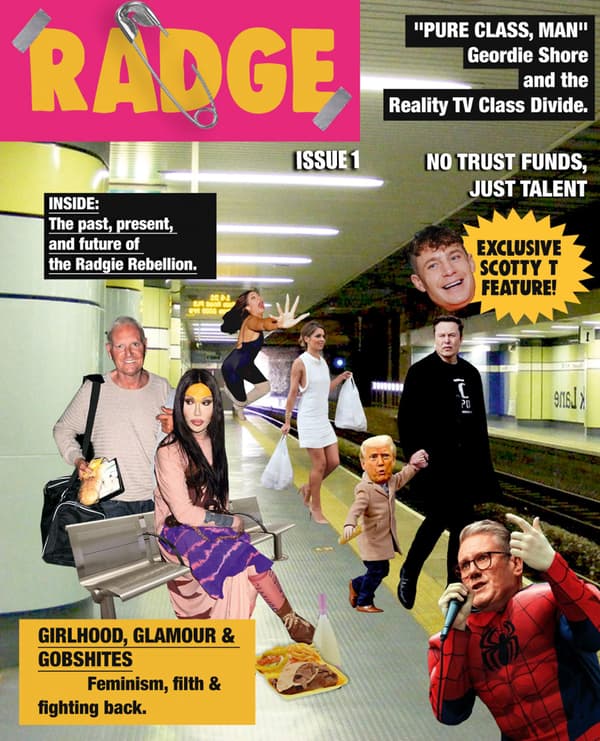
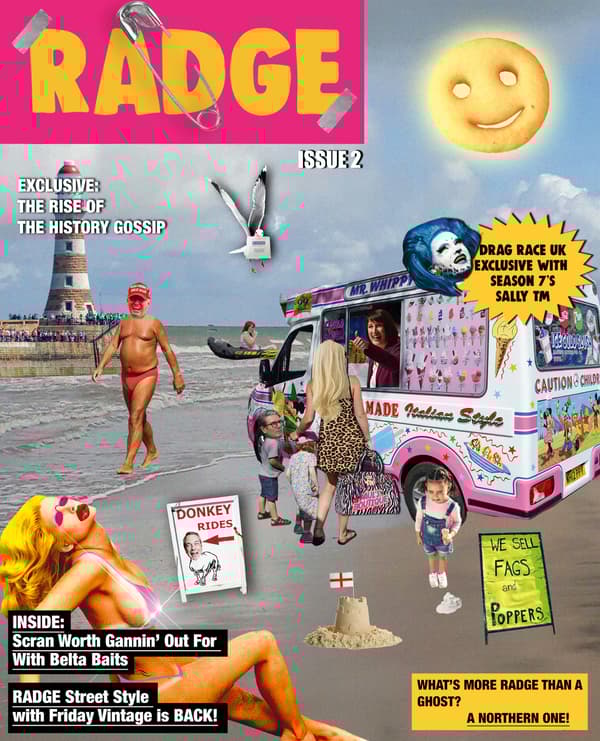
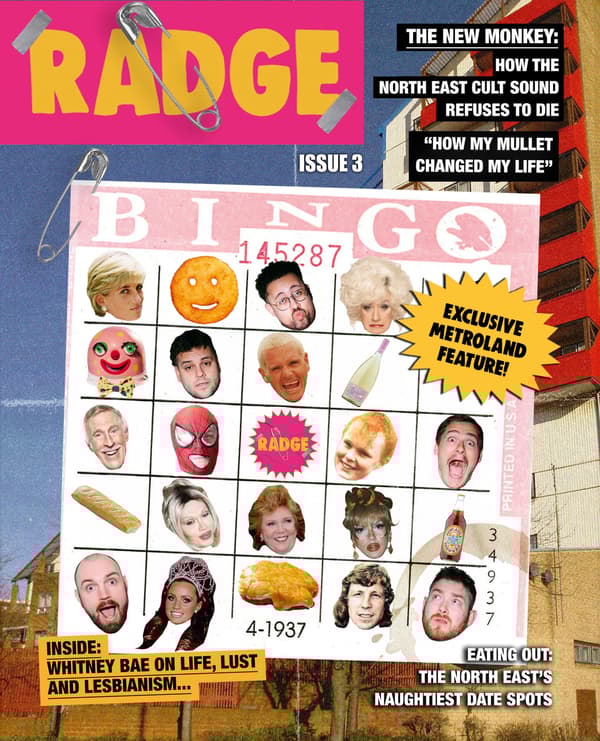
Not having much money can easily make a better magazine because of the resourcefulness you have to have. It brings me to Scott’s legendary fashion feature ‘Epidemic’, which I think is one of the best ideas in magazines. To fill pages with hardly any budget with press photos of football hooligans and crediting what they were wearing. Would you say by not having a lot, it makes you more creative?
MM: Definitely. I’ve always been used to having nothing, so making something from nothing was like instinct. All of the magazine is me. I’ve not taken any money from it really. It’s all gone back into the magazine and it keeps you humble – just not taking the piss with money, it’s really good for budgeting because you’re not used to having money to spend. I did a talk recently in Durham and I was saying that the epitome of being posh when I was growing up was having an ice machine in your fridge.
SK: That would be a good feature for Radge – “What Is Posh?”
MM: I’ll write that down! My best friend is a drag queen called Whitney Bay and she’s doing an agony aunt column for my next issue and the whole photoshoot was done in her living room with a few ring lights. Her boyfriend's an amateur photographer but that really gives it our look. The Radge look is punk and DIY so I think people would be a bit confused if all of a sudden it's got a glossy cover star on the front.
If you’d gone to Oxbridge and came from Surrey then people would view ‘Epidemic’ in a totally different way. It would be seen as punching down and mocking.
SK: I hadn’t thought about that and I suppose it’s true. When we did the ‘Epidemic’ story there had been a rise in hooliganism and it had become ugly. I know that sounds contradictory but there was more racist chanting and Nazi salutes and all these terrible things. And more central to this culture, the clothing had gone downhill. When I was a teenager in the ’80s, the hooligans looked amazing and that was the whole point, they were peacocks. They looked fantastic, it wasn’t about the theatre of violence, it was about the clothing. When you saw these knob heads in ‘Epidemic’ wearing Union Jack hats and tabloid sponsored t-shirts, they looked terrible.
You have to be a bit of a megalomaniac to be an art director or editor, or both.
SK: You’ve got to be totally. If you want to keep your job you don’t have to be, and if you want to do well then you don’t have to be. But if you want to do something that you think is brilliant and want to get anywhere near genius, then you have to be. Because, like everything else, magazines are run by consensus. If you did a poll and asked everyone in the office what they thought, you’d end up doing something really shit because it would be a compromise. I always think being an art director of a magazine is like being a football manager – you’ve got to do it your way, you’ve got to be in charge, you’ve got to be an arsehole when you need to be. But you run the risk everyday of being sacked for being an arsehole.
MM: I have had to have HR meetings with myself!
SK: For me, someone like George Lois, the American art director of Esquire who did that cover with Mohammed Ali as Saint Sebastian, shot with arrows, that was genius, especially at the time when Ali had been made a pariah after refusing the draft for Vietnam. I dare say in popular culture, Ali was one of the most important figures of the century, and to put him there on a white background with the arrows, I can’t imagine that with a cover like that everybody just said: “Oh that’s brilliant! Let’s do that!” Can you imagine the amount of arguments and fights George Lois must have had? If George, and whoever supported him, hadn’t fought for that then we wouldn’t be talking about it now. That changed the language of what a magazine cover could be. It was absolutely genius.
What happens if Radge gets to a stage where it needs more staff?
MM: I think I’ll always do the graphic design. The visual language of Radge is me, and I don’t think anyone could do it like me. It sounds so arrogant doesn’t it? But graphic design is my passion. Every page is so cohesive because it’s me designing it. I always want to be hands on, all the time. I just want someone to do social media. What I've learnt about collaborating with other people is you’ve got to work with them before you get them in on something you’re so passionate about. You’ve got to be radge to work for Radge.
Final thoughts?
MM: Do you have any advice to give someone like me, who’s just starting out?
SK: It depends what you want. I’d absolutely say to carry on with what you’re doing if you’re happy with what you’re doing. I know money comes into things. But I think just build on what you’ve already done because what you’ve done is great, and I think being in the northeast and not London is great. My suggestion would be to try and make it work for you as your job, and to try and make a living out of it. Then you’re doing what you want to do, there probably will be some compromises but then it’s up to you to make that choice. I remember when Joerg Koch started 032c, he sent me the first copies because its format was influenced by a magazine I did called Crash, which I self-published with my friend Matt Warning. I was very proud that he felt like that. Then within a year this magazine had become a Dazed-level style magazine in Berlin and then it became this huge thing that was an alternative to Vogue to a degree. But to get from being influenced by my very much underground magazine to the level it is now there must have been some compromises. He’d have had to have put in certain labels, and used certain photographers to get in the advertising for instance. It depends how far you want to go. It’s like a band – if the band becomes popular, they don’t have to play Wembley Stadium just because they’re meant to. You might decide you never want to sell more than 500 copies of Radge but you do want some decent advertising, which will make your business model work out. I think you can choose, but I think it really boils down to what do you want from it?
MM: I always choose who I want to work with depending on what I want from the magazine. It used to be what I want from my art but now I’ve funnelled it all into my magazine. But I think Radge is my art.
Josh Jones is Huck’s editor. Follow him on Instagram.
Buy your copy of Huck 83 here.
Enjoyed this article? Follow Huck on Instagram for more from the cutting edge of sport, music and counterculture.
Support stories like this by becoming a member of Club Huck.