Haiti: If There Is Nothing Left, Why Are They Still Here?
[Building From Humus] By Kemi Owo Gbohunmi Photos: Wikimedia Commons There is a book that has lived on my grandmother’s shelf for nearly forty years. Haiti, published in 1989 by Suzanne Anthony as part of the Chelsea House series Places and Peoples of the World, a title whose ambition is announced in its name and abandoned in its execution. What the book actually delivers is a portrait of a people rendered, with the calm authority of the educational press, as the authors of their own ruin. Greedy leaders. Desperate populations. A nation that squandered its forests, agreed to ruinous arrangements with European powers, and arrived at its present condition through an accumulation of self-inflicted wounds. A people who were worked to exhaustion building the wealth of others, then abandoned to govern a ruined land and blamed for its condition. The book is thirty-six years old. No text of comparable reach has arrived since to displace it. In the popular imagination that continues to shape policy, journalism, aid, and intervention, the essential story of Haiti (and by extension the essential story told about Black and brown nations the world over), remains the one Suzanne Anthony told. A people who cannot steward what they have been given. A land that has been exhausted by the failures of those who lived on it. That story has survived thirty-six years on its consistency. It has never been required to answer the question it was designed to prevent. If there is nothing left, if these lands are truly stripped, these peoples truly incapable, these nations truly beyond recovery, why do the foreigners keep coming back? The Narrative Was the First Extraction I want us to consider the sequence carefully, because the order matters. The story of indigenous incompetence did not arrive after the extraction. It arrived before it, or alongside it, as its justification and its cover, a covert operation if you will, primed for a narrative that satisfies any prerequisite for blatant piracy. You cannot take what belongs to someone else without first establishing, at least to your own satisfaction, that they were not making proper use of it. Even that may be too generous, because colonial historiography has always required this move: render the resources wasted on those who do not know their value. And there exist far more careless and sinister reasons for extraction than ideological cover, like sheer desire and a compulsion toward theft. In the colonial framing, the extractor arrives as an intervener, a developer, an assistant. Apparently. Haiti’s deforestation narrative is a masterwork of this genre. What the dominant account usually attempts to systematically omit is that deforestation in Haiti did not begin with Haitian mismanagement but with French colonial plantation agriculture, which consumed timber at industrial scale to fuel the sugar production that enslaved African people made possible and that made Saint-Domingue the most profitable colony in the Western hemisphere. It omits the indemnity of 150 million francs that Haiti was forced to pay France beginning in 1825 as reparations for the “loss” of its enslaved population, a debt serviced through loans from French banks at punishing interest rates, not fully repaid until 1947. If it were not so catastrophic, the spectacle of formerly enslaved people paying reparations to their enslavers would be so absurd that streaming platforms would have already purchased the rights. Haiti paid France for the audacity of its own freedom, not for land, or goods, or any injury France sustained. That debt, and the loans taken to service it, shaped every economic arrangement Haiti entered for the next hundred years. The contemporary conditions of Haitian poverty are the continuation of that economic arrangement. The story also casually omits the two decade long American occupation during which U.S. forces reorganized Haitian land, labor, and governance in the interest of American capital. The land was not the only thing taken. In 1986, the IMF conditioned its loans on Haiti slashing import tariffs. Simultaneously, the United States subsidized American rice farmers to export cheaply overseas. “Miami rice”, what Haitian farmers call it, flooded the market at a fraction of the price of anything grown in-country. Domestic rice farming, which had fed Haitian families for generations, quietly collapsed. Bill Clinton later apologized. The apology is noted and entirely beside the point. The breakdown did not begin with Clinton or Reagan or any individual administration. It began with the importation of Africans. Now that they can no longer enslave them, they import the goods and make us slaves to consuming them. Haiti could feed itself. Its capacity to do so was stripped intentionally. Why do we keep agreeing to this? What the narrative installs in place of this history is the figure of the self-sabotaging Haitian. And once that figure is in place, once it has b
 Black News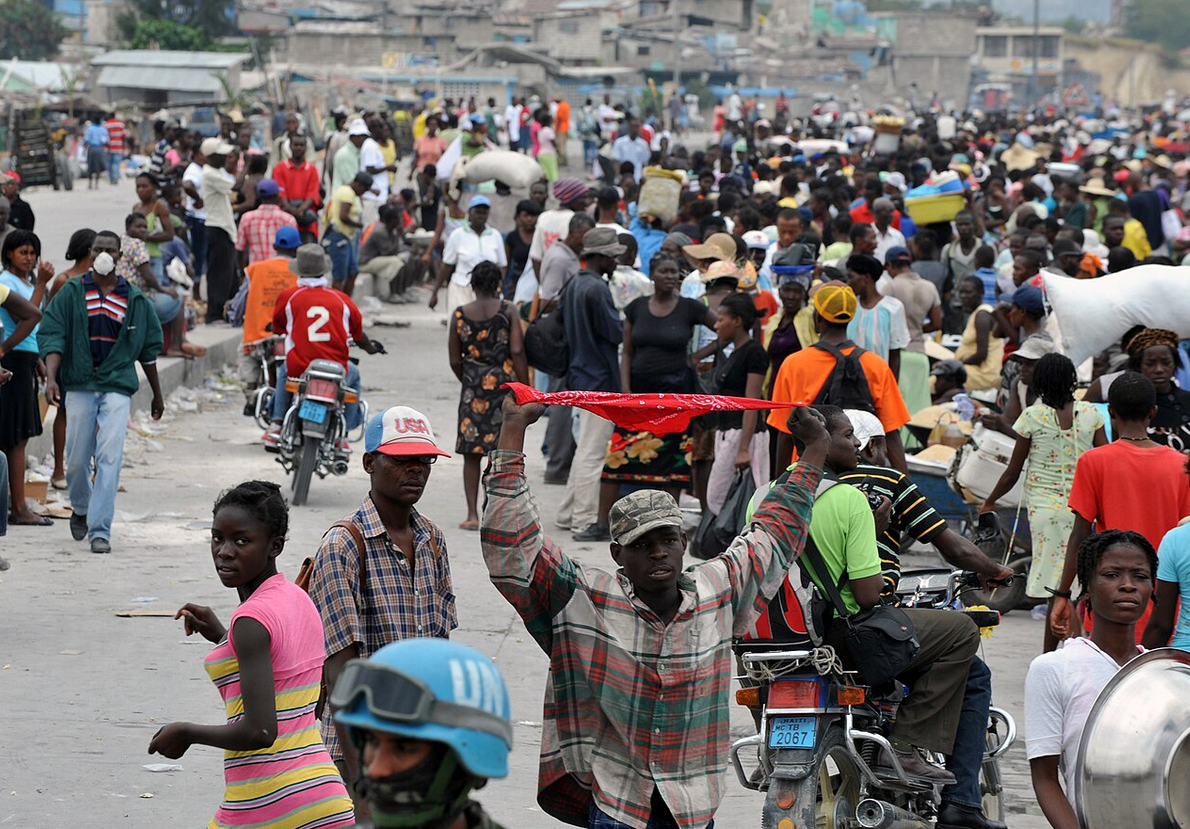

[Building From Humus]
By Kemi Owo Gbohunmi
Photos: Wikimedia Commons
There is a book that has lived on my grandmother’s shelf for nearly forty years. Haiti, published in 1989 by Suzanne Anthony as part of the Chelsea House series Places and Peoples of the World, a title whose ambition is announced in its name and abandoned in its execution. What the book actually delivers is a portrait of a people rendered, with the calm authority of the educational press, as the authors of their own ruin. Greedy leaders. Desperate populations. A nation that squandered its forests, agreed to ruinous arrangements with European powers, and arrived at its present condition through an accumulation of self-inflicted wounds. A people who were worked to exhaustion building the wealth of others, then abandoned to govern a ruined land and blamed for its condition.

The book is thirty-six years old. No text of comparable reach has arrived since to displace it. In the popular imagination that continues to shape policy, journalism, aid, and intervention, the essential story of Haiti (and by extension the essential story told about Black and brown nations the world over), remains the one Suzanne Anthony told. A people who cannot steward what they have been given. A land that has been exhausted by the failures of those who lived on it.
That story has survived thirty-six years on its consistency. It has never been required to answer the question it was designed to prevent.
If there is nothing left, if these lands are truly stripped, these peoples truly incapable, these nations truly beyond recovery, why do the foreigners keep coming back?
The Narrative Was the First Extraction
I want us to consider the sequence carefully, because the order matters. The story of indigenous incompetence did not arrive after the extraction. It arrived before it, or alongside it, as its justification and its cover, a covert operation if you will, primed for a narrative that satisfies any prerequisite for blatant piracy. You cannot take what belongs to someone else without first establishing, at least to your own satisfaction, that they were not making proper use of it. Even that may be too generous, because colonial historiography has always required this move: render the resources wasted on those who do not know their value. And there exist far more careless and sinister reasons for extraction than ideological cover, like sheer desire and a compulsion toward theft. In the colonial framing, the extractor arrives as an intervener, a developer, an assistant. Apparently.
Haiti’s deforestation narrative is a masterwork of this genre. What the dominant account usually attempts to systematically omit is that deforestation in Haiti did not begin with Haitian mismanagement but with French colonial plantation agriculture, which consumed timber at industrial scale to fuel the sugar production that enslaved African people made possible and that made Saint-Domingue the most profitable colony in the Western hemisphere. It omits the indemnity of 150 million francs that Haiti was forced to pay France beginning in 1825 as reparations for the “loss” of its enslaved population, a debt serviced through loans from French banks at punishing interest rates, not fully repaid until 1947. If it were not so catastrophic, the spectacle of formerly enslaved people paying reparations to their enslavers would be so absurd that streaming platforms would have already purchased the rights. Haiti paid France for the audacity of its own freedom, not for land, or goods, or any injury France sustained. That debt, and the loans taken to service it, shaped every economic arrangement Haiti entered for the next hundred years. The contemporary conditions of Haitian poverty are the continuation of that economic arrangement. The story also casually omits the two decade long American occupation during which U.S. forces reorganized Haitian land, labor, and governance in the interest of American capital.
The land was not the only thing taken. In 1986, the IMF conditioned its loans on Haiti slashing import tariffs. Simultaneously, the United States subsidized American rice farmers to export cheaply overseas. “Miami rice”, what Haitian farmers call it, flooded the market at a fraction of the price of anything grown in-country. Domestic rice farming, which had fed Haitian families for generations, quietly collapsed. Bill Clinton later apologized. The apology is noted and entirely beside the point. The breakdown did not begin with Clinton or Reagan or any individual administration. It began with the importation of Africans. Now that they can no longer enslave them, they import the goods and make us slaves to consuming them. Haiti could feed itself. Its capacity to do so was stripped intentionally. Why do we keep agreeing to this?
What the narrative installs in place of this history is the figure of the self-sabotaging Haitian. And once that figure is in place, once it has been printed in educational series and absorbed into the background assumptions of policymakers and journalists and aid workers and the readers of books on grandmothers’ shelves, it does its work automatically. It does not need to be argued, nor will it ever be. It’s simply as present as ambient as weather, shaping what questions get asked (very few if any) and which ones never occur to anyone to raise (most of them).
They Took the Land and Then They Took the Keys

Haiti is the historical text nobody has been required to read carefully. The DRC is the contemporary one, perhaps more egregiously obvious, and the mechanism is identical: a narrative of incapacity that preceded the arrival of extractors, so that their presence could be read as rescue. To be fair, reinvention of systemic theft protocols has never really been a strength for the Western world. What the DRC holds in cobalt, Saint-Domingue held in sugar and gold. The script does not even require new authorship. It runs on repetition, and makes its ripples through the constructed community of complexion and through terms like sub-Saharan, third world, and “global south”; because the south, omitting the south of France, carries its own not-so-covert interpretation. If you know, you know.
For most of recorded history, cobalt was just pigment. The deep, saturated blue in European porcelain and glazed tile: cobalt produced it. It is a byproduct of copper extraction, low-value and not the kind of resource around which sovereign wealth funds organized long-term positions. It produced the blue in the Delftware that enriched European aesthetics. The beauty and the omission were part of the same arrangement. The origin was inconsequential; beauty resonates with any human being’s desire to live in pleasure and consume, at will, the earth’s bounty.
But then cobalt became interesting. Enter: lithium-ion batteries. Electric vehicles. The particular genius of the twenty-first century’s energy transition, which required, conveniently, the one mineral concentrated almost entirely under African soil, inconvenienced only by the Africans that live there. By the time the world understood what cobalt could do, what it was worth, what economies it would organize, what wars it would quietly cause, the DRC was already sitting on seventy percent of the world’s known reserves and had already been separated from the knowledge that would allow it to act on what it held. All of it. The geology. The science. The processing technology. The contract law. That separation was the precondition for the arrangement that followed, maintained deliberately for decades, while DRC citizens spent between seventy-five and eighty-eight percent of their working lives trying to survive in the informal trade of just getting by.
Now, what were the Congolese supposed to know, and when, and who was supposed to teach them?
The Belgian colonial administration left the DRC at independence in 1960 with, by most documented accounts, fewer than thirty university graduates among a population of fifteen million. Yes, thirty. In a country of fifteen million people who had been producing, trading, governing, and building for centuries before Europe arrived to educate them into servitude. The subjects withheld the actual curriculum. Colonial schools were built to produce clerks and manual laborers, not geologists, not mineral economists, not lawyers who specialize in resource contracts. The knowledge gap the narrative of incompetence would later call a cultural failing was, in fact, a carefully design and deliberately maintained policy. When cobalt mattered, the DRC arrived at the negotiating table for its own resources without the trained engineers, the processing expertise, or the sovereign institutional leverage that the other parties had spent decades building precisely in order to be there first.
Think of it this way. Your aunt calls. She has a conference nearby. You offer the guest room. She arrives with cousins. The cousins need the closet, so you move your things. Then your uncle. Then their people. Somehow, the moves were small and each one seemed reasonable, and now you are on the couch. By the time you understand the shape of what has occurred, your aunt has changed the locks on the guest room and she is telling you there is a fee if you want your old room back. She has people with her who make clear the discussion is over. You leave. Later you return, strapped, and she offers you the room again, for rent, of course, while her people have the run of the house you own. She may have even discovered a storage space you never knew existed, built an enterprise on top of it, and sent you an invitation to patronize.
Losing what is yours is never announced as a single declaration. It happens in the accumulation of moves you did not recognize as strategic, because you were not conditioned to think strategically about what you held. Because the people who came for it had already been thinking about it for a really, really long time. You may even ignorantly assist in the taking, offering secrets and knowledge where you thought you were merely being hospitable.
Chinese state-owned enterprises and policy banks, the product of exactly that kind of deliberate, decades-long formation, now control approximately eighty percent of the DRC’s cobalt output. The mines are in Congo. The profit, the expertise, the refining capacity, the downstream value chain: largely elsewhere. How it moved from Belgian colonial dominance to Chinese core infrastructure is a thread nobody in power seems particularly interested in tracing. It is an exchange of hands, and the hands keep changing, and the Congo stays in the ground. When the DRC attempted to assert mineral sovereignty through a cobalt export ban in 2025, Washington and Beijing negotiated an accommodation between themselves, without Congolese representation. You cannot make this kind of absurdity up. What we dress up as diplomacy is two guests deciding what to do with your kitchen while you wait outside. The audacity is only remarkable until you understand that this is precisely the arrangement the last century of policy was designed to produce.
They took the cobalt, the keys, and your favorite slippers for good measure. And then they offered to rent the rooms back, and you would have to replace the slippers on your own.
This is where the prosecutorial question becomes inescapable: they are still there. In 2025, Haiti received the brunt of Trump administration tariffs, extended to the Caribbean and by extension one of the least developed nations on earth, while foreign aid was cut, Haitian immigrants were deported, and the trade preferences that had provided one of the country’s few consistent mechanisms of economic participation expired without replacement. Nobody disrupts a wasteland. The targeting is the confession.
And yet there is a massive budget to keep sending aid to Haiti. We are to understand this as generosity, a selfless commitment to a people who cannot fend for themselves. Are we so bored of money that we waste it on a wasteland? There are other nations with more urgent claims to this kind of institutional charity. They are busy being bombed into oblivion and receiving no such sustained attention. Because there is nothing left there to maintain. Aid is not charity. Aid is how you keep the door open to a dependency you spent decades designing. Real charity would be France returning what Haiti’s own reparations committee now estimates at $115 billion. Real charity would be restoring the tariffs so Haitian farmers can compete with Miami rice. What gets called generosity is the cost of administering an arrangement that still pays.
Nobody sends warships to a wasteland. Nobody negotiates mineral agreements with a people who have nothing left to offer. Nobody builds trade offices, installs transitional governments, extends tariff regimes, and funds multinational security missions in places that have been exhausted beyond utility.
Their continued presence is the confession the narrative is working so hard to conceal.
And yet the people whose lands they occupy are told to leave. Japa. Find a better life elsewhere. The door out is always open, while the door in, to the resource, to the contract, to the value chain, swings only one way. A continent that exports its most educated people to run other people’s institutions has no shortage of voices calling this a feature.
What We Do When We Fall Into the Script

The more consequential question, the one that actually keeps me up, is what happens when we accept the story. What the story requires, in the end, is less coercion than consent, less enforcement than absorption; inasmuch as we have internalized its grammar, we become its most efficient operators, arriving at policy tables to argue against our own mineral sovereignty in borrowed language, narrating our dispossession as deficiency, and then writing think pieces about the need for more discipline, less corruption in Africa, et cetera.
We have had to work out, slowly and deliberately, how to become the technical authors of what is ours. That work was always our defense, perhaps our only real defense. The colonial voice that said this domain is not yours, you are a recipient of knowledge, the appropriate posture toward your own resources is gratitude for whatever arrangement others are willing to offer should have been rejected. Instead we said thank you. Geology and GIS mapping may not have felt like a strong act of resistance, but the expertise of your own terrain would have prevented so much harm because you would have been able to see them coming but you didn’t.
The DRC’s cobalt export ban was an act of narrative refusal as much as economic strategy. So was Zimbabwe and Namibia insisting on local mineral processing on value chains that extend into African hands rather than terminating at the mine shaft. These are not policy positions. They are people deciding to stop performing the role they were assigned. The world’s response, predictably, has been to call this instability.
* * *
The very people who authored the story of Black and brown incompetence cannot stay away from the places they claimed were ruined. They know something. We must insist that we are let in on the secret or discover more for ourselves. The contradiction is not ironic; it is evidentiary. This instruction manual for a theft is relentless. Look how rich we are that they are still stealing from us centuries later. Do you even understand the magnitude of that wealth that still powers the whole world?
So the next time someone tells you a Black or brown nation is hopeless, ungovernable, stripped bare by its own people… ask who is currently there. Ask what they came for. Ask what they are taking home. Ask who holds the mineral contracts, who built the trade offices, who funds the security missions, who controls the refining capacity, who wrote the educational series that told an entire generation of children what kind of people Haitians are. The answers are not difficult to find. They are simply inconvenient for the people who would have to act on them.
And then ask what it would mean, for Haiti, for the DRC, for every Black and brown community sitting on something someone else has decided they need, to finally, decisively, stop performing the role that story assigned us or that ultimately, we feebly assigned to ourselves.
The ground does not lie. It holds what happened. It is waiting, as it has always waited, for us to read it on our own terms.

Kemi Owo Gbohunmi is a philosopher, curator, and cultural strategist whose work sits at the intersection of African aesthetic theory, decolonial economics, and Black diaspora thought. She holds academic formation in philosophy, business, and religious studies, and has spent years in sustained engagement with West African and Caribbean traditional cosmologies, learning from elders and practitioners who hold these traditions from the inside. She writes “Building from Humus,” a column on culture, art, world-building, and human potential for Black Star News.”