From Liberation To Orthodoxy: Kagame’s Shrinking Moral Universe
By Theogene Rudasingwa Photos: Wikimedia Commons In his recent interview with Jeune Afrique, Paul Kagame offers what has become a familiar narrative: Rwanda as a nation under perpetual threat, encircled by hostile forces, and compelled—reluctantly but necessarily—to act beyond its borders in the name of survival. It is a narrative forged in the crucible of the 1994 genocide against the Tutsi, and for years it has carried moral force. But today, that narrative is showing signs of strain—less a doctrine of liberation than an orthodoxy struggling to explain a changing world. Kagame’s argument rests on a stark premise: that the continued existence of the Democratic Forces for the Liberation of Rwanda, rooted in remnants of genocidal forces, justifies Rwanda’s expansive security posture. In this telling, the government of Félix Tshisekedi is not merely ineffective but complicit—allegedly tolerating or even collaborating with these elements. From this flows a logic that Kagame does not shy away from articulating: Rwanda’s “defensive measures” include occupying territory in eastern Democratic Republic of the Congo, working with proxy forces fighting the Congolese government, and engaging actors opposed to Kinshasa, including networks linked to former president Joseph Kabila. This is a remarkable admission—not because it is entirely new, but because it is so openly framed as necessity. The language of defense has expanded to encompass actions that, in any other context, would be recognized as intervention, destabilization, and the projection of power beyond sovereign borders. What is presented as reluctant self-preservation begins to look, under scrutiny, like a doctrine of permanent preemption: a belief that threats are not only real but enduring, and that therefore Rwanda’s military and political reach must remain indefinitely elastic. Yet this doctrine rests on a profound simplification. It reduces the complex crisis in eastern Congo—a region shaped by decades of weak governance, regional rivalries, economic predation, and international neglect—into a binary moral struggle. Rwanda is cast as the vigilant survivor; others are, at best, negligent, and at worst, complicit in genocidal designs. This framing has been politically effective. It mobilizes memory, commands sympathy, and silences criticism. But it also erases Rwanda’s own agency as a regional power with interests, alliances, and consequences. There is a deeper problem. By treating security as existential and perpetual, Kagame transforms policy into something closer to theology. The threat is not something to be managed; it is something to be eradicated absolutely, across time and space. And because such eradication is impossible, the state of emergency becomes permanent. In such a framework, there is no natural endpoint—only a continuous justification for action. Central to this is the invocation of memory. The genocide against the Tutsi is not merely remembered; it is operationalized. It becomes the ultimate reference point against which all present actions are measured and justified. Critics are not simply wrong; they risk being cast as naïve at best, or complicit at worst. Opponents are not merely adversaries; they are linked, rhetorically or symbolically, to a past that carries the heaviest moral weight imaginable. Memory, in this sense, becomes not only a moral obligation but a political instrument. And yet, even as this orthodoxy persists, its effectiveness is diminishing. For years, Kagame’s moral clarity allowed him to shame the international community for its failures in 1994—failures of both commission and omission. Rwanda’s contributions to peacekeeping missions and its reputation for order and development reinforced this standing. The argument was simple and compelling: Rwanda had earned the right to be heard, and perhaps even the benefit of the doubt. But the global context is shifting. The Democratic Republic of the Congo is no longer viewed primarily through a humanitarian lens. It is increasingly seen as a strategic prize, rich in critical minerals essential for the technologies of the 21st century—cobalt, coltan, lithium. Major powers—the United States, China, European states, and Russia—are recalibrating their engagement accordingly. In this environment, moral narratives, however compelling, compete with hard interests. Realpolitik is not a theoretical concept; it is the operating system of global power. This does not mean that history no longer matters. It means that it matters differently. The language of existential threat and moral exceptionalism, which once commanded deference, now encounters skepticism. Assertions of defensive necessity are weighed against evidence of regional influence. Claims of victimhood are examined alongside allegations of intervention. The world, in short, is less willing to accept a single, unchallenged narrative. What emerges from Kagame’s interview, therefore, is a
 Black News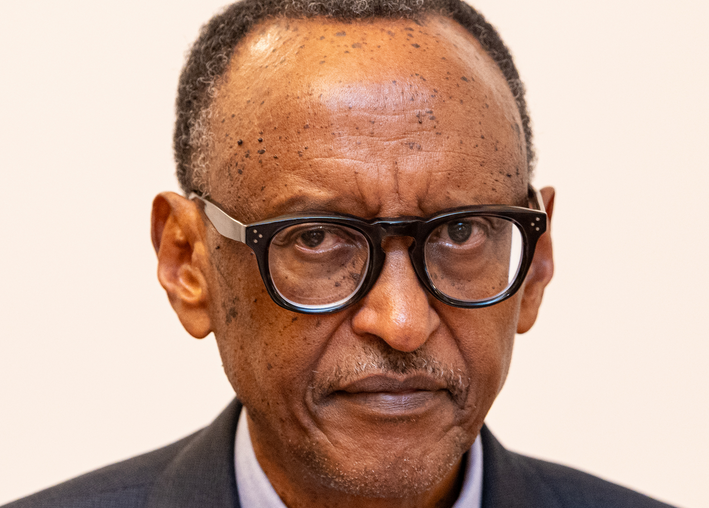
By Theogene Rudasingwa
Photos: Wikimedia Commons
In his recent interview with Jeune Afrique, Paul Kagame offers what has become a familiar narrative: Rwanda as a nation under perpetual threat, encircled by hostile forces, and compelled—reluctantly but necessarily—to act beyond its borders in the name of survival. It is a narrative forged in the crucible of the 1994 genocide against the Tutsi, and for years it has carried moral force. But today, that narrative is showing signs of strain—less a doctrine of liberation than an orthodoxy struggling to explain a changing world.

Kagame’s argument rests on a stark premise: that the continued existence of the Democratic Forces for the Liberation of Rwanda, rooted in remnants of genocidal forces, justifies Rwanda’s expansive security posture. In this telling, the government of Félix Tshisekedi is not merely ineffective but complicit—allegedly tolerating or even collaborating with these elements. From this flows a logic that Kagame does not shy away from articulating: Rwanda’s “defensive measures” include occupying territory in eastern Democratic Republic of the Congo, working with proxy forces fighting the Congolese government, and engaging actors opposed to Kinshasa, including networks linked to former president Joseph Kabila.
This is a remarkable admission—not because it is entirely new, but because it is so openly framed as necessity. The language of defense has expanded to encompass actions that, in any other context, would be recognized as intervention, destabilization, and the projection of power beyond sovereign borders. What is presented as reluctant self-preservation begins to look, under scrutiny, like a doctrine of permanent preemption: a belief that threats are not only real but enduring, and that therefore Rwanda’s military and political reach must remain indefinitely elastic.
Yet this doctrine rests on a profound simplification. It reduces the complex crisis in eastern Congo—a region shaped by decades of weak governance, regional rivalries, economic predation, and international neglect—into a binary moral struggle. Rwanda is cast as the vigilant survivor; others are, at best, negligent, and at worst, complicit in genocidal designs. This framing has been politically effective. It mobilizes memory, commands sympathy, and silences criticism. But it also erases Rwanda’s own agency as a regional power with interests, alliances, and consequences.
There is a deeper problem. By treating security as existential and perpetual, Kagame transforms policy into something closer to theology. The threat is not something to be managed; it is something to be eradicated absolutely, across time and space. And because such eradication is impossible, the state of emergency becomes permanent. In such a framework, there is no natural endpoint—only a continuous justification for action.
Central to this is the invocation of memory. The genocide against the Tutsi is not merely remembered; it is operationalized. It becomes the ultimate reference point against which all present actions are measured and justified. Critics are not simply wrong; they risk being cast as naïve at best, or complicit at worst. Opponents are not merely adversaries; they are linked, rhetorically or symbolically, to a past that carries the heaviest moral weight imaginable. Memory, in this sense, becomes not only a moral obligation but a political instrument.

And yet, even as this orthodoxy persists, its effectiveness is diminishing. For years, Kagame’s moral clarity allowed him to shame the international community for its failures in 1994—failures of both commission and omission. Rwanda’s contributions to peacekeeping missions and its reputation for order and development reinforced this standing. The argument was simple and compelling: Rwanda had earned the right to be heard, and perhaps even the benefit of the doubt.
But the global context is shifting. The Democratic Republic of the Congo is no longer viewed primarily through a humanitarian lens. It is increasingly seen as a strategic prize, rich in critical minerals essential for the technologies of the 21st century—cobalt, coltan, lithium. Major powers—the United States, China, European states, and Russia—are recalibrating their engagement accordingly. In this environment, moral narratives, however compelling, compete with hard interests. Realpolitik is not a theoretical concept; it is the operating system of global power.
This does not mean that history no longer matters. It means that it matters differently. The language of existential threat and moral exceptionalism, which once commanded deference, now encounters skepticism. Assertions of defensive necessity are weighed against evidence of regional influence. Claims of victimhood are examined alongside allegations of intervention. The world, in short, is less willing to accept a single, unchallenged narrative.
What emerges from Kagame’s interview, therefore, is a paradox. The very framework that once elevated Rwanda’s voice on the global stage is now constraining it. By insisting on a closed moral universe—one in which Rwanda is perpetually right and others perpetually suspect—the space for dialogue, accountability, and adaptation narrows. Power, insulated by its own certainties, risks becoming dogma.
Nations, like individuals, must evolve in their self-understanding. They must find ways to honor their past without being imprisoned by it, to secure their future without destabilizing their neighbors, to wield power without surrendering to its temptations. Rwanda’s story since 1994 is, in many ways, extraordinary—a testament to resilience, reconstruction, and ambition. But no story, however compelling, can remain static in a dynamic world.
The challenge for Kagame—and for Rwanda—is not to abandon the lessons of history, but to reinterpret them for a new era. An era in which security cannot be built on indefinite expansion and dictatorship, in which memory must coexist with plurality, and in which moral authority is strengthened, not weakened, by accountability.
The tragedy would not be that Rwanda remembers. The tragedy would be if remembrance becomes a closed system—one that explains everything, justifies everything, and ultimately, limits the very future it seeks to secure.