Full forecourts amid scarce dollars
In Blantyre, Mzuzu and Lilongwe, roadsides of major roads are filled with rows of imported used vehicles. To any passer-by, the message is clear: business is booming. That is the paradox facing Malawi an economy that is struggling to raise foreign exchange to finance sustainable importation of fuel, fertiliser and essential drugs the imported used … The post Full forecourts amid scarce dollars appeared first on Nation Online.
 Black News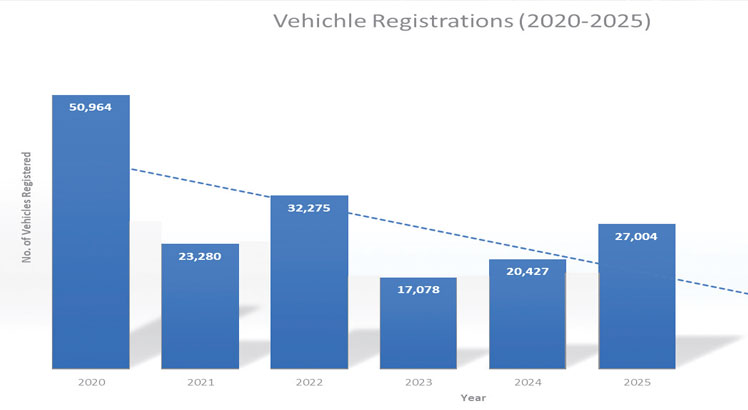
In Blantyre, Mzuzu and Lilongwe, roadsides of major roads are filled with rows of imported used vehicles. To any passer-by, the message is clear: business is booming.
That is the paradox facing Malawi an economy that is struggling to raise foreign exchange to finance sustainable importation of fuel, fertiliser and essential drugs the imported used motor vehicle market appears to be thriving.
But as The Nation investigation finds, the full forecourts are not proof of abundance. Instead, they are proof of adaptation, delay and a foreign exchange system that is rationing dollars away from the productive sectors and toward consumer imports.
The data behind the contradiction
The numbers look strong on the surface. Ministry of Transport and Public Works data show that Malawi’s vehicle population grew from 288 885 in 2020 to 409 745 by December 2025. On the other hand, annual new registrations recovered to 27 004 in 2025 after crashing to 17 078 in 2023.
Yet, that recovery happened during the country’s worst forex squeeze in a decade. Reserve Bank of Malawi (RBM) figures show gross official reserves—the amount of forex under the direct control of the central bank—collapsed from $565.1 million, or 2.7 months of import cover, at end-2020 to $239.3 million, or 1.0 month, by end-2023.
By December 2025, total reserves had recovered to $608.9 million, an equivalent of about 2.4 months of cover—still below the three-month international benchmark and far short of what an import-dependent economy like Malawi needs.
The question is not whether dollars exist. It is who gets them.
The irony: cars move, factories stall
Manufacturers, agro-processors and hospitals continue to complain that banks cannot fund letters of credit for raw materials, fuel and medicines. Yet dealerships keep receiving consignments.
Used Car Dealers Association president Themba Mkandawire says the optics are misleading.
“What you’re seeing is not the true reflection of what is happening. The imports have gone down. It’s just that there is no business on the market,” he said.
With slow pace of sales, vehicles sit longer on the shelve, according to Mkandawire who added that new shipments arrive before old stock clears, inflating forecourt inventories and creating an illusion of a boom while volumes actually fall.
A formal importer, who asked not to be named, estimates the industry is now importing 60 percent of pre-crisis volumes.
Banks, he says, now cap forex allocations at about $10 000 per transaction. For a $100 000 invoice, that means months of negotiation and delay.
How the trade is surviving: the parallel route
With commercial banks described as “unreliable,” dealers say they have built workarounds.
Importer Rajab Phiri says the last bank telegraphic transfer (TT) he got approved was in 2023.
Now, he pieces together payments during the tobacco season, when farmers receive dollar export proceeds.
“Farmers make telegraphic transfers available,” explains Phiri.
Others describe relying on overseas contacts who pay suppliers directly, to be reimbursed locally in kwacha. Two other importers confirmed similar arrangements using middlemen linked to tobacco proceeds or offshore dollar accounts.
If true, this means a significant share of vehicle imports is now financed outside the formal banking system—precisely what RBM’s forex controls were meant to curb.
RBM’s dilemma
RBM has in the last 18 months tightened rules on forex access, prioritisation and reporting, in part to stop leakages to non-essential imports.
But the spread between official and parallel rates—which has at times exceeded 40 percent—creates a powerful incentive to bypass banks.
Bankers Association of Malawi president Phillip Madinga concedes the problem. Vehicles were a $191 million import line in 2020.
But as dollars dried up, banks were forced to prioritise fuel, fertiliser and drugs.
“Vehicle imports are easing not because demand has disappeared, but because foreign exchange has become increasingly difficult to access,” said Madinga who is also Standard Bank plc chief executive.
However, that prioritisation appears inconsistent. If dollars are truly reserved for essentials, how are dealers still landing containers? The answer likely lies in the alternative channels dealers describe as sitting in a grey area between formal trade and parallel market activity.
What it means for the economy
This is the core policy failure. Malawi is rationing forex for productive imports while a consumption-driven sector finds ways to stay liquid. The result: factories face downtime for lack of inputs, but car lots stay full.
It also distorts the exchange rate. Demand for kwacha to reimburse offshore payments and tobacco-farmer TTs add pressure on the parallel market, widening the gap with the official rate and making fuel, fertiliser and other crucial imports even more expensive for everyone.
Silence from authorities
For two months, The Nation sought data and comment from RBM and Malawi Revenue Authority to establish: actual forex allocations to vehicle imports, import values by category, and whether RBM’s anti-diversion measures are working.
By press time, there was no response.
That silence matters. With reserves still thin and the kwacha under pressure, the public deserves clarity on how forex is allocated, who benefits, and whether rules are being enforced or evaded.
Bottom line
Malawi’s vehicle market is not escaping the forex crisis. It is navigating around it.
Full forecourts mask falling volumes, longer turnover times and a financing model that relies on tobacco dollars, the black market and offshore accounts rather than bank allocations.
The post Full forecourts amid scarce dollars appeared first on Nation Online.