Galkayo on edge as Somalia govt, Puntland inch toward armed conflict
MOGADISHU (Somaliguardian) – Former Somali Prime Minister Omar Abdirashid Ali Sharmarke on Tuesday warned that Somalia risks sliding into another internal conflict as military tensions between the federal government and Puntland escalate around the strategic central town of Galkayo, cautioning that a new confrontation would divert critical human and military resources from the country’s fight […]
 Black News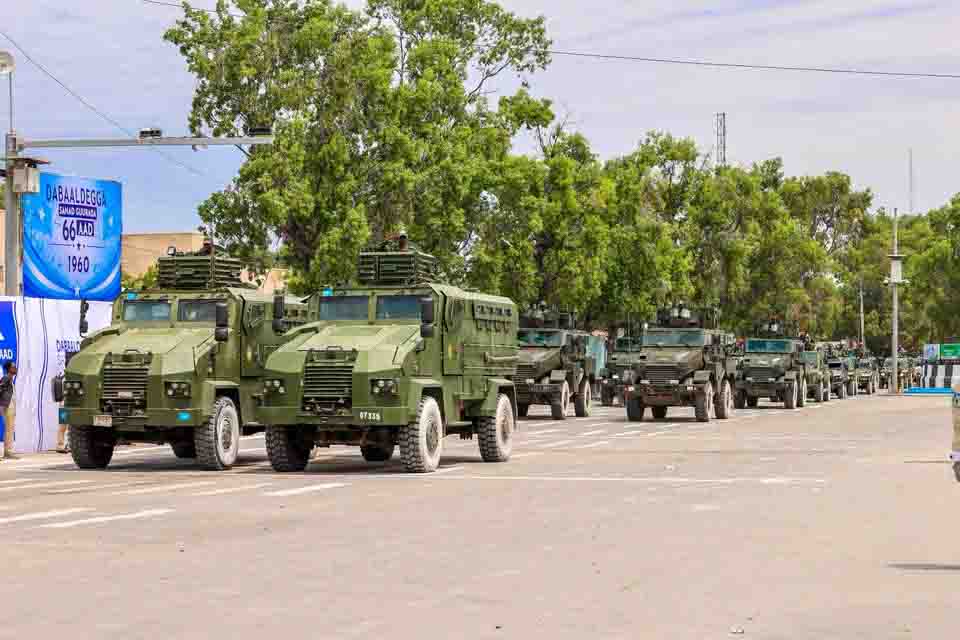
MOGADISHU (Somaliguardian) – Former Somali Prime Minister Omar Abdirashid Ali Sharmarke on Tuesday warned that Somalia risks sliding into another internal conflict as military tensions between the federal government and Puntland escalate around the strategic central town of Galkayo, cautioning that a new confrontation would divert critical human and military resources from the country’s fight against Al-Shabaab and ISIS while deepening an already severe political crisis.
Sharmarke said the growing military buildup around Galkayo carries the potential to ignite a conflict whose consequences would extend far beyond the disputed front lines, threatening national stability and undermining ongoing counterterrorism operations.
“Galkacyo is not Almiskad. Puntland State authority must refrain itself from waging a war of aggression against fellow Puntland Forces without any legal justifications,” he wrote in a statement posted on X.
“The amount of weaponry that has been directed towards this looming conflict in Galkacyo city will definitely drain human and material capital needed for the war on terror.”
The former prime minister warned that fighting in Galkayo could trigger widespread instability, fuel a humanitarian crisis and draw additional actors into an already volatile confrontation. He urged Puntland politicians, traditional elders and religious scholars to intervene before the situation deteriorates into open warfare.
Sharmarke’s warning was echoed by former Foreign Minister Abdisaid Muse Ali, another senior politician from Galkayo, who also cautioned against allowing political disagreements to spill into armed conflict.
Referring to Puntland’s objections over the federal government’s appointment of Gen. Jimale Takar as commander of the 54th Division, Abdisaid argued that the dispute should not become a catalyst for violence in Galkayo.
“If Puntland claims are correct that FGS appointed the 54th Division commander then he is already in Garowe, deal with the issue in there. There is no reason for this political dispute to spread to Gaalkacyo,” he wrote on X.
“Its residents have paid enough for conflicts they did not create. HSM, Deni, & Golaha Mustaqbalka should put their efforts into reaching a credible elections agreement instead of opening another front.”
The warnings come amid mounting concerns over an expanding military buildup around Galkayo.
Earlier this week, a clan leader in Galmudug claimed that the federal government had deployed about 3,000 soldiers who recently completed military training in Galmudug to Galkayo, alleging the deployment was intended to undermine Puntland’s security.
Combined with Sharmarke’s assertion that Puntland has also directed substantial weaponry toward the looming confrontation, the claims have heightened fears that Somalia’s widening political crisis could soon evolve into another armed conflict between the federal government and a regional administration.
Relations between Mogadishu and Puntland have deteriorated sharply in recent weeks.
This week, Puntland authorities accused Somalia’s federal government of carrying out a troop buildup and military maneuvers in Galkayo that they said were intended to undermine the regional administration and its security, urging residents to stand behind Puntland leadership in the face of what they described as escalating threats.
Puntland authorities recently said they captured 30 fighters aligned with the federal government and seized 13 military vehicles after attacking positions held by federal-aligned PSF forces near Bosaso, in the first major military confrontation between the two sides in the region.
The latest tensions unfold against the backdrop of an increasingly polarized political landscape.
Since President Hassan Sheikh Mohamud returned to office in 2022, his administration has entered into confrontations with two regional states – Jubaland and Southwest.
The federal government suffered a setback in its conflict with Jubaland but prevailed in Southwest after regional president Abdiasis Laftagaren was removed from office in March and the outgoing speaker of the regional parliament, a close ally of President Mohamud, assumed the presidency.
Should tensions around Galkayo escalate into open warfare, the confrontation would mark a third major conflict between the federal government and a regional administration during Mohamud’s current term, although the outcome of any such conflict remains uncertain.
The mounting security concerns come as Somalia remains mired in an escalating political crisis over elections, with the mandates of both the federal government and parliament having expired months ago and no agreement yet reached on a path forward.
The federal government maintains that it has another year to remain in office and insists it is committed to holding a one-person, one-vote election.
Opposition leaders say they do not oppose universal suffrage in principle but argue that any election must be free, fair and credible. They have criticized the elections conducted in Southwest State and Mogadishu’s municipal polls, describing them as controlled, rigged and lacking legitimacy.
Against that backdrop, political tensions have increasingly overlapped with security concerns, raising fears that unresolved disputes over governance could further complicate Somalia’s efforts to confront Al-Shabaab and ISIS while preserving fragile relations between the federal government and regional administrations.
On Monday, opposition leaders also appealed to countries contributing troops to the African Union Support and Stabilization Mission in Somalia (AUSSOM) ahead of their July 29 meeting in Uganda, urging them to help establish a transitional governing body to administer the country until elections are held and legitimate institutions assume office.
The opposition argued that what it described as the federal government’s attempts to consolidate power are deepening the political crisis that has prevented Somalia from fully assuming responsibility for its own security, contributed to growing international donor fatigue and increased the risk of a complete collapse of the AUSSOM mission.
The warnings from Sharmarke and Abdisaid, coupled with claims of military deployments around Galkayo and the recent confrontation near Bosaso, underscore growing concerns that Somalia’s long-running political dispute could enter a more dangerous phase if tensions between Mogadishu and Puntland continue to escalate.
With competing political camps locked in an impasse over elections, military tensions rising between the federal government and Puntland, and the country simultaneously battling Al-Shabaab and ISIS, the prospect of another internal conflict threatens to open a new front at a time when Somalia is already facing one of its most consequential periods of political and security uncertainty in nearly two decades.
Contact us: info@somaliguardian.com