Gambia launches onion revolution with landmark market pact
Officials say the agreement will enhance structured market access, improve coordination between producers and buyers, reduce post‑harvest losses, and promote the consumption of locally grown onions. By linking farmers directly to markets, the initiative aims to cut reliance on imports and empower smallholders to compete more effectively. The deal is part of the Agricultural Value Chain Interaction Platforms (AVIPs) under the ROOTS Project, supported by the International Fund for Agricultural Development (IFAD). Stakeholders believe the agreement could reshape Gambian agriculture, positioning onions not only as a staple of domestic consumption but as a symbol of resilience and self‑sufficiency in the face of global food challenges. Famara Trawally, Project Director of the ROOTS Project, underscored the significance of the event, describing the signing ceremony as a “milestone in our vision journey towards access to markets for major crops, especially tomatoes, which are highly perishable.” He added: “This is a game changer for us as far as the MOU is concerned. As a project, our first component is production and productivity. When you increase production, you expect to have excess, and when you have excess, you need to have a very good market. That is why component two is all about market.” Mr Trawally acknowledged that access to markets has long been a challenge, noting that this was the reason consultants were tasked with helping to institutionalise the Agricultural Value Chain Interaction Platforms (AVIPs). He explained: “The MOU will be dedicated to NFSPMC and Sosolaso, which is the marketing federation. We hope this will help us increase our marketability, particularly in relation to our highly perishable vegetables, such as onions.” Lamin L. Sanyang, Deputy Managing Director of NFSPMC, underscored the significance of the MOU, saying its importance cannot be overemphasised, as it represents a critical step towards creating structured and sustainable market access for smallholder onion producers in The Gambia. “This initiative aligns directly with NFSPMC’s mandate as a national aggregator and market stabiliser, ensuring that farmers have reliable markets for their produce and receive fair returns for their hard work and investment,” he said. Importantly, Mr Sanyang noted, the MOU seeks to address several key challenges affecting the sector, including limited market access for smallholder farmers; post-harvest losses resulting from poor handling and inadequate storage facilities; heavy dependence on imported onions; unstable incomes for onion farmers; low local production and limited competitiveness within the market; and foreign exchange pressures caused by excessive importation. He continued: “This initiative will contribute significantly towards improving food security, enhancing rural livelihoods, increasing local production, and promoting sustainable agricultural development in The Gambia.” Kutubo Jarju, Senior Economist at the Ministry of Trade, Industry, Regional Integration and Employment, stressed the timeliness of the initiative. “This comes at a particularly important moment, as global uncertainties continue to underscore the need for resilient domestic supply systems. It also reinforces an important reality: reliance on importation is not a sustainable long‑term solution. Strengthening local production must therefore be accompanied by improved market access and efficient value chain linkages that enable our farmers to fully benefit from their production.” He added: “The Ministry has remained committed to supporting this agenda, including through the seasonal moratorium on onion imports to safeguard market opportunities for local producers, as well as through continued collaboration with SOSOLASO to strengthen the onion value chain. This MOU is a valuable complement to these efforts.” Musa Huma, Director General of Agriculture, reaffirmed the Agriculture ministry’s continued commitment to the nation’s quest for food self‑sufficiency. He said the MOU had come at a crucial time, when the country was experiencing significant losses, particularly in vegetables and onions. Speaking at the event, Alhagie Nyangado, Permanent Secretary at the Ministry of Agriculture, Livestock and Food Security, described the agreement as a “game changer” in the quest for food security. “This could not have come at a better time than now. Therefore, it is important that all of us as stakeholders come together and support this initiative,” he said, while stressing that one of the key issues affecting onion production in the country is quality. He urged stakeholders to ensure they produce quality onions so that NFSPMC would not face difficulties in selling them. He added that the project would continue to provide quality seeds to support this effort. Ousman Manneh, a representative of SOSOLASO, welcomed the signing of the MOU, saying it would help reduce post‑harvest losses and increase farmers’ incomes.
 Black News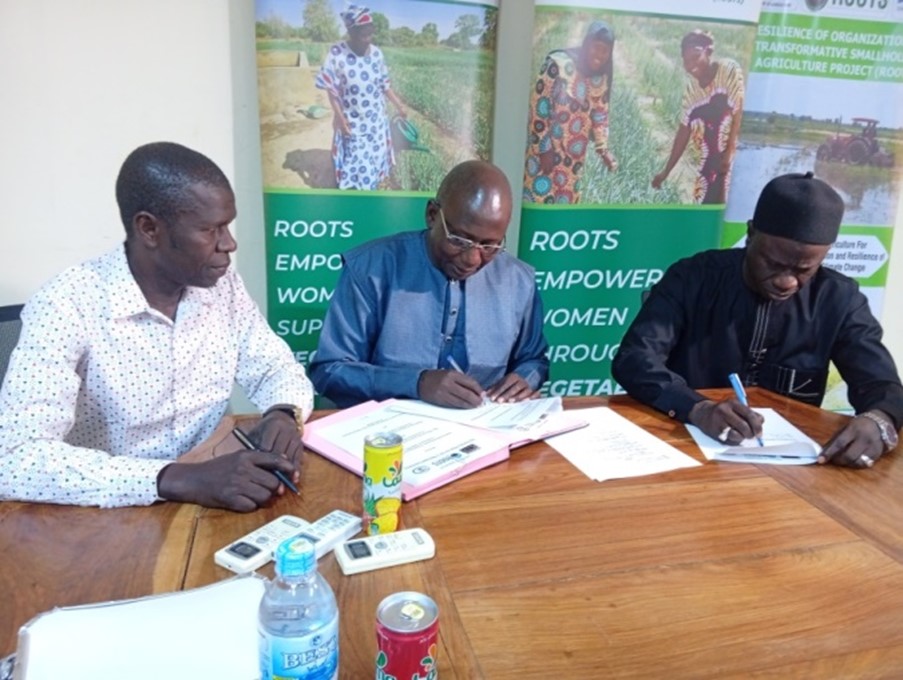

Officials say the agreement will enhance structured market access, improve coordination between producers and buyers, reduce post‑harvest losses, and promote the consumption of locally grown onions. By linking farmers directly to markets, the initiative aims to cut reliance on imports and empower smallholders to compete more effectively.
The deal is part of the Agricultural Value Chain Interaction Platforms (AVIPs) under the ROOTS Project, supported by the International Fund for Agricultural Development (IFAD). Stakeholders believe the agreement could reshape Gambian agriculture, positioning onions not only as a staple of domestic consumption but as a symbol of resilience and self‑sufficiency in the face of global food challenges.
Famara Trawally, Project Director of the ROOTS Project, underscored the significance of the event, describing the signing ceremony as a “milestone in our vision journey towards access to markets for major crops, especially tomatoes, which are highly perishable.”
He added: “This is a game changer for us as far as the MOU is concerned. As a project, our first component is production and productivity. When you increase production, you expect to have excess, and when you have excess, you need to have a very good market. That is why component two is all about market.”
Mr Trawally acknowledged that access to markets has long been a challenge, noting that this was the reason consultants were tasked with helping to institutionalise the Agricultural Value Chain Interaction Platforms (AVIPs). He explained: “The MOU will be dedicated to NFSPMC and Sosolaso, which is the marketing federation. We hope this will help us increase our marketability, particularly in relation to our highly perishable vegetables, such as onions.”
Lamin L. Sanyang, Deputy Managing Director of NFSPMC, underscored the significance of the MOU, saying its importance cannot be overemphasised, as it represents a critical step towards creating structured and sustainable market access for smallholder onion producers in The Gambia.
“This initiative aligns directly with NFSPMC’s mandate as a national aggregator and market stabiliser, ensuring that farmers have reliable markets for their produce and receive fair returns for their hard work and investment,” he said.
Importantly, Mr Sanyang noted, the MOU seeks to address several key challenges affecting the sector, including limited market access for smallholder farmers; post-harvest losses resulting from poor handling and inadequate storage facilities; heavy dependence on imported onions; unstable incomes for onion farmers; low local production and limited competitiveness within the market; and foreign exchange pressures caused by excessive importation.
He continued: “This initiative will contribute significantly towards improving food security, enhancing rural livelihoods, increasing local production, and promoting sustainable agricultural development in The Gambia.”
Kutubo Jarju, Senior Economist at the Ministry of Trade, Industry, Regional Integration and Employment, stressed the timeliness of the initiative. “This comes at a particularly important moment, as global uncertainties continue to underscore the need for resilient domestic supply systems. It also reinforces an important reality: reliance on importation is not a sustainable long‑term solution. Strengthening local production must therefore be accompanied by improved market access and efficient value chain linkages that enable our farmers to fully benefit from their production.”
He added: “The Ministry has remained committed to supporting this agenda, including through the seasonal moratorium on onion imports to safeguard market opportunities for local producers, as well as through continued collaboration with SOSOLASO to strengthen the onion value chain. This MOU is a valuable complement to these efforts.”
Musa Huma, Director General of Agriculture, reaffirmed the Agriculture ministry’s continued commitment to the nation’s quest for food self‑sufficiency. He said the MOU had come at a crucial time, when the country was experiencing significant losses, particularly in vegetables and onions.
Speaking at the event, Alhagie Nyangado, Permanent Secretary at the Ministry of Agriculture, Livestock and Food Security, described the agreement as a “game changer” in the quest for food security. “This could not have come at a better time than now. Therefore, it is important that all of us as stakeholders come together and support this initiative,” he said, while stressing that one of the key issues affecting onion production in the country is quality.
He urged stakeholders to ensure they produce quality onions so that NFSPMC would not face difficulties in selling them. He added that the project would continue to provide quality seeds to support this effort.
Ousman Manneh, a representative of SOSOLASO, welcomed the signing of the MOU, saying it would help reduce post‑harvest losses and increase farmers’ incomes.