Houston Black community confronts modern lynching fears
Black families, students, clergy, and lawmakers demand deeper investigations into suspicious hanging deaths.
 Black News

America’s sordid history of anti-Black violence has taken many forms. Few were as public, brutal, and socially sanctioned as lynching. Houston knows this story personally. In addition to the 1919 lynching of John White, who was burned to death near the Harris County courthouse, there were the members of the all-Black 24th Infantry, lynched for their participation in the Camp Logan Rebellion of 1917.
In 1919, John White was lynched, burned to death near the Harris County courthouse. In 1998, James Byrd was lynched, dragged to death in nearby Jasper, Texas. Also, members of the all-Black 24th Infantry were lynched for their participation in the 1917 Camp Logan Rebellion.
Today, Camp Logan is known to the public as Memorial Park. While lynchings today, according to the sentiment of many Black people locally and nationally, are labeled “suicides.”

Books such as 100 Years of Lynching, Without Sanctuary: Lynching Photography in America, and Popular Justice: A History of Lynching in America document a period when Black people could be murdered by mobs without due process, while law enforcement, elected officials, and white communities frequently looked the other way or actively participated in the brutality.
Lynchings oftentimes became public spectacles, attracting hundreds or thousands of white spectators. The violence was not simply about killing an individual. It was racial terror designed to intimidate entire Black communities.
That history matters now because Black people are again asking a disturbing question: What happens when a Black person is found hanging, and authorities quickly conclude suicide?
A troubling pattern
There’s no comprehensive government database specifically tracking suspected modern-day lynchings, making an exact national count difficult. But the available numbers are alarming.
A September 2026 Capital B investigation reported at least 10 Black people found hanging from trees over the previous year, with some deaths ruled suicides and families questioning those conclusions.
Meanwhile, the civil rights organization JULIAN has identified roughly 70 cases between 2000 and 2025 that it describes as modern-day lynchings across Mississippi, Texas, Georgia, Louisiana, Florida, Tennessee, and Alabama.
All too often, according to Black people nationally, these cases are declared suicides, and investigations are closed seemingly before they even start. That is precisely why families and advocates are demanding something more fundamental: Thorough investigations before conclusions are reached.
The historical context makes hanging deaths particularly difficult for Black communities to dismiss.
Historian and lawyer Jill Collen Jefferson told The Washington Post in 2021 that “lynchings never stopped,” arguing that the difference is that the perpetrators stopped publicly documenting and celebrating the violence as they once did.
History still speaks
The Equal Justice Initiative has documented more than 4,400 racial-terror lynchings of Black people between 1877 and 1950. Its subsequent Reconstruction research documented nearly 2,000 additional lynchings between 1865 and 1877.
That history helps explain why a noose is not simply another method of death in the Black American imagination.

Naomi Carrier, founder and CEO of the Texas Center for African American Living History, said her research into Reconstruction-era Texas revealed extraordinary levels of violence.
“In my research for my book on Reconstruction-era Texas, there was so much violence, so much murder, until lynching became a celebratory event for people of a Confederate mindset,” said Carrier. “We’ve got to be aware that this evil is not new.”
Carrier’s organization has also produced a documentary about a 1864 Parker County courthouse-well lynching involving four Black teenage boys, ages 13 to 16.
“We want to offer this 27-minute documentary to bring awareness to the fact that there has been a resurgence in the lynching of young Black people,” added Carrier.
Houston students are watching
Young Black Houstonians are noticing the recent cases, even when mainstream news coverage does not match the level of concern circulating through Black communities and social media.
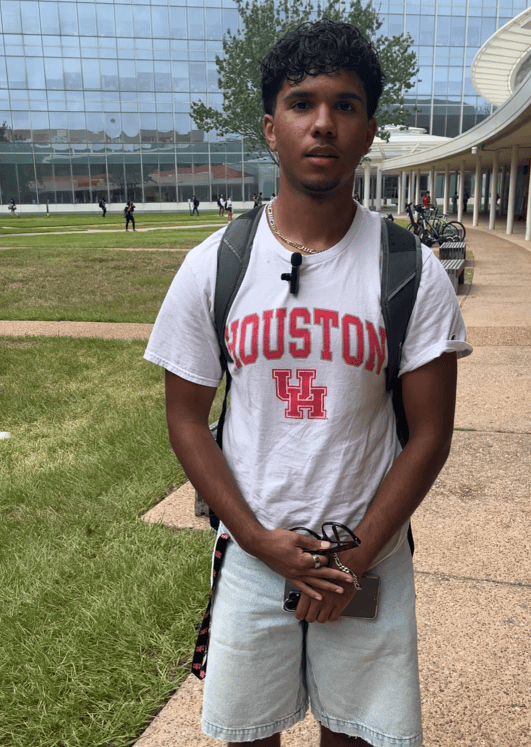

Joseph Lacerte, a University of Houston health major aspiring to a career in epidemiology, said the lack of attention troubles him.
“The current [suspected lynching] in Mississippi is just sad,” stated Lacerte. “I don’t feel like a lot of people are speaking up about it.”
UH sophomore psychology major Taylor Randle said she has primarily encountered the issue through social media.
“I feel like nobody’s really doing anything about it, how it should be handled, especially because we’re Black people,” Randle said. “I hope that we could do something about it, or at least bring some more awareness to it, because a lot of people still don’t even know about it.”
A state of emergency

Those concerns prompted the Shrine of the Black Madonna, a national Black church with a Houston congregation and other congregations in Detroit, Atlanta, South Carolina, and West Africa, to declare a national state of emergency regarding the resurgence of lynchings of Black people.
The Shrine of the Black Madonna’s Presiding Bishop, Kimathi Nelson, said the declaration should not be necessary.
“It should be unnecessary for the Shrine to declare a state of emergency over the lynching epidemic claiming the lives of Black people, as if we are back in 1910,” said Nelson. “But the fact that it is happening so frequently without being confronted by government, media, or social justice organizations leaves us no choice.”
The Shrine is calling on faith institutions, community organizations, and Black self-determination movements to move beyond concern and into action.
Congress demands answers
On Sept. 10, Congresswoman Ayanna Pressley (D-MA) and 59 colleagues sent a letter to the Department of Justice and the FBI demanding comprehensive federal investigations into Black people found hanging under suspicious circumstances. The lawmakers cited more than 70 suspected modern-day lynchings since 2000 and at least 10 reported hanging deaths in 2026.
Their demands include independent autopsies, reviews of local investigations, examination of physical and testimonial evidence, transparent reporting to Congress, and systematic federal data collection.
The lawmakers also pointed to the Emmett Till Antilynching Act, signed into law in 2022. The law gives federal prosecutors an additional tool for prosecuting certain conspiracies involving hate crimes that result in death or serious bodily injury.

What Black Houstonians can do
Justice begins with refusing to allow suspicious deaths to disappear from public consciousness.
Black Houstonians can:
- Contact elected officials and demand independent, transparent investigations of suspicious hanging deaths.
- Demand federal involvement when local investigations appear incomplete or compromised.
- Support Black media covering these cases and share credible reporting.
- Ask questions about local cases from previous decades that may deserve renewed scrutiny.
- Document and preserve information about suspicious deaths, including public records, news reports, and family statements.
- Support affected families with legal, financial, emotional, and community resources.
- Build community networks that can respond quickly when Black lives are threatened.
- Vote accordingly, holding law enforcement leaders and elected officials accountable for their responses to racial violence.
The goal is to ensure no Black person’s death, especially those that mirror America’s historic anti-Black terrorism of choice, is prematurely dismissed without a vigorous investigation. It is also to raise awareness within Black Houstonians of the current uptick in potential lynchings of Black people in order to take all appropriate steps to keep themselves and loved ones safe.
As Nelson put it, “No one is going to save us but us.”
For a people whose history includes thousands murdered beneath trees, bridges, courthouses, and jail cells, vigilance isn’t paranoia. It’s memory. And memory, when joined with organization and action, can become a form of protection.