Kenny Anthony Says Parliament, Not Judges, Must Decide How Laws Evolve
Former Prime Minister and constitutional law scholar Dr Kenny Anthony delivered a forceful lecture on the relationship between the courts, Parliament, and citizens, arguing that lawmakers, not judges, bear the primary responsibility for ensuring laws evolve alongside society. Speaking at the headquarters of the Eastern Caribbean Supreme Court in Bois D’Orange under the theme “The […] The post Kenny Anthony Says Parliament, Not Judges, Must Decide How Laws Evolve appeared first on Saint Lucia Daily Post.
 Black News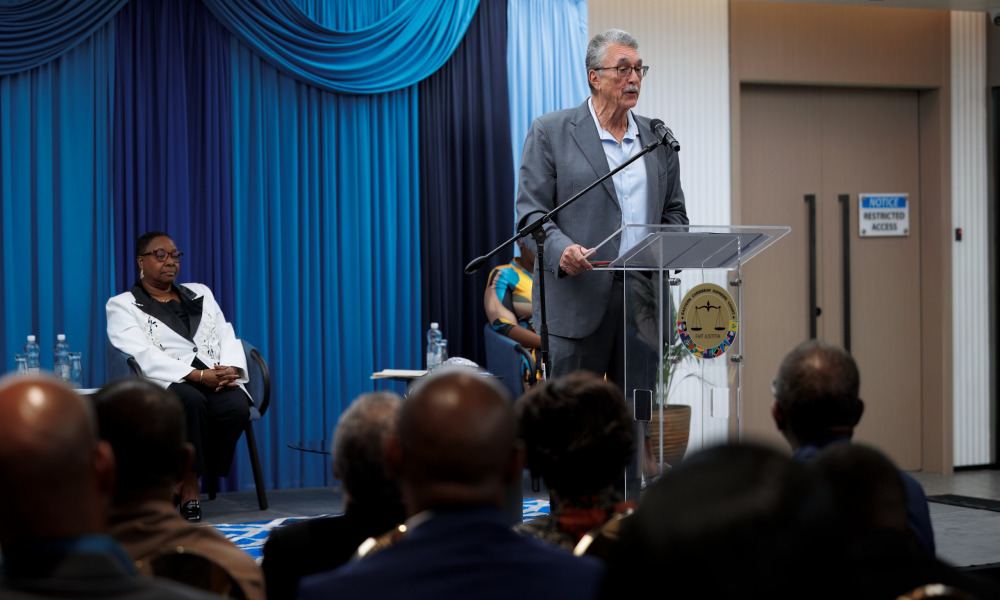
Former Prime Minister and constitutional law scholar Dr Kenny Anthony delivered a forceful lecture on the relationship between the courts, Parliament, and citizens, arguing that lawmakers, not judges, bear the primary responsibility for ensuring laws evolve alongside society.
Speaking at the headquarters of the Eastern Caribbean Supreme Court in Bois D’Orange under the theme “The Court, The Constitution and The Citizen: Who Guards the Guardian?”, Dr Anthony examined what he described as the “imperfect balance” between judicial independence and democratic accountability.
Drawing on several regional legal decisions, Dr Anthony cautioned against courts imposing their own social views through constitutional interpretation.
Quoting previous judicial rulings, he stated: “The court has no license to read its own predilections and moral values into the Constitution.”
Referring to constitutional developments in Trinidad and Tobago, Dr Anthony said the Privy Council had made it clear “that where the civil laws of that jurisdiction are concerned, it is for the Parliament of that country to change social policy, not the courts.”
He pointed specifically to the case of J. Chandler, noting that the Privy Council ruled that the 1976 Constitution of Trinidad and Tobago reserved to Parliament “the power to determine, modify, alter, amend any civil laws to ensure conformity to the fundamental rights provisions and changing social morals and values.”
Quoting Lord Hodge, Dr Anthony added: “The allocation of powers in the 1976 Constitution places on Parliament the burden of deciding when the existing laws which are protected by the saving clause should be amended or repealed to reflect changes in thinking about the fundamental rights and freedoms and to accommodate changes in social and political values.”
“There you have it,” he remarked. “So the Constitution, no matter what they tell you that it is a living instrument, is static.”
Dr Anthony also referenced the high-profile Jason Jones constitutional matter in Trinidad and Tobago, in which sections of the Sexual Offences Act were challenged by “an openly homosexual man” on constitutional grounds.
He cited Justice of Appeal Pemberton, who warned that: “Parliament is ultimately responsible for ensuring that laws reflect the evolving standards. That is their role and function.”
“Any provision found to be unconstitutional must be taken from the statute books by Parliament through legislative reform and not by judicial overreach,” Dr Anthony quoted from the judgement.
He further highlighted remarks by Justice of Appeal Barrow, who stated that courts are predisposed “to give effect to the will and intention of Parliament unless the legislation transgresses the limits laid down by the Constitution.”
“Judges cannot change the law,” Dr Anthony quoted. “They must give effect to Parliament’s intention expressed through the will of the people.”
Despite his caution against judicial activism, Dr Anthony strongly defended the importance of judicial independence, describing judges as “ultimate guardians of the Constitution and the citizens for whom the Constitution was made.”
“Clearly, judges cannot be guardians if they are not fearless, independent, and secure in the knowledge that their decisions will be respected and honoured,” he said.
According to Dr Anthony, Caribbean constitutions have adopted extensive safeguards to protect judicial independence, including entrenched constitutional provisions, security of tenure, protected jurisdiction, and special procedures for disciplining or removing judges.
He acknowledged, however, that tensions naturally exist between independence and accountability.
“There is, of course, a seeming duality between judicial independence and accountability,” he stated. “This duality is essential even if the two concepts appear irreconcilable.”
“Independence ensures freedom from external influence. Accountability demands unwavering fidelity of judges and judicial administrators to legal and ethical standards.”
Dr Anthony said the challenge is particularly sensitive within small Caribbean societies where institutions are often interconnected and political divisions can become deeply intense.
“In our Caribbean context, this balance is particularly delicate and often misunderstood,” he explained. “Our societies are small. Our institutions are interconnected. Sometimes their membership and processes overlap. “Laws, conventions, and practices are not enough to protect and safeguard judicial independence. It must be supported by institutional culture,” he said.
He argued that public trust remains central to preserving confidence in the administration of justice.
The post Kenny Anthony Says Parliament, Not Judges, Must Decide How Laws Evolve appeared first on Saint Lucia Daily Post.