Inside the UK’s amateur robot wars scene
Bot Builders — Decades after the sport’s ’90s television heyday, a community of enthusiasts are continuing the craft of building extravagant machines for duelling. Juliet Nottingham attends a Bristol competition to witness the damage, destruction and intricately engineered fighters.
 Black News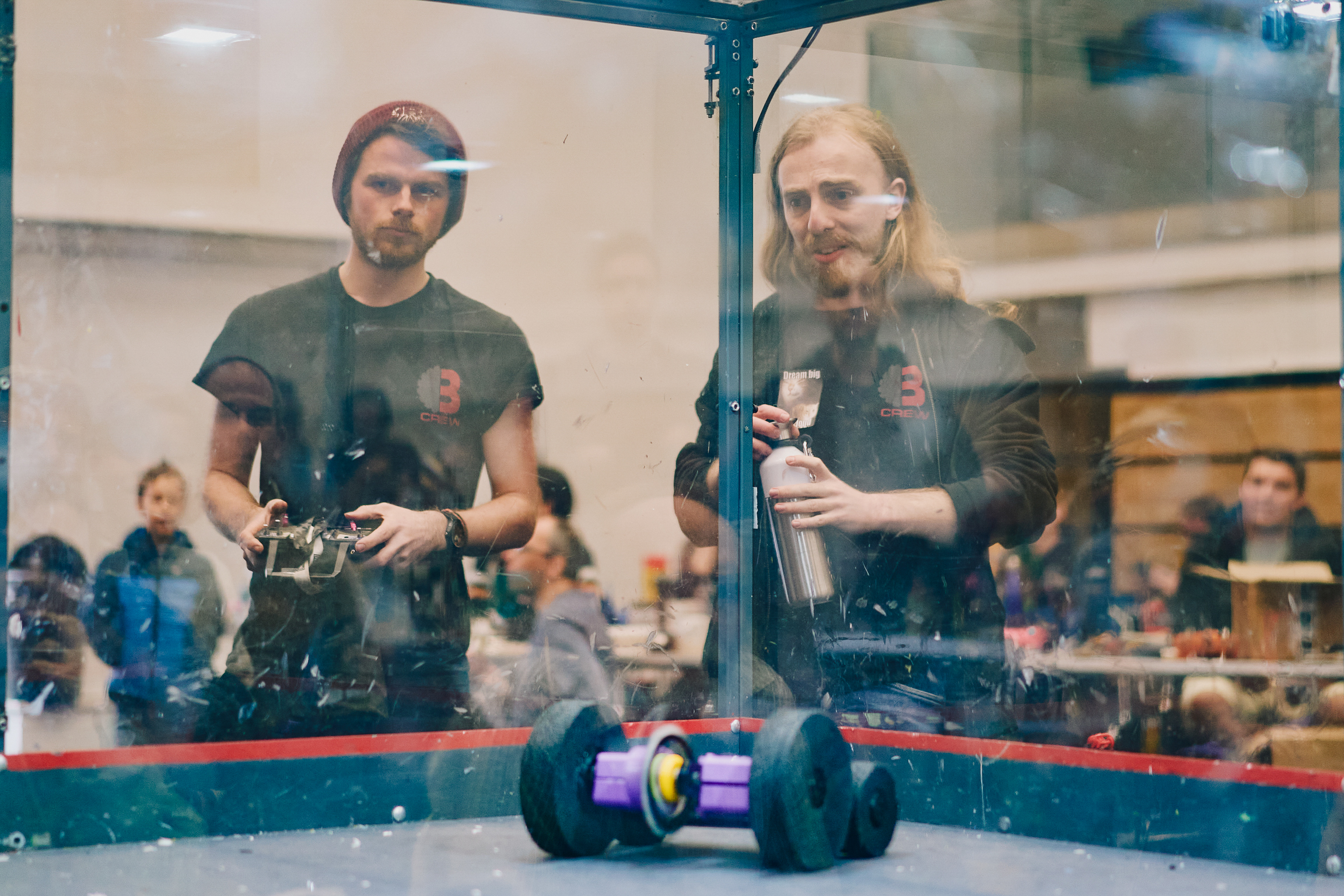
Bot Builders — Decades after the sport’s ’90s television heyday, a community of enthusiasts are continuing the craft of building extravagant machines for duelling. Juliet Nottingham attends a Bristol competition to witness the damage, destruction and intricately engineered fighters.
“I think this is the best one I’ve ever seen,” a woman says in awe to her friend. She’s speaking as a 13kg wooden treasure chest with a huge wooden tongue vibrates around its metallic competitor.
This feels like significant praise, considering I had walked into my first bot battle event 15 minutes prior, just in time to see a 3D-printed plastic goose named Honk plummet into a ball pit prison.
I stay long enough to see its battered carcass lie on the backstage table for the next two hours, before returning to be eliminated again after stepping in at the last minute for another robot that had begun leaking gas. “I drilled the holes…uh, not aligned,” admits its builder over the tannoy.
The show goes on.
Robot combat, a sport emerging from a STEM background to build “destructive weapons” to “immobilise or disable [an] opponent’s robot” – as defined by a peer-reviewed article – was brought to mass attention over three decades ago. Robot Wars brought in 6 million weekly viewers to BBC2 in the 1990s, while people in the United States were similarly obsessed with their version, Battlebots.
But since the short-cut reboot of Robot Wars aired in 2016, robot combat has been kept alive by a devoted underground community. Grafted through Bristol’s breweries and pubs, the southwest has become a particular hotbed for the sport, thanks to the Bristol Bot Builders (BBB). Formed by Joe Brown, Craig Croucher, and Gareth Barnaby, the community and event series launched in 2018 and hold competitions roughly once a month.
At the first of their summer event trilogy in late March, Bristol’s Left-Handed Giant Brewery & Taproom becomes an outdoor theatre of absurdist mechanical brawling. One man wears a tee with white paint sprawled into the words ‘Team Forgotten Gods’. It turns out he’s the owner and builder of a garden-themed bot, armed with a brown plant pot powered by a CO2 gas tank, and adorned in plastic shrubbery.
Read next: Eating concrete with London Skate Mums
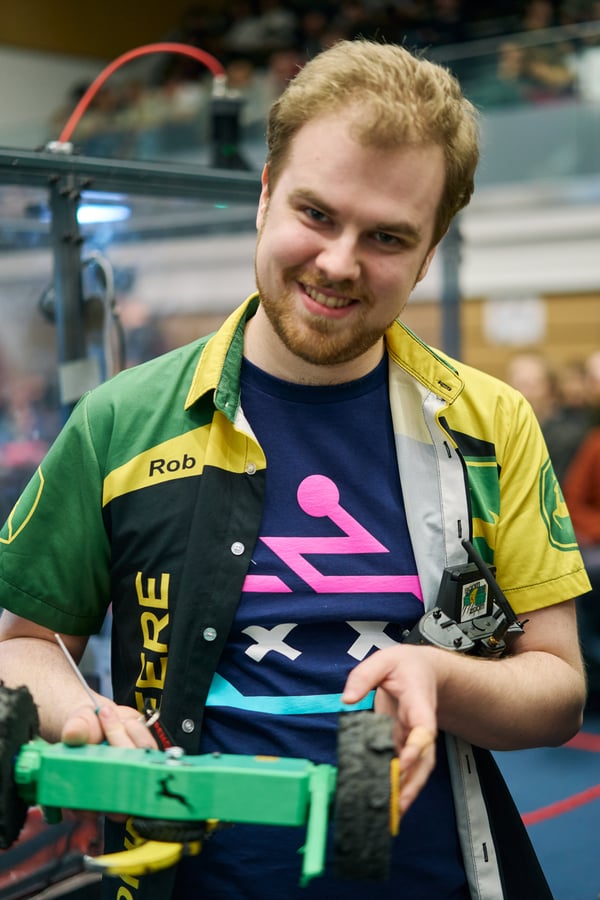

“There was a sale on at Hobbycraft,” he explains of its inspiration.
During its first fight a few moments later, the commentator laments, “There’s gardening equipment all over the arena.”
The event is deemed a ‘featherweight’ battle class, a level up from the handheld ‘antweights’ and the 1.5kg ‘beetleweights.’ Feathers weigh around 13kg – about the weight of an electric guitar, or a toddler. Some take a couple of months to build; one took two years.
Entry requirements are based on robot quality and adherence to the rules. Among these, an active weapon is required: lifters, hammers, grabbers, flippers, and overheads. At this particular venue, spinners are banned. “I mean, look at the roof,” the commentator says, looking at a sheet of mesh cast over the arena. “Those things get to 250mph. So instead, it’s an elephant vs the sheep vs the cat,” he segues into introducing the next round’s contestants.
Competition rules state there are no overall winners at BBB featherweight events. “It’s remote-control cars with weapons on. It doesn’t need to be that deep,” Craig tells me. Rounds are two minutes long, and results are judged by ‘mob rule’ – an audience vote.
“It has changed lives, which is bizarre for something that is remote control cars with chainsaws on.”
The commonly accepted origin story of robot combat runs that during a 1989 science convention, a group of engineers named the Denver Mad Scientist Club merged inspiration from robotic performance art with household droids to make them duel. Organiser Bill Llewellin christened it the Critter Crunch. “The winner will be the last critter standing (rolling, crawling) on the field of combat,” Llewellin wrote in a pre-convention mailbag. From there, mass appeal followed in just a handful of years.
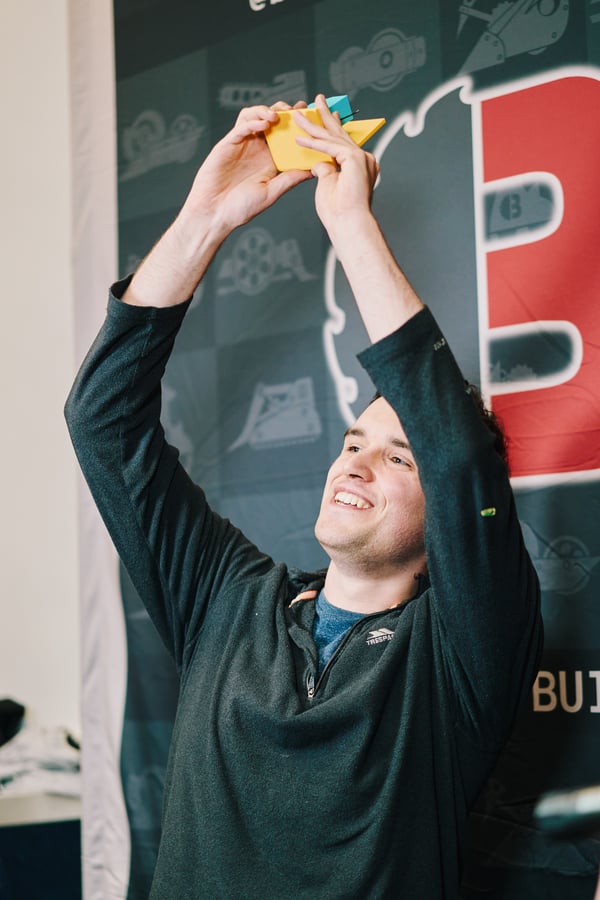
While Craig notes that new generations of engineers are still being inspired by bot-building shows – practical skills of soldering and sawing, among others, are all crucial – BBB has previously talked about adding an ‘A’ for the Arts into STE(A)M. “The arts are a massively under appreciated area, but the intersection is wonderful,” Craig says. “The robots that the crowd get behind are the ones that have larger-than-life personalities.”
Aside from a particularly terrifying pizza slice hammer with police tape around it, and the wooden chest with wide eyes, slinging tongue, and shuffling plastic feet – a divisively unsettling character – the BBB featherweight event is largely a day of animals. There’s a big crustacean turnout, much to the pampering of the populist vote. Still, no bot or character is the same.
After all, creativity is on show everywhere. I learn it’s somewhat frowned upon to buy pre-crafted kits; the act of personally piecing together an individual idea is the very point. “It’s partly about getting people excited about engineering,” Craig says after the event. “Seriousness doesn’t do a great job of that, but engaging a bunch of people at a brewery does. As a community, it’s important we still exist, that it’s accessible. Everyone just wants to see everyone succeed. It has changed lives, which is bizarre for something that is remote control cars with chainsaws on.”
Before entering, I was somewhat braced to encounter an insular, masculine subcultural world, but I don’t think I’ve heard more giggles at a sporting event before. Nor have I seen a crowd – a fairly even gender split, with some families sprinkled in – so enthralled in a long time.
“To be fair, I wouldn’t want it to stamp on my foot,” is among the hardest chat I overhear, muttered by a spectator in reference to a 10kg metal hammer pounding onto the arena floor with all the velocity of a death machine in the shape of a drone. It narrowly misses a speeding frying pan.
Looking around, it is somewhat difficult to decipher the split between fans who have made the trip for the event, or the average beer-seeking Saturday groups. A group of passing cyclists appear confused when they first arrive, before one of them observantly states, “robot wars.” The rest nod and head to the bar. I see them heavily invested in some crabs and what can only be described as a sandbagged smirking cat fighting about an hour later.
It strikes me as remarkable: there are not many concepts, certainly not robots – certainly not war – that have continued to stay the same since the ’90s.
When the shows first aired and intrigued engineers or their wannabes, online shopping facilitated homebody builders to purchase parts electronically. Early forums allowed communities to share codes and breakthroughs. It was the perfect collision of content, spectacle, and emerging possibilities.
30 years ago, robot creation was abstract and apocalyptic. Now we live within an uncanny ubiquity of them. The fantasy of futurism has quickly caught up.
Robot combat in popular culture has gone from fears of robotic rebellion and replacement on industrial factory floors to modern workplaces, with venture capital firms pouring billions into humanoid robot startups to the first Olympic Games-style between machines. They exist between family sci-fi and comedic spectacles and the carnal instinct for humans to fuck things up. Soon, Robot Wars might no longer feel so harmless, with the spectre of AI warfare and robot armies looming over humanity as the next frontier of militarism.
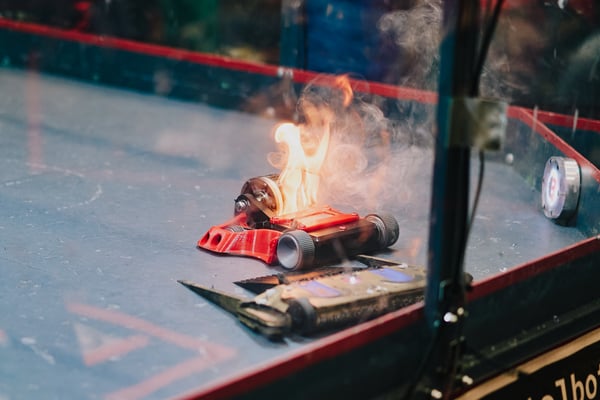
And yet the scene is still thriving. I was initially apprehensive about whether this interest, this enduring fascination and spectacle was about the past or the present, if it was about creating or destroying. A creative science eliciting guilt-free violence, it is not far off from childlike hedonism.
A little out of the way from the crowds, I sit beside an American who has long lived in the city whilst she’s on a smoke break from watching. She says that she thinks this is all perhaps an act of nostalgia: people miss making things and “pressing the buttons themselves”.
In an age of pervasive algorithms, there is something perversely invigorating about two robots cooped up in a cage, under the control and whim of human hands and eyes, tearing themselves apart.
Juliet Nottingham is a freelance sport journalist. Follow her on X.
Buy your copy of Huck 83 here.
Enjoyed this article? Follow Huck on Instagram for more from the cutting edge of sport, music and counterculture.
Support stories like this by becoming a member of Club Huck.