In the pit at one of the UK’s last stock car & banger speedways
Stock Car Racing Isn’t Dead — Photographer Liam McCarthy spent time in and around the Arlington Raceway’s circuit, capturing the diehard community that keeps the sport alive.
 Black News
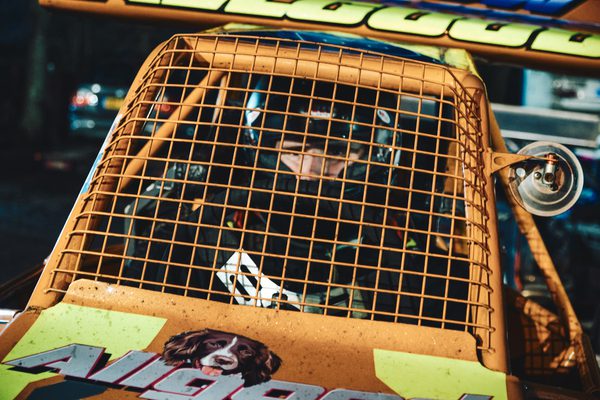
Stock Car Racing Isn’t Dead — Photographer Liam McCarthy spent time in and around the Arlington Raceway’s circuit, capturing the diehard community that keeps the sport alive.
In the late ’80s, when Martyn Coles was a child, his father worked as a stock car racing mechanic. The young Coles would accompany his father to the track, and watched as he changed tyres, repaired engines and tuned the suspension for a British Spedeworth Superstox Formula driver named Howard Cole, dreaming of sitting behind the wheel himself. His father did so until October 1990, when Cole tragically died in a race, reportedly suffering from a heart attack while driving and crashing into the speedway’s safety fence.
Despite the tragedy, the young Coles never strayed from his goal. He’s a driver today, and a regular in the UK’s stock car and banger racing circuit. “I remember growing up watching Howard and wanting to race, then unfortunately Howard got killed,” Coles recalls. “But I still wanted to race. As soon as I was old enough that was it – I was racing. I just wanted to make him proud, really.”
Photographer Liam McCarthy met Coles in the pit in January when he attended a stock car racing event at the Arlington Raceway. Seeing several hundred fans turn up on a blistering wintry day, while getting close-up access to the drivers, mechanics and marshals that made the race days tick, it was an eye-opening introduction to a sport rooted in rural British working class culture and kept alive by a devoted community.
- Read next: Poignant photos of Cornwall’s last raceway
“They’ll travel around the country to race and sleep on the road for days,” McCarthy explains. “But it’s a completely community oriented space, from the chip stands to the children helping out with the cars prior to the race – it’s like a family essentially.”
It ultimately sparked his series, Stock Car Racing Isn’t Dead, where he spent time wandering around the fringes of the Arlington Raceway, capturing candid shots of the community who turn up to races rain or shine. Stock car and banger racing – which sees drivers race modified production model cars spanning decades past around typically an oval track – originated in the USA in the 1920s, when Prohibition era moonshine runners tweaked and upgraded their cars to escape police vehicles.
The culture ultimately birthed the National Association for Stock Car Auto Racing, LLC (NASCAR), with the organisation now responsible for some of the world’s largest motorsports races. But stock car racing began gaining popularity in the UK in the mid-20th century and took on its own flavour. While NASCAR adopted a sheen of modernism, the UK – led mainly by Spedeworth Motorsports and British Stock Car Association (BriSCA) – saw the evolution of banger racing, where drivers and mechanics tune and refit old, often discarded stock cars, with full contact “bashing” between cars playing a key part in overtaking.
For McCarthy, the sport is a manifestation of Britishness. “It was born from NASCAR, and along with the mechanical and technological developments it was a really big spectacle,” McCarthy says. “But it’s funny how the UK has its own way of taking a piece of culture and putting its own gritty spin on it.”
On his second visit to the Arlington Raceway, McCarthy accompanied driver Tim Hudson, a driver who specialises in the Legends Formula. Based off vintage 1930s and 1940s American hot rod cars but amped up with 1200/1250cc Superbike engines, the regulations of the class prohibit upgrading parts. It means that winning is often determined solely by driving skill, and it tends to attract those who lean towards the purist side of stock car racing.
“What tends to win the Legends Formula races is experience, because the cars have to be the same,” McCarthy explains. “The culture was slightly more diehard than other formulas – there’s only a select few groups of people that still compete in it, and everyone knows each other. I spoke to Tim for ages about the diehard nature of it – he spends almost all his free hours either working on his car, racing or driving to races.”
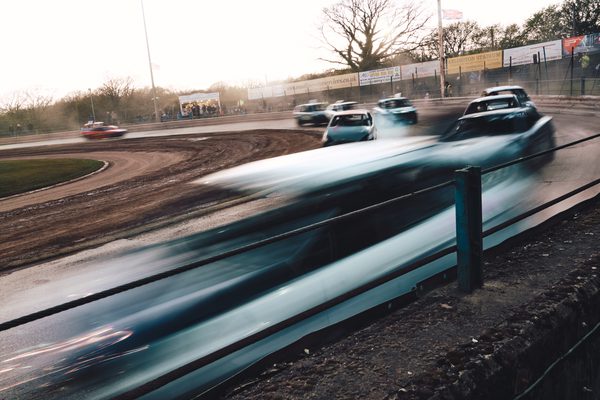
Stock car and banger racing is ultimately an extreme sport, which draws acute devotion. Despite the sport’s overall decline in health, with the iconic Wimbledon Stadium, Arena Essex Raceway and Birmingham Wheels Park all shuttering within the last decade, there remains a devoted core of participants like Hudson who take to the road year-round. And for many, like Coles, it runs in the blood. What keeps him racing now? “The buzz when I’m out there,” Coles says. “And to see the family’s face when I’ve done well – that’s what I do it for.”
Stock Car Racing Isn’t Dead by Liam McCarthy is produced in partnership with BA Photography and Creative Industries at the London College Of Communication. Follow Liam on Instagram.
Isaac Muk is Huck’s digital editor. Follow him on Bluesky.
Buy your copy of Huck 83 here.
Enjoyed this article? Follow Huck on Instagram for more from the cutting edge of sport, music and counterculture.
Support stories like this by becoming a member of Club Huck.