Korea eyes Nigeria’s critical minerals with new strategic partnership
South Korea has signalled a strategic shift in its relationship with Nigeria, moving away from a traditional aid-based model towards a partnership focused on shared responsibility, institutional development and economic cooperation.
 Black News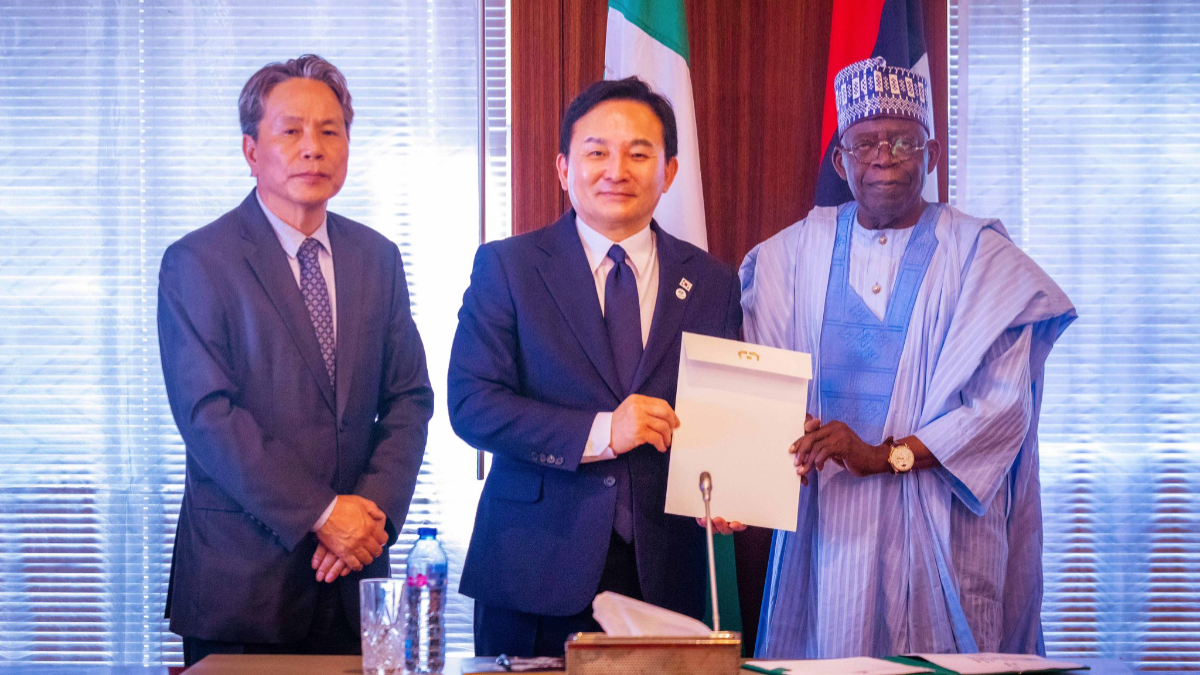

![L-R: Mr Won Hee-Ryong, the Special Envoy of the President of South Korea (middle) and President Bola Tinubu of Nigeria. [X, formerly Twitter/Bayo Onanuga]](https://ocdn.eu/pulscms/MDA_/9f89498ecb2df54d842b96acf1e9a3e9.jpg)
South Korea has signalled a strategic shift in its relationship with Nigeria, moving away from a traditional aid-based model towards a partnership focused on shared responsibility, institutional development and economic cooperation.
- South Korea is redefining its relationship with Nigeria, moving away from traditional aid towards a partnership model.
- The shift comes as global development assistance declines sharply, forcing donor countries to rethink engagement.
- Both nations are exploring stronger economic ties, particularly in critical minerals and industrial development.
- Officials say future cooperation will depend on transparency, institutional strength and shared accountability.
The change was outlined during a joint seminar hosted by the Nigerian Institute of International Affairs and the Embassy of the Republic of Korea, where officials pointed to declining global aid as a key driver of the new approach.
Speaking at the event, Korea’s Chargé d’Affaires, Tak Namgung, said global Official Development Assistance fell to about $174 billion in 2025, marking a 23 per cent drop, the steepest decline in recent years. Bilateral aid to Sub-Saharan Africa is expected to shrink further, potentially by up to 28 per cent, as major donors scale back spending.
Namgung argued that the traditional donor-recipient framework is no longer viable in the current economic climate.
“Meaningful cooperation must now be built on shared knowledge, strong institutions and mutual accountability,” he said.
He pointed to South Korea’s own development trajectory as a reference point, noting that the country prioritised building resilient systems, including digital governance. However, he acknowledged that rapid economic growth came with early trade-offs, particularly in areas such as democratic governance and human rights.
“Economic growth and respect for human rights should not be pursued separately,” Namgung said, warning that imbalances between the two can undermine long-term stability.
Critical minerals and industry key to Nigeria–Korea economic ties
The shift comes as both countries explore deeper economic ties, particularly in the critical minerals sector. South Korea imports more than 95 per cent of its critical mineral needs, while Nigeria holds significant reserves of lithium, graphite and other materials essential for electric vehicles and clean energy technologies.
Namgung stressed that unlocking these opportunities would require more than resource extraction.
“Sustainable industrial development depends on transparency, trust and strong institutions,” he said.
South Korean companies, including Daewoo Engineering & Construction, have long been involved in Nigeria’s infrastructure projects. Technology firms such as Samsung Electronics and LG Corporation are also active in the country, contributing to industrial capacity and workforce development.
Through the Korea International Cooperation Agency, Seoul has additionally supported Nigeria’s e-governance initiatives, reflecting a broader emphasis on institutional strengthening as aid flows decline.