Mali strengthens Russia ties after insurgent attacks, junta leader promises security crackdown
Mali’s military ruler, Assimi Goïta, has said the country’s security situation is “under control” following a wave of coordinated attacks that exposed growing insurgent coordination and raised concerns about regional stability.
 Black News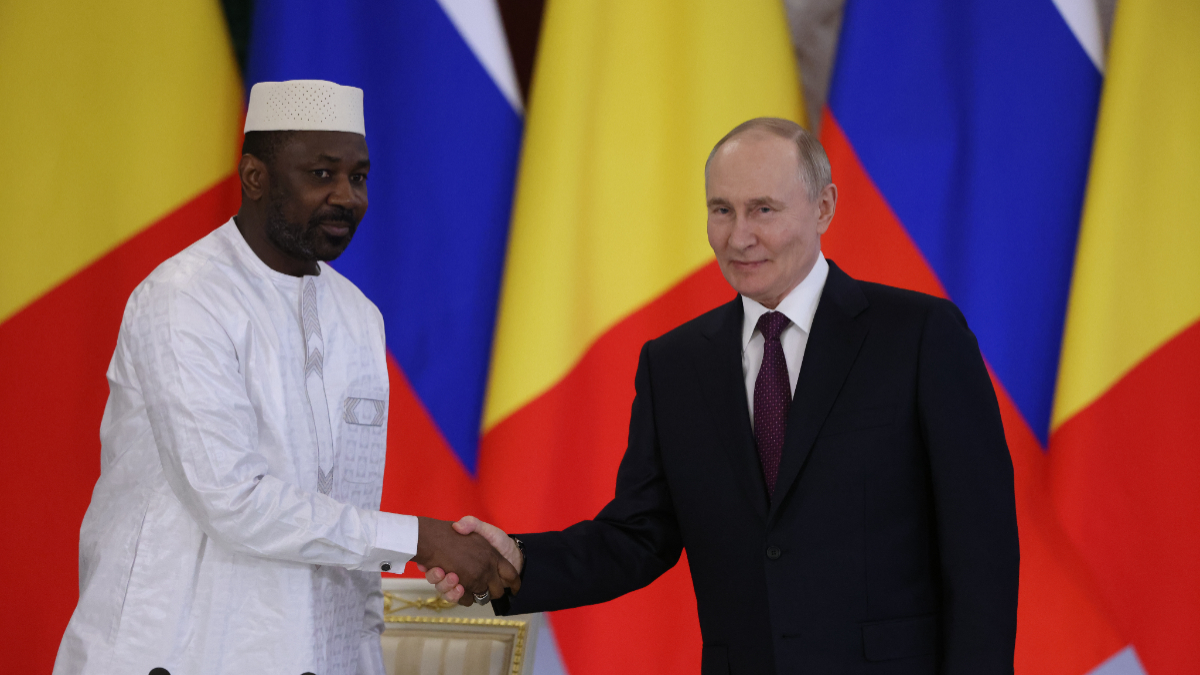
![Russian President Vladimir Putin (R) shakes hands with Malian junta Assimi Goita (L) during their meeting at the Grand Kremlin Palace, June 23, 2025, in Moscow, Russia. [Photo by Contributor/Getty Images]](https://ocdn.eu/pulscms/MDA_/f3fc761e2626e34e8711e689cc95926b.jpg)
Mali’s military ruler, Assimi Goïta, has said the country’s security situation is “under control” following a wave of coordinated attacks that exposed growing insurgent coordination and raised concerns about regional stability.
- Mali’s junta leader Assimi Goïta says the security situation is under control after deadly coordinated attacks.
- The assault, claimed by an al-Qaeda-linked group, killed Defence Minister Sadio Camara and exposed rising insurgent coordination.
- Russia reaffirmed its support for Mali as concerns grow over militant expansion across the Sahel.
- Analysts warn the attacks signal a shift in insurgent capability with implications for regional stability.
In his first public appearance since the weekend assault, Goïta addressed the nation on Tuesday, April 28, 2026, promising to “neutralise” those responsible.
The attacks, claimed by an al-Qaeda-linked group alongside a Tuareg separatist faction, struck multiple targets, including a key military base and areas near Bamako’s main airport.
The violence also led to the death of Mali’s defence minister, Sadio Camara, marking one of the most significant blows to the country’s military leadership in recent years.
Security analysts say the scale and coordination of the assault signal a shift, with armed groups demonstrating an increased ability to collaborate despite differing agendas.
The development raises the risk of further destabilisation in Mali’s vast northern regions and beyond, where militant groups have increasingly targeted neighbouring countries.
In a televised statement, Goïta insisted military operations would continue until “complete neutralisation” of the attackers is achieved.
Earlier in the day, images released by his office showed him meeting Russia’s ambassador to Mali, Igor Gromyko, underlining Bamako’s deepening security ties with Moscow.
Russia reinforces alliance with Mali
![Russian President Vladimir Putin (R) talks to interim Malian President Assimi Goita (L) during their meeting at the Grand Kremlin Palace, June 23, 2025, in Moscow, Russia. [Photo by Contributor/Getty Images]](https://ocdn.eu/pulscms/MDA_/7a6be8e16af4112bd4f1034518cf1be7.jpg)
According to a government statement, both sides reaffirmed their commitment to cooperation against “international terrorism.”
Russia has emerged as a key security partner for Mali following the expulsion of French and United Nations forces after coups in 2020 and 2021.
Moscow said its forces helped repel what it described as an attempted seizure of critical infrastructure, including the presidential palace.
In a statement, Russia’s defence ministry said insurgents were regrouping and warned that further attacks remained likely.
“The enemy has not abandoned its aggressive intentions,” the ministry said, adding that reconnaissance operations were underway to dismantle militant camps.
Meanwhile, a spokesperson for Jama’at Nusrat al-Islam wal-Muslimin (JNIM), Bina Diarra, claimed responsibility for the attacks in a video message, describing them as retaliation for Malian military operations, including drone strikes. He also threatened to impose a siege on Bamako, a city of roughly four million people.
“As of today, Bamako is closed off from all sides,” Diarra said, echoing previous tactics such as fuel blockades that have disrupted the capital in the past.
![Tuareg rebels of the Azawad Liberation Front (FLA) ride on the back of pickup trucks in Kidal, on April 26, 2026. [Photo by abdollah Ag Mohamed / AFP via Getty Images]](https://ocdn.eu/pulscms/MDA_/bb8826e35bd182bc0aad55aa03f38bd0.jpg)
The security situation remains fluid as separate reports indicate that fighters linked to the Islamic State in the Sahel Province have entered the northeastern town of Ménaka, near the Niger border.
While no clashes were reported, witnesses said militants had established checkpoints in parts of the town, highlighting the complex and overlapping presence of armed groups in the region.
JNIM and Islamic State affiliates have long been rivals, with hundreds of clashes recorded since 2019 and more than 2,000 deaths linked to their conflict, according to conflict monitoring data.
Russia’s response to the crisis is being closely watched internationally, particularly as it seeks to expand its security footprint in Africa while continuing its military campaign in Ukraine.
For Mali, the latest violence underscores the persistent challenges facing its military government as it attempts to assert control over a fragmented and volatile security landscape.