New language, same soul
Everyone who filled the Kirkwood Performing Arts Center’s Strauss Black Box Theatre last weekend knew what they were about to see. But if they hadn’t, the opening montage could have easily passed for a signature moment from one of The Black Rep’s many August Wilson productions. Silhouettes of Black actors with dreads, fros and fades […] The post New language, same soul appeared first on St. Louis American.
 Black News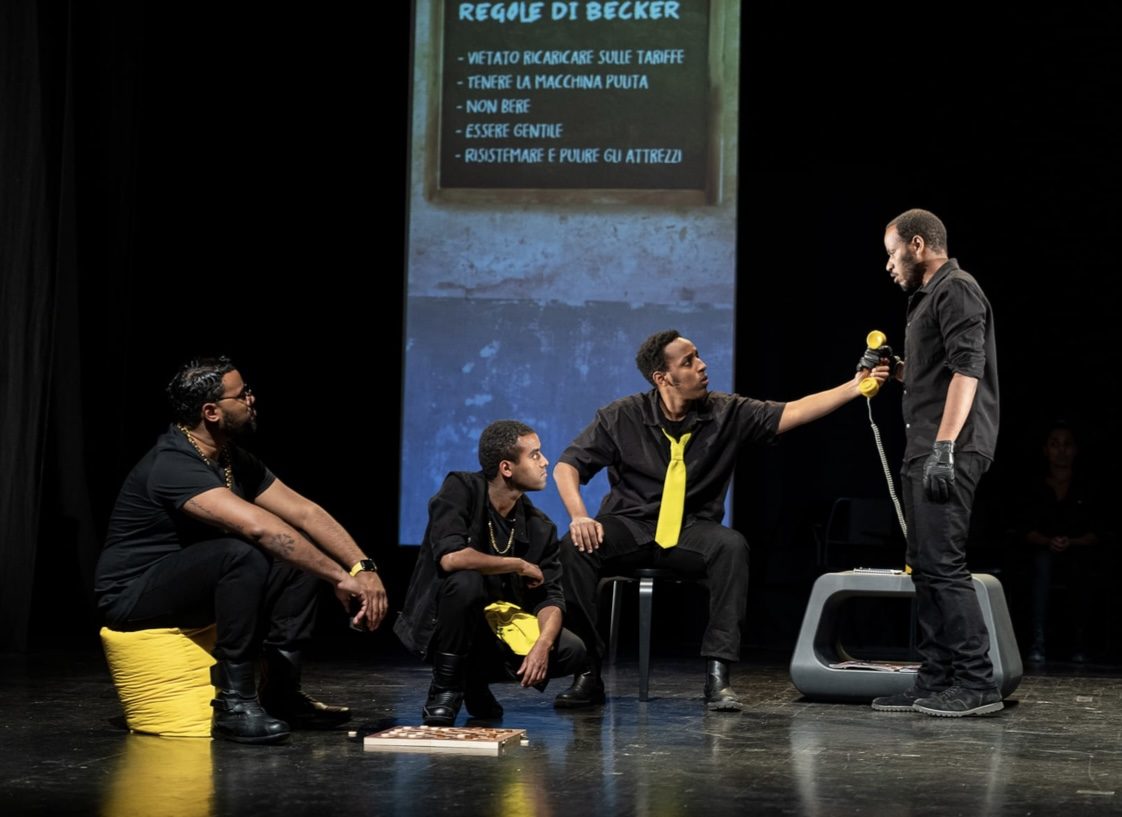

Everyone who filled the Kirkwood Performing Arts Center’s Strauss Black Box Theatre last weekend knew what they were about to see. But if they hadn’t, the opening montage could have easily passed for a signature moment from one of The Black Rep’s many August Wilson productions. Silhouettes of Black actors with dreads, fros and fades took their places as Marvin Gaye’s “Inner City Blues” pulsed through the room. Video screens flashed scenes of urban life that could have been pulled from any Black neighborhood in America — though the smokestacks and steel mill aerials hinted at a more specific location.
Wilson’s plays are declarations of unapologetic Blackness told through the lens of theater.
As the cast settled into their seats, the yellow-and-black accents nodded to the director’s devotion to the Pittsburgh Steelers — and to Wilson’s hometown, the backdrop for nine of his ten Century Cycle plays. The actors crooned along softly to Gaye’s lyrics.
“Rockets, moon shots. Spend it on the have nots,” they sang. “… Make me wanna holler…the way they do my life…This ain’t living.”
When the music faded, Youngblood prepared to deliver the play’s first line. He opened his mouth.
“Ma dai! Non puoi farlo! Come fai a portarmi via il mio uomo?”
A huge screen behind them provided the translation: “Naw! You can’t do that! How you gonna take my man?”
The two men locked in a heated game of checkers — like the rest of the cast — were Italian. And for the first time anywhere, August Wilson’s Jitney was being performed in another language, presented by The Black Rep.
Director Renzo Carbonera chose St. Louis as the first stop on the international tour, which will move on to Cleveland and Pittsburgh before heading back to Italy. Their names — including Marcos Piacentini, Rosanna Sparapano — revealed where they came from, but once they stepped into Wilson’s world, it didn’t matter. Onstage, they blended in so seamlessly that anyone unfamiliar with their backgrounds might not have realized they were watching a global experiment unfold in real time.
The language was the anomaly. The passion was not. The cast delivered Wilson’s thick, layered dialogue with the urgency and reverence expected of actors entrusted with his work. Their ability to shift between multiple roles only underscored the depth of their preparation, especially given the density of Wilson’s text.
Wilson’s plays are declarations of unapologetic Blackness told through the lens of theater. This production showed just how far that lens reaches. For more than a century, Black culture has been commodified, appropriated and absorbed into global mainstreams — from the jazz age to hip-hop — while Black people continue fight for their full agency as human beings at home. Wilson captured that tension in his ten-play cycle chronicling each decade of 20th-century Black life. Wilson’s genius lies not only in the stories, but the poetry in everyday Black speech he revealed through his dialogue.
None of that was lost in translation.
The company — which also included Miguel Gobbo Diaz, Federico Lima Roque and Tomiwa Samson Segun Aina — handled Jitney with care and intention.
Diaz moved between Becker and Shealy with ease. As Shealy, he burst onto the stage with gold chains and hustler bravado. As Becker, he softened — shoulders lowered, voice steady, eyes fixed on whoever needed his counsel. Becker is the moral anchor of Jitney, a man carrying a family history that would have broken someone with less resolve.
Piacentini faced a similar challenge with Turnbo and Booster. Turnbo gossips and gripes his way through the station, while Booster returns home after two decades of reckoning with the act that changed his life. Piacentini found the truth in both. Each of his portrayals was rooted in a different kind of vulnerability.
All of the performances were so focused, so engrained in Wilson’s intent, that the supertitles became secondary. The work spoke for itself.
And in doing so, this production proved what many already know. Wilson belongs in the same conversations as Shakespeare — a playwright whose words shift culture, cross borders and resonate no matter the time, the people or the place.
The post New language, same soul appeared first on St. Louis American.