Regional Autonomy Strained as Puntland Leadership Rejects Somalia’s Proposed One-Person, One-Vote Election Plan in Garowe
Regional Autonomy Strained as Puntland Leadership Rejects Somalia’s Proposed One-Person, One-Vote Election Plan in Garowe
Facebook

Twitter (X)

Instagram

Somali Magazine - People's Magazine
The sudden rejection of the central government’s proposed one-person, one-vote election plan by regional leaders has introduced deep institutional friction into the democratic trajectory of the Horn of Africa. Puntland State President Said Abdullahi Deni voiced sharp criticism against the federal administration’s sweeping electoral reform agenda, […]
The post Regional Autonomy Strained as Puntland Leadership Rejects Somalia’s Proposed One-Person, One-Vote Election Plan in Garowe first appeared on Somali Magazine.
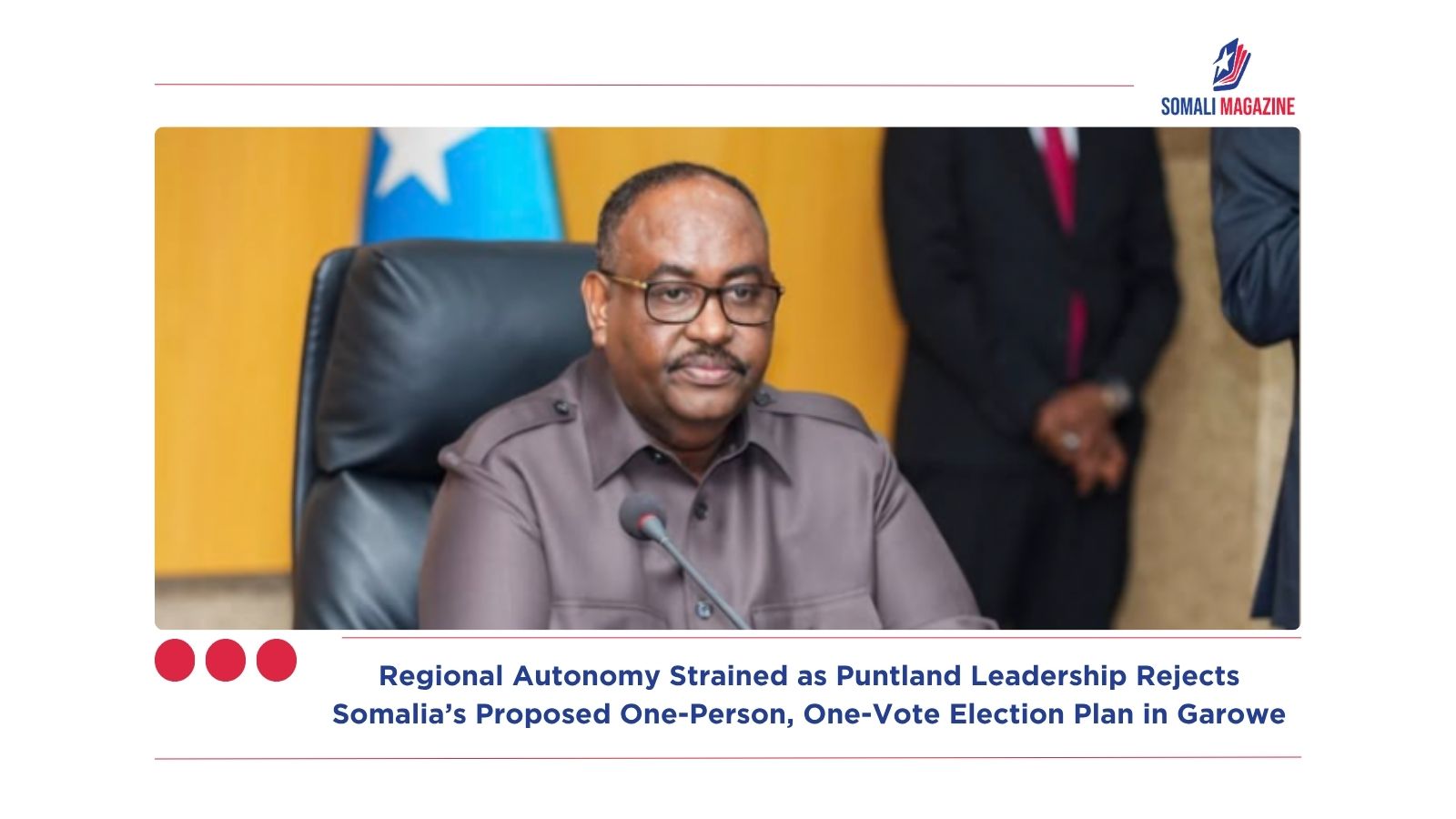
The sudden rejection of the central government’s proposed one-person, one-vote election plan by regional leaders has introduced deep institutional friction into the democratic trajectory of the Horn of Africa. Puntland State President Said Abdullahi Deni voiced sharp criticism against the federal administration’s sweeping electoral reform agenda, arguing that unilateral efforts to overhaul the nation’s traditional voting framework threaten to destabilize the fragile state-building progress achieved over recent decades. Speaking from the regional capital of Garowe, the regional executive asserted that the central leadership in Mogadishu is actively attempting to consolidate authority by altering the foundational rules of political representation without the necessary broad-based consensus from all federal member states. This high-stakes administrative standoff underscores the persistent structural vulnerabilities inherent within the country’s decentralized governance system, where shifting legislative boundaries frequently clash with deep-seated desires for regional autonomy.
At the heart of the expanding political gridlock is the federal government of Somalia’s determined push to transition the state away from the long-standing, clan-based indirect electoral system toward a direct universal suffrage model. While proponents in the capital frame these sweeping changes as a necessary evolution toward authentic democracy, regional authorities view the timeline and methodology with immense skepticism, characterizing the process as a calculated effort to tilt the upcoming legislative landscape in favor of the incumbent administration. President Deni has repeatedly cautioned that forcing a highly complex one-person, one-vote election plan across contested or insecure territories without comprehensive registration infrastructure or verified local security guarantees is fundamentally unrealistic. Furthermore, the semi-autonomous state of Puntland has previously suspended its formal recognition of federal institutions in protest of recent constitutional amendments passed by the national parliament, which regional officials maintain violate the core tenets of the provisional federal pact.
The escalating constitutional dispute has raised significant concerns among international stakeholders and diplomatic partners who are closely monitoring the growing potential for political fragmentation across the strategic maritime corridor. Both the United States and the United Kingdom have recently emphasized the critical importance of maintaining a dual-track diplomatic approach that balances support for central authorities with robust, direct engagement with autonomous regional administrations to preserve localized stability. Independent security analysts note that prolonged governance disputes between Mogadishu and Garowe risk distracting the national armed forces from vital counter-insurgency operations against active al-Shabaab networks and expanding extremist factions along the coast. To avoid a protracted institutional breakdown, domestic political mediators are urgently calling for a comprehensive national dialogue capable of synthesizing the federal government’s preferred one-person, one-vote election plan with the non-negotiable regional autonomy demanded by the country’s diverse federal members.


 Black News