Rwanda expedites its nuclear ambition via a new agreement with a major nuclear agency
Rwanda and the International Atomic Energy Agency (IAEA) recently had a conversation on Rwanda’s ambitious nuclear goals.
 Black News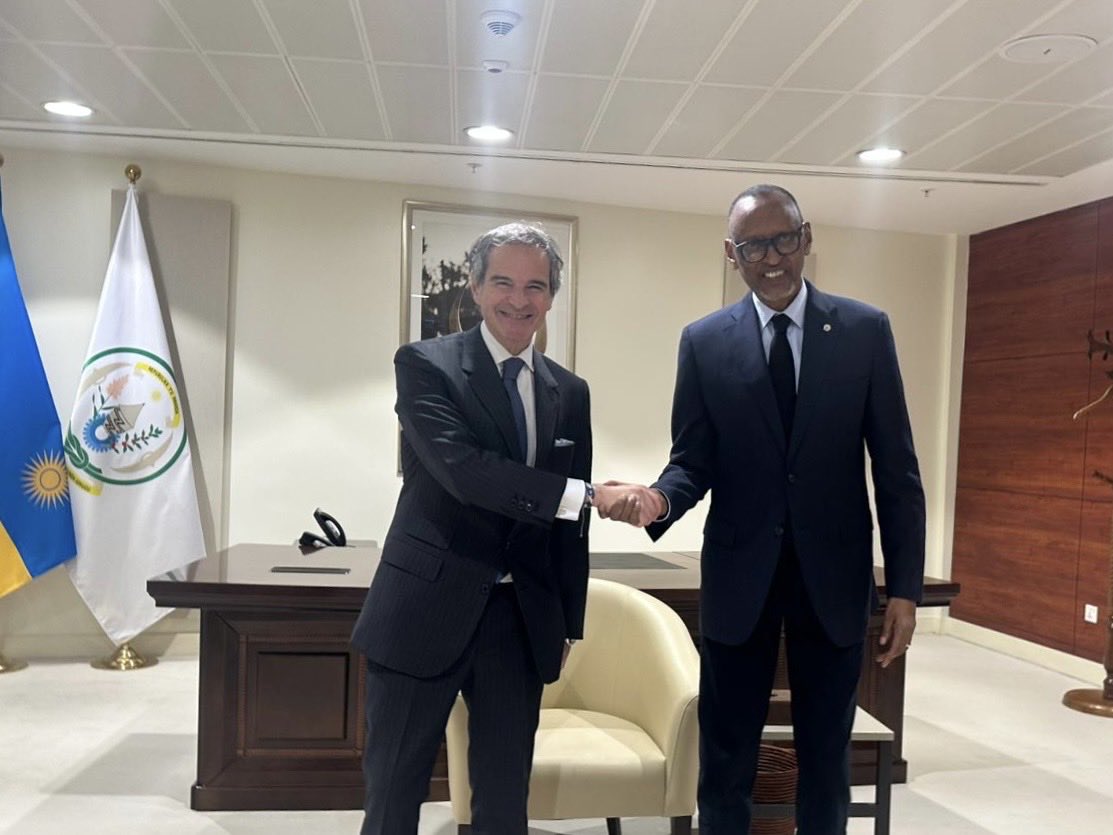
![L-R Rafael Mariano Grossi, director of IAEA and the President of Rwanda Paul Kagame on the margins of the Nuclear Energy Innovation Summit on Africa [X:@rafaelmgrossi]](https://ocdn.eu/pulscms/MDA_/2879519ffeb212ed7a9c468ad9d1d4ab.jpg)
Rwanda and the International Atomic Energy Agency (IAEA) recently had a conversation on Rwanda’s ambitious nuclear goals.
- Rwanda and the International Atomic Energy Agency (IAEA) recently discussed Rwanda's ambitious nuclear energy plans during the Nuclear Energy Innovation Summit on Africa.
- IAEA Director General delivered the final report of an Integrated Nuclear Infrastructure Review (INIR) mission and signed an agreement to enhance cooperation on nuclear energy, especially small modular reactors.
- Rwanda aims to have nuclear energy operational by the early 2030s, with a goal for nuclear power to make up over 60% of its energy mix by 2050.
- The INIR mission praised Rwanda's institutional, legal, and technological progress, highlighting strong government support and proactive regulatory measures.
These discussions came on the heels of the IAEA’s visit to the East African region for the Nuclear Energy Innovation Summit on Africa.
There, the director of the agency, Rafael Mariano Grossi, met with the presidents of some countries in the region, including the president of Tanzania, Samia Suluhu Hassan, the president of Rwanda, Paul Kagame, and Faure Gnassingbé, President of the Council of Ministers of Togo.
According to the information disclosed by the agency, Rafael Mariano Grossi delivered the final report of an Integrated Nuclear Infrastructure Review mission, discussed Rwanda's ambitious nuclear power aspirations with President Paul Kagame, and signed a deal to improve nuclear energy collaboration between the IAEA and Rwanda.
The Integrated Nuclear Infrastructure Review (INIR) mission represents a pivotal development in Rwanda's strategic efforts to establish a robust framework for a safe, secure, and sustainable nuclear power program.
“Rwanda is pleased to have successfully completed the IAEA’s Phase 1 Integrated Nuclear Infrastructure Review (INIR).
We intend to have nuclear energy operational by the early 2030s, and this assessment confirms that we are on track. For Africa, energy is not simply a development issue.
It is the foundation of industrial growth and competitiveness,” the Rwandan president stated.
Rwanda's energy policy identifies nuclear power as a fundamental element of a diversified energy portfolio intended to mitigate reliance on imported electricity and liquid fuels, established with a strategic objective for nuclear energy to constitute over 60% of the national mix by 2050.
The East African country intends to commission its initial small modular reactor (SMR) during the 2030s.
The IAEA’s Director General and Rwanda's Minister of Infrastructure, Jimmy Gasore, executed an agreement to enhance cooperation with the IAEA regarding the integration of nuclear energy, specifically small modular reactors (SMRs), into the national energy portfolio.
Furthermore, Director General Grossi engaged in discussions with President Samia Suluhu Hassan of Tanzania concerning the expanding partnership between the IAEA and the United Republic of Tanzania.
These deliberations encompassed a broad range of initiatives, including oncological care, the enhancement of food security via the IAEA flagship programs Rays of Hope and Atoms4Food, and the strategic development of Tanzania's electrical power infrastructure.
Rwanda and the IAEA a few months ago
Back in March, reports indicated that the IAEA backed Rwanda’s progress toward developing a nuclear power programme, following an eight-day review mission that assessed the country’s readiness to introduce nuclear energy into its power mix.
The Integrated Nuclear Infrastructure Review (INIR) mission noted, after making its findings between March 2 and 9 at Kigali's request, that Rwanda is steadily developing the institutional, legal, and technological underpinnings needed for nuclear power.
DON'T MISS THIS: Rwanda plans up to $6billion investment in nuclear power as Kagame targets high-income economy by 2050
Strong government cooperation, early regulatory creation, and proactive stakeholder involvement were identified by the IAEA as the nation's main advantages.
The findings coincide with Paul Kagame's recent international reaffirmation of the nation's nuclear aspirations.
Speaking at an Emmanuel Macron-hosted nuclear energy event in Paris, Kagame revealed intentions to invest up to $6 billion in nuclear power infrastructure to ensure dependable electricity for sustained economic growth.
In order to assist developing nations pursuing nuclear energy, he also advocated for the expansion of international financial institutions.