The Dangote Refinery and the End of Africa’s Engineered Dependency
For decades, Africa’s place in the global oil economy was not merely subordinate; it was designed to be so. Crude flowed out. Refined fuel flowed back in. Value accumulated elsewhere. This was not an unfortunate equilibrium but a system built with precision: refining infrastructure in Europe, currencies of trade external, shipping, and pricing settled far beyond African control. To call this a market outcome is to misunderstand it. It was architecture. What the Dangote Refinery represents is a direct challenge to that architecture. At 650,000 barrels per day, the largest single-train refinery ever built, the $20 billion facility’s real significance […] The post The Dangote Refinery and the End of Africa’s Engineered Dependency appeared first on African Arguments.
 Black News
For decades, Africa’s place in the global oil economy was not merely subordinate; it was designed to be so.
Crude flowed out. Refined fuel flowed back in. Value accumulated elsewhere. This was not an unfortunate equilibrium but a system built with precision: refining infrastructure in Europe, currencies of trade external, shipping, and pricing settled far beyond African control. To call this a market outcome is to misunderstand it. It was architecture.
What the Dangote Refinery represents is a direct challenge to that architecture. At 650,000 barrels per day, the largest single-train refinery ever built, the $20 billion facility’s real significance lies in what it keeps on the continent: the ability to transform crude into value without routing it through someone else’s system, striking at the very mechanism through which Africa’s dependency has been reproduced for generations.
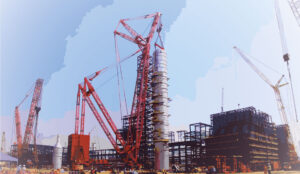
The world’s largest crude distillation column installed at the Dangote Refinery in Lekki, Lagos. At 112 metres, the column is taller than Big Ben.
Breaking the Atlantic loop
Nigeria embodied the old contradiction most nakedly. Africa’s largest crude oil producer, it routinely drained its foreign reserves importing the very petrol its own ground produced. The explanation was never simply corruption or mismanagement. It was structural: Africa was permitted to produce, but not to complete the chain.
The consequences of breaking that chain are already measurable. According to the Dangote Group, Nigeria spent $2.6 billion on fuel imports in the first quarter of 2024; by the same period in 2025, that figure had fallen to $1.2 billion, a 54 per cent drop, as the refinery displaced foreign supply. By late 2025, Bloomberg reported the facility was loading over 45 million litres of petrol and 25 million litres of diesel daily, exceeding Nigeria’s domestic demand. Africa as a whole still refines only 30 per cent of its crude domestically, losing an estimated $25 billion a year to imports, and Dangote is the most significant single intervention into that equation. European refiners are already registering the erosion of markets that once absorbed West African crude and returned finished products. What is disappearing here is not trade, but inevitability.
Delays, disputes, and the weight of the old order
The path from announcement to operation was neither smooth nor swift, and that journey is itself revealing. Announced in 2013 at an estimated $9 billion, the project ultimately consumed $20 billion; major construction only began in July 2017, and commissioning came nearly a decade later than projected.
The most persistent challenge has been crude supply. Under a naira-for-crude agreement with the Nigerian National Petroleum Company (NNPC), Dangote was promised a minimum of 385,000 barrels per day. NNPC consistently failed to deliver. “We need 650,000 barrels per day. NNPC agreed to give a minimum of 385,000 bpd, but they are not even delivering that,” Devakumar Edwin, Vice President of Dangote Industries, told Reuters in November 2024. Sources told Nairametrics the shortfall was deliberate, a scheme to preserve the import model. The Crude Oil Refinery Owners Association of Nigeria (CORAN) called publicly for stricter licensing, accusing international traders of using Nigeria as a dumping ground for substandard products in contravention of the Petroleum Industry Act.
The commercial dimension was equally contentious. NNPC had been buying petrol from Dangote at ₦898.78 per litre while reselling it to marketers at ₦765.99, absorbing a de facto subsidy of ₦133 per litre. When NNPC exited its role as sole off-taker in October 2024, that arrangement collapsed. Pump prices surged, fuel queues briefly returned, and the refinery was forced to source crude internationally, including purchases of US WTI Midland, because domestic supply was insufficient.
These tensions expose something deeper than a commercial dispute. This is a story of new industrial capacity running headlong into an institution that had long profited from the import model it was now supposed to dismantle, and that resistance did not stay in the boardroom. It shaped the political choices that followed.
How the state opened the door
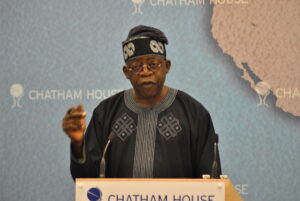
President Bola Tinubu
When President Tinubu was sworn in on 29 May 2023, his first act was to abolish Nigeria’s fuel subsidy regime, in place since the 1970s. The social costs were immediate: petrol prices surged, the naira was simultaneously floated, and inflation climbed. Nigeria’s fuel import bill hit a record ₦15.42 trillion in 2024 as naira depreciation inflated costs even as dollar-denominated prices held relatively steady.
Yet that pain created the conditions for domestic refining to compete. Under the subsidy model, NNPC had effectively price-capped the market through subsidized imports; Dangote could not have survived it. Deregulation opened the space. In February 2024, Tinubu signed three executive orders to reduce contracting timelines, clear local content bottlenecks, and incentivize oil and gas investment. In October 2025, the government approved a 15 per cent import duty on refined petroleum products, a deliberate act of industrial protection recommended by the Federal Inland Revenue Service. Independent importers warned it risked entrenching a monopoly; the government called it temporary, pending competitive domestic capacity.
The refinery was not built despite the state. It was enabled by specific decisions at specific moments, and obstructed by others. That the same logic now applies across Angola, East Africa, and beyond reveals something the trade data alone cannot: what is at stake here is not one refinery, but whether African industrial power can consolidate before the architecture of dependency reasserts itself.
What African scale actually threatens
What unsettles the existing order is not the refinery itself but what it signals: that African capital, sufficiently concentrated, can bypass the intermediary roles historically imposed on it. For decades, Western influence over African economies has depended less on ownership than on orchestration, control of the financing, the technical standards, the insurance markets, and shaping the outcome without appearing to. But when the value chain shortens, and fewer transactions require external mediation, that quiet centrality begins to erode. It does not vanish overnight. It thins.
The Dangote Refinery complex at Lekki, near Lagos
The regional shift is already visible. By early 2026, the refinery had shipped 456,000 tonnes of refined products to Côte d’Ivoire, Cameroon, Tanzania, Ghana, and Togo, with South Africa, Kenya, and Ghana in formal supply discussions. A continent that once looked exclusively to European and Middle Eastern refiners for finished products is increasingly looking inward, which is precisely why the pressure to abandon this kind of infrastructure is arriving now.
Africa is being told to decarbonize. That instruction comes after more than a century of carbon-intensive industrialization in the Global North, directed at economies where energy scarcity remains a daily reality. A transition that denies industrialization to those who have not experienced it is not a transition; it is a reassignment of who bears the cost of a problem they did little to create. The dependency architecture Dangote is dismantling was built over generations; the pressure to forgo its successor arrives, with striking convenience, just as African capital begins to complete the chain.
What is actually ending
For Western powers, the instinct may be to read all this as a loss. That would be a mistake, but only if adjustment follows. The real risk is not exclusion. It is obsolescence.
A policy framework built on the quiet assumption that African value addition will always happen elsewhere is already out of step with reality. Meaningful engagement now means supporting African-led industrial ecosystems rather than benefiting from their absence. That is not a concession. It is recognition.
The Dangote refinery will not overturn the global order. But it does something more unsettling: it makes that order’s contingency visible. For generations, Africa’s role as a supplier of raw materials and consumer of finished goods was presented as natural, even inevitable. That story no longer holds.
What is ending is not a set of trade flows but a set of assumptions about where value must be created, who gets to create it, and on whose terms. The shift will be uneven. It will face resistance. But it has already begun. And once the logic of dependency breaks in one sector, it becomes far harder to sustain in others.
The post The Dangote Refinery and the End of Africa’s Engineered Dependency appeared first on African Arguments.